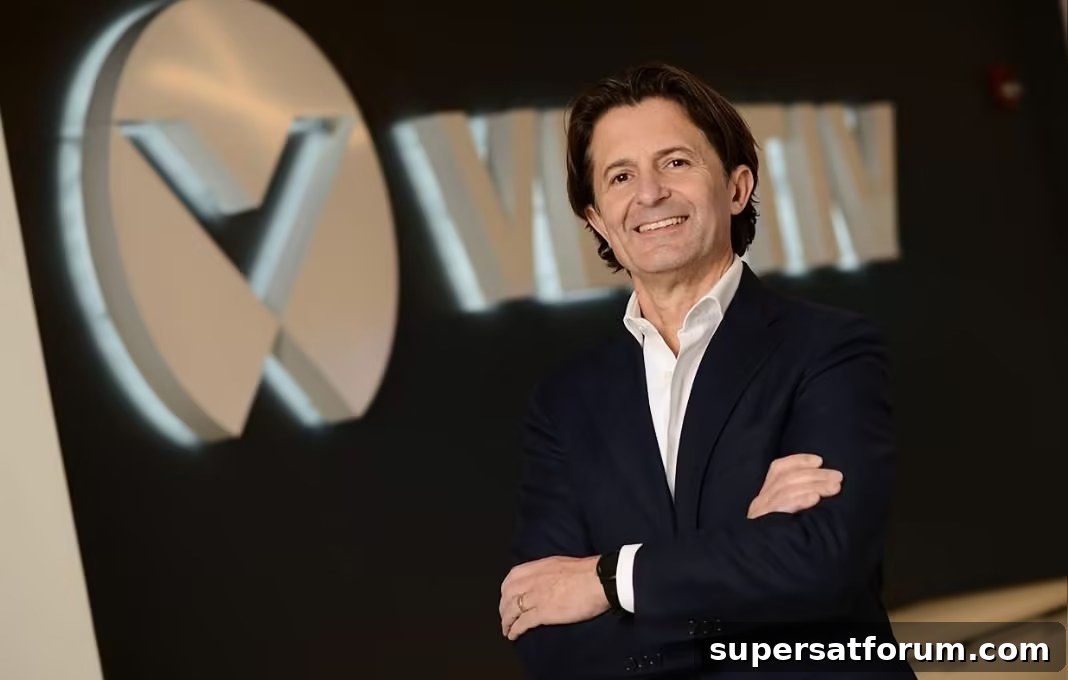
Giordano Albertazzi, CEO of Vertiv, discusses the company’s role in the fast-growing data center industry and how Vertiv is adapting to meet the technical challenges driven by the AI revolution and rising demand for data center infrastructure.
Why Vertiv Matters Today
A decade ago the data center sector was less visible, but even then we could see it becoming a cornerstone of the global economy. “We observed a steady increase in data traffic and understood that trend would continue,” says Albertazzi. “Today, emerging technologies—especially artificial intelligence—are adding demand and accelerating growth.”
AI, now advancing rapidly, is transforming not only society but also how data centers operate. Meeting these changes requires new design approaches and greater capacity. AI-driven systems demand more compact, efficient power and cooling solutions, presenting fresh technical challenges. Vertiv’s ability to innovate and scale solutions quickly places the company well to address these needs.
Vertiv’s Growth and Preparations for the Future
In recent years Vertiv has experienced a sharp rise in demand for its products and systems. To support this growth, the company has made strategic investments in its supply chain. “We opened a new factory in South Carolina and are expanding capacity across our 23 facilities worldwide,” Albertazzi explains.
Vertiv has also focused on improving efficiency through lean manufacturing practices to free up capacity in existing plants. “By working closely with partners such as NVIDIA, we ensure our product roadmaps align with the latest AI and data center developments,” he adds.
Technical Innovations and Next-Generation Cooling
One of the most significant technical shifts Albertazzi highlights is the growing use of graphical processing units (GPUs) and the resulting redesign of data centers. “To put it into perspective: today racks operate around 10 kilowatts, but we’re already preparing for racks that exceed 100 kilowatts. We anticipate future racks operating at 500 kilowatts and, eventually, possibly 1 megawatt,” he says.
This extreme density demands new cooling technologies, and liquid cooling has emerged as a critical solution. “Our capability to deliver complete solutions—including heat rejection systems and prefabrication—allows us to meet the rising need for efficiency and rapid deployment in these environments,” Albertazzi emphasizes.
AI and Energy Efficiency: Challenges Ahead
Although AI is still in an early phase, its potential is vast. Albertazzi sees AI as a game changer for companies and data centers alike. “AI will not only optimize processes but enable machines to work together in ways we haven’t seen before. As the technology matures, AI will increasingly be able to evolve and improve itself, accelerating progress,” he explains.
Despite rapid advances, energy efficiency remains a major challenge. “AI will drive significant demand for advanced infrastructure capable of handling new requirements. We’re seeing roughly a 15% annual increase in demand for data center infrastructure, reflecting the growing need to support AI systems,” Albertazzi notes.
Outlook to 2030: The Industry’s Path
Looking toward 2030, Albertazzi is optimistic about the industry’s trajectory. “AI will become essential across all sectors. Companies that don’t adopt AI risk falling behind. For those of us providing the infrastructure for AI, this is an exciting time to be involved,” he says.
AI will transform the industry and enhance customer experience, making it a critical factor in maintaining competitive advantage.
Vertiv’s Future Technologies and Challenges
Albertazzi describes future technologies related to AI and data center infrastructure as both exciting and demanding. “We’ll see dramatic increases in rack density—from today’s 10 kilowatts to 100, then 500, and eventually 1 megawatt. That places new demands on power delivery and cooling. We are preparing for these challenges and focusing on developing solutions that can keep pace with AI’s rapid evolution,” he explains.
Vertiv continues to invest in its technology portfolio, from network integration to chip-level power management, to ensure the company can meet future needs and support efficient industry growth.
Vertiv’s emphasis on integrated solutions, supply chain expansion, and collaboration with technology partners positions it to help data centers adapt to higher densities, increased power demands, and evolving cooling requirements—key to enabling the next wave of AI innovation.