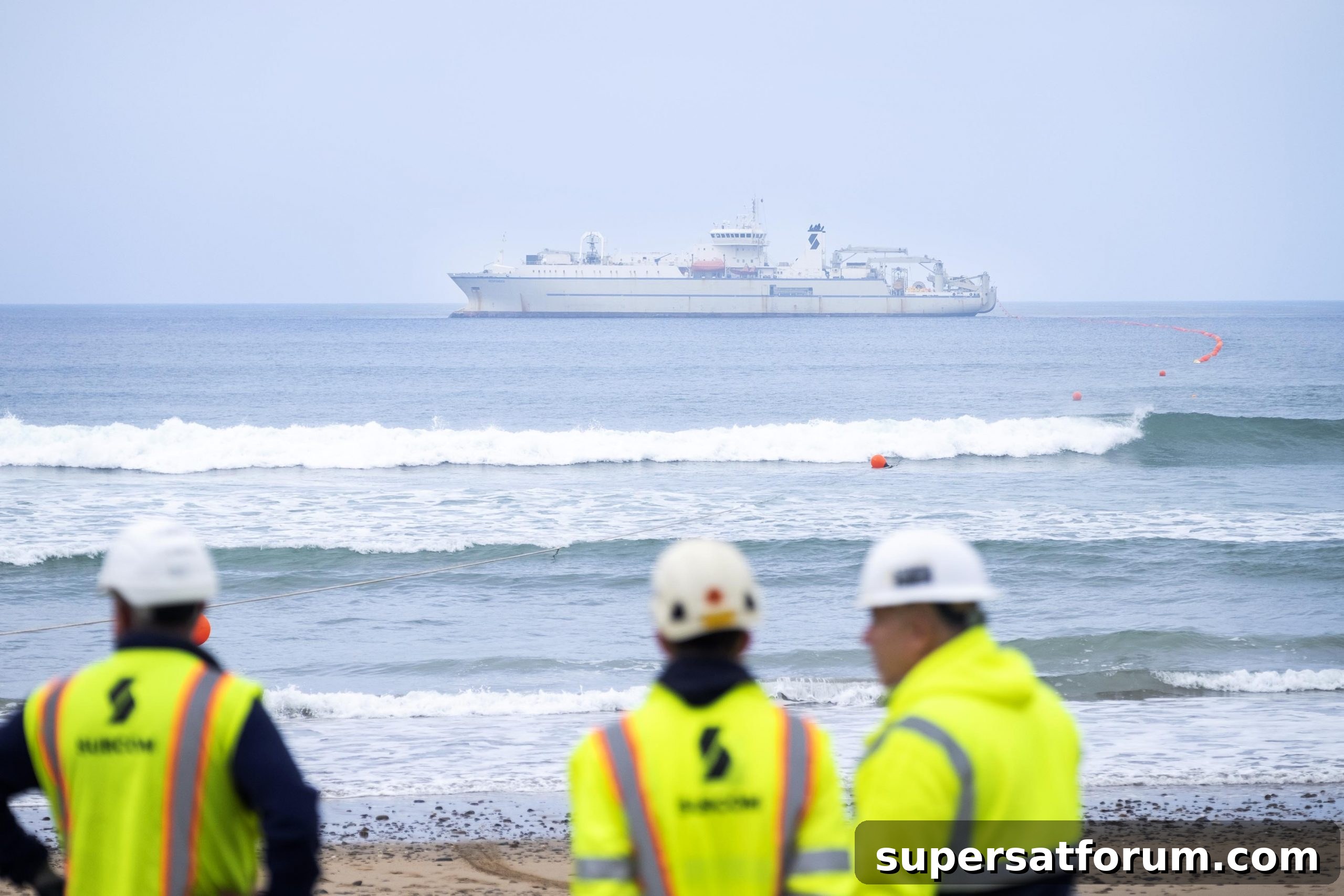
Google has announced that its subsea cable, Grace Hopper, has landed in the UK, introducing a new generation of transatlantic connectivity.
This is one of the first new cable connections between the US and the UK since 2003. The Grace Hopper system spans from New York, US to Bude, UK, with an additional branch to Bilbao, Spain.
Featuring 16 fiber pairs, Google states the Grace Hopper cable offers up to 340 Tbps of capacity—roughly equivalent to allowing about 17.5 million people to stream 4K video at the same time.
In a Google blog post, the company emphasized the growing role of technology in the UK economy and the importance of resilient infrastructure. Google noted that the technology sector in the UK has expanded steadily, venture capital investment has reached record levels, and demand for tech roles remains strong—trends that highlight why diversifying and strengthening network capacity is vital to support the country’s economic growth.
The Bilbao landing marks Google’s first funded route to Spain and will help integrate the upcoming Google Cloud region in Madrid more tightly with the rest of Google’s global network.
Named for pioneering computer scientist Rear Admiral Grace Hopper, the system uses a fiber switching architecture that lets operators reroute traffic across fibers to increase reliability. Google says it collaborated with established carriers and industry experts for years to help ensure the cable supports free and dependable data flows.
The increasing threat to subsea cables
As reliable internet access becomes ever more essential, subsea cables have become increasingly important—and more exposed to risk. Around 97 percent of data between the US and Europe traverses these undersea links, and they carry roughly $10 trillion in financial transactions each day.
NATO military leaders have warned that the Russian navy is actively probing undersea communications infrastructure. Several submarines are believed capable of damaging or cutting cables, with the deep-diving research and salvage vessel Losharik cited as one of the most advanced platforms for operations at depth.
Last year NATO Secretary-General Jens Stoltenberg said member states had received a discussion paper on improving protection for Atlantic submarine cables. He noted that most cables are privately owned and publicly charted, which creates distinct security and resilience challenges.
Stoltenberg also highlighted NATO’s new Atlantic Command in Norfolk and said one of its tasks will be to examine how to protect and monitor threats to undersea infrastructure.
(Image Credit: Exposure Photo Agency)
Learn more about Digital Transformation Week North America, a virtual event held November 9–10, 2021, which explored advanced digital transformation strategies for a rapidly evolving digital world.