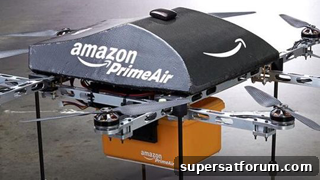
The Smart City revolution may be arriving within a few years, but Amazon is already shaping the future of package delivery with a bold new concept: drone-based shipping. Announced by CEO Jeff Bezos on a 60 Minutes segment, “Amazon Prime Air” is designed to deliver small packages in roughly 30 minutes, promising to transform expectations around e-commerce delivery times.
Amazon plans to launch Prime Air after securing the necessary regulatory approvals, including clearance from aviation authorities such as the FAA. The system envisions autonomous drones waiting on conveyors at fulfillment centers. When an order is ready, the drone would receive delivery coordinates—likely via GPS and associated technologies like RFID or NFC—attach the package to its undercarriage, and fly autonomously to the customer’s location.
Current prototypes are designed to carry packages up to 5 pounds, which Amazon estimates covers approximately 86 percent of its deliveries. Range is targeted at about 10 miles from the company’s fulfillment centers, which number 96 in total. These specifications suggest significant potential for accelerating delivery speed and reshaping last-mile logistics.
Industry experts see long-term promise in unmanned aerial delivery. Lambert Dopping-Hepenstal of The Institution of Engineering and Technology (IET) observed that substantial progress is likely over the next decade, while noting key hurdles remain. Chief among them is maturing drone technologies and convincing regulators that unmanned aircraft can operate safely in shared airspace. Programs such as the UK’s ASTRAEA initiative are already working on these safety and integration challenges. Initially, Dopping-Hepenstal notes, drone delivery might focus on high-value or time-sensitive items—medical supplies and transplant organs are clear candidates.
Bezos’s remarks in the 60 Minutes interview highlight how far Amazon has come since its origins as a garage-based online bookstore. He recalled personally driving deliveries in the company’s early days and dreaming of owning a forklift—small ambitions that have scaled into a global logistics and cloud computing powerhouse. Bezos emphasized Amazon’s appetite for experimentation, saying, “We like to pioneer, we like to explore. We like to go down dark alleys and find out what’s on the other side.” That mindset underpins initiatives like Prime Air and helps explain Amazon’s willingness to pursue disruptive innovations.
Beyond retail logistics, Amazon’s broader infrastructure business—Amazon Web Services (AWS)—is a major part of the company’s reach. AWS provides cloud storage, compute power, and hosting for countless websites and services, including major video-streaming platforms and enterprise customers. The combination of AWS’s backbone and Amazon’s retail logistics gives the company unique capabilities to innovate at scale.
Despite Amazon’s momentum, Bezos recognizes the need for continuous innovation: “Companies have short life spans. And Amazon will be disrupted one day.” Competitors such as Google are also investing in drone technology and autonomous vehicles, signaling that the race to reinvent delivery and transportation will be competitive and fast-moving. Google’s work on drones and self-driving cars demonstrates the industry-wide interest in automation, though clear consumer release timelines remain uncertain.
Drone delivery raises important questions around safety, privacy, logistics, and regulation. Urban airspace integration, collision avoidance, reliable navigation in adverse weather, and secure package handling are among the technical and operational challenges that must be resolved. Regulators will require robust demonstrations of safety before permitting widespread autonomous drone operations over populated areas.
At the same time, the potential benefits are significant: faster delivery for everyday items, reduced road traffic from traditional delivery vehicles, faster medical logistics for urgent supplies, and new logistics models for businesses and consumers. For many shoppers, a 30-minute delivery window for small purchases would redefine convenience.
Amazon Prime Air represents a noteworthy step toward an automated delivery future. While timelines and full-scale deployment depend on technological maturation and regulatory approvals, the initiative highlights how leading technology companies are testing radical changes to the way goods move from warehouses to front doors. As industry players iterate and regulators adapt, drone delivery could become one of the defining logistics innovations of the coming decade.
What are your thoughts on drone delivery and Amazon’s Prime Air concept?