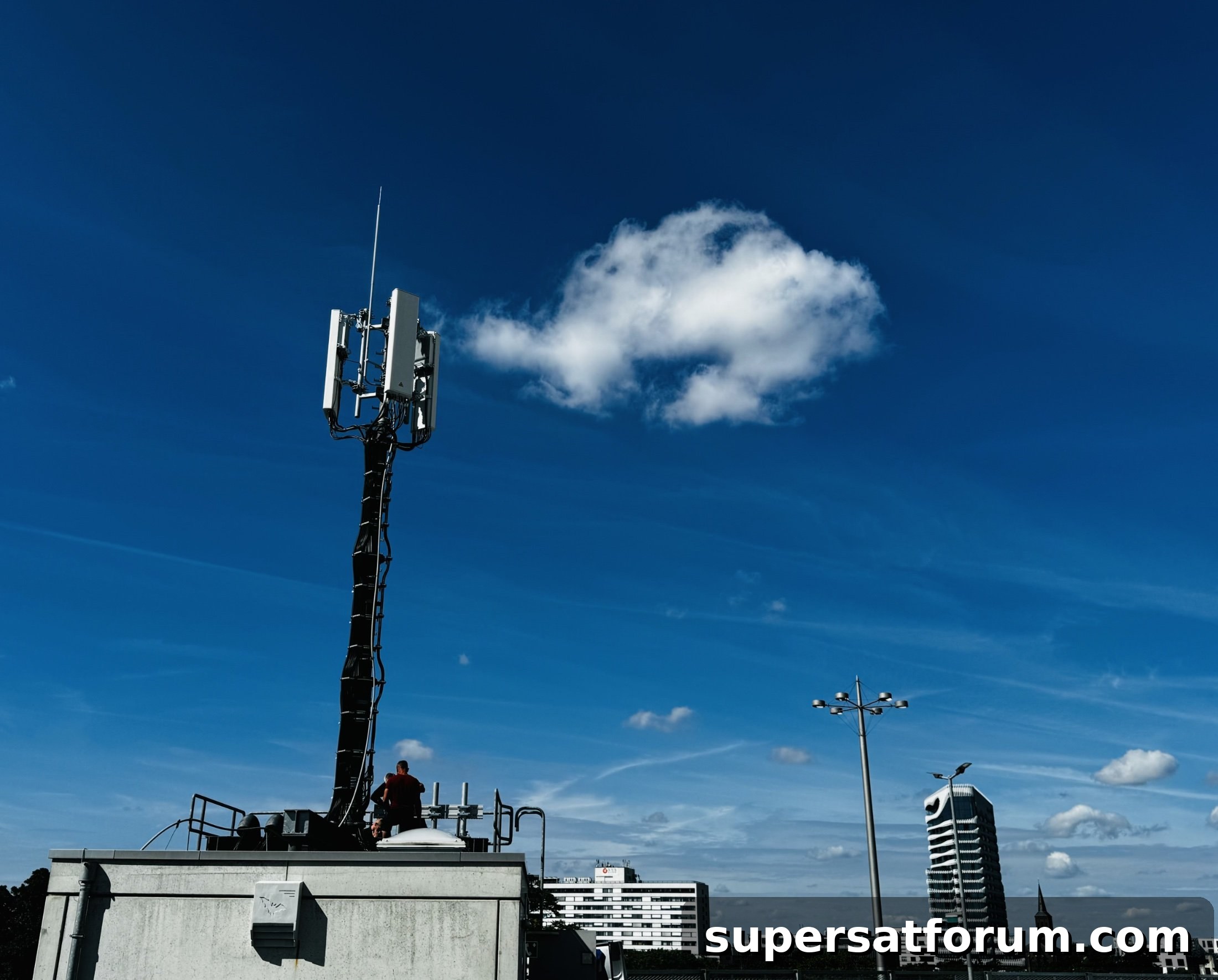
Vodafone has begun rolling out Ericsson’s Interleaved AIR 3218 antennas to improve 5G performance, capacity, and coverage while avoiding an increase in the physical footprint of existing antenna installations.
Finding suitable rooftop locations for additional 5G antennas has been a significant challenge in Germany’s dense urban centres. Many rooftop sites fail to meet the structural requirements set by network planners, and existing LTE mast sites often lack the space for added 5G equipment.
Tanja Richter, Head of Technology at Vodafone, explained the difficulty: “Strong winds put pressure on antenna surfaces mounted on roofs. The more mobile phone antennas there are, the higher the wind load.”
“That increases the demands on wind resistance and static load capacity, which means not every existing rooftop location can be upgraded with active 5G antennas,” she added.
Ericsson’s new antenna design addresses this problem by integrating an active antenna behind the passive antenna, reducing the need for additional mounting space on masts.
Richter emphasised the practical benefits: “This means we need less space on the mast to deliver more 5G in city centres. Innovations like this can accelerate 5G expansion in Germany and help us handle annual data-traffic growth of more than 30 percent.”
The first compact Interleaved AIR 3218 antenna has been installed on a multi-storey car park in Düsseldorf. Vodafone plans to deploy up to 500 more units across its network by the end of 2026, a move that should substantially ease the challenges of expanding capacity on rooftops and other constrained urban sites.
These antennas support both low- and mid-band frequencies, delivering a combination of wide coverage and high capacity that urban environments require. They are capable of providing data rates that exceed one gigabit per second in localized areas and can extend 5G coverage up to roughly one kilometre under the right conditions.
Daniel Leimbach, Head of Ericsson’s Customer Unit Western Europe, said: “A compact active-passive antenna can significantly improve mobile broadband experiences in cities. Ericsson’s Interleaved AIR 3218 will simplify site upgrades and speed up 5G roll-out in areas previously restricted by building regulations, planning law or structural limitations.”
Technically, the Interleaved AIR 3218 combines antenna-integrated radio (AIR) with multiband passive antenna elements in a single unit. That enables Vodafone to add high-performing 5G capacity without increasing the site footprint. Supporting frequencies from 700 MHz to 3.5 GHz, the antenna allows the use of FDD uplink and TDD downlink to extend both coverage and capacity.
As cities continue to face growing demand for faster and more reliable mobile connectivity, solutions like Ericsson’s Interleaved AIR 3218 can help overcome the physical constraints of dense urban environments and accelerate network densification where traditional approaches are limited.
With this deployment, Vodafone is taking a notable step toward strengthening Germany’s 5G infrastructure and may set an example for other carriers dealing with similar urban expansion challenges.
(Image Credit: Vodafone)
See also: Vodafone and Meta collaborate on European network optimisation
Unified Communications is a two-day event held in California, London, and Amsterdam that explores the future of workplace collaboration in a digital world. The event is co-located with Digital Transformation Week, IoT Tech Expo, Edge Computing Expo, Intelligent Automation, AI & Big Data Expo, and Cyber Security & Cloud Expo.
Discover other upcoming enterprise technology events and webinars powered by TechForge.