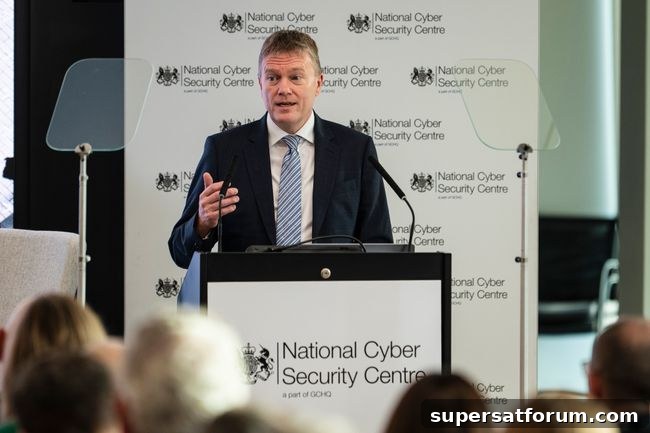
Dr Richard Horne, CEO of the National Cyber Security Centre (NCSC), has issued a stark warning about the escalating cybersecurity threats confronting the UK.
In his first review since assuming leadership, Horne described a growing “contest for cyberspace” between legitimate users and malicious actors intent on exploiting society’s increasing reliance on digital systems.
“What has struck me more forcefully than anything else since taking the helm at the NCSC is the clearly widening gap between, on the one hand, the threat and our exposure to it and, on the other, the defences that are in place to protect us,” Horne said, stressing that current protections are falling behind the pace and sophistication of modern attacks.
Tom Kidwell, a former British Army and UK Government intelligence specialist and co‑founder of Ecliptic Dynamics, echoed Horne’s concerns about state actors. He noted that public perception often separates criminal cyber gangs—driven by financial motives—from state-sponsored campaigns, which are typically viewed as slower, longer-term threats. Kidwell warned that the NCSC chief’s view implies an eventual breach: “We don’t understand, or maybe don’t acknowledge, the level of threat because it’s not obvious or apparent today. This is why it’s critical for the UK to not only consider how we stop an attack, but also how we will react if an attack does happen.”
Horne referenced recent high-profile cyber incidents such as attacks on Synnovis and the British Library to underline how deeply technology is entwined with daily life and the significant human and operational impact that follows when systems are compromised.
Dr Muhammad Ajmal Azad, Senior Lecturer in Cybersecurity at Birmingham City University, pointed out that human users remain the weakest link in cybersecurity and are frequently overlooked in design processes. He advocates for more human-centered security approaches and real‑time collaborative platforms to share threat intelligence efficiently.
Horne singled out Russia and China as particular concerns. Alongside recent government warnings about Russian cyber aggression, he highlighted that Chinese state‑affiliated groups present a highly capable threat with growing global ambitions.
Mark Jow, Technology Evangelist, EMEA at Gigamon, emphasised that cybersecurity can no longer be static. He noted rising risks—such as numerous legacy systems operating at critical risk levels and studies showing many businesses still struggle to detect breaches—and argued that organisations must adopt dynamic, proactive strategies. “Accountability is crucial,” Jow said. “Businesses must be held fully accountable for improving the UK’s cyber preparedness by building resilience through proactive and holistic strategies, ensuring security by design, and maintaining real‑time visibility and insight into everything that enters, leaves and moves across their infrastructure, including encrypted traffic, which often becomes an organisation’s Achilles’ heel.”
The NCSC warns that the scale and severity of cyber risks are widely underestimated across the country. Evidence shows organisations implementing Cyber Essentials controls are significantly less likely to need cyber insurance claims, illustrating the value of basic, consistent security measures.
Kidwell stressed the need for organisations to prepare for scenarios they might otherwise dismiss. “Organisations can’t rely on ‘Why would anyone want to do X to us’. If it’s a state act of hostility, it’s to disrupt the UK economy—of which all UK businesses are part—meaning they could be seen as legitimate targets for disruption,” he said.
Looking forward, Horne urged support for the forthcoming Cyber Security and Resilience Bill, describing it as a crucial step to strengthen national cyber defences and raise baseline resilience amid growing threats.
“It’s not enough any more to talk about being resilient,” Horne concluded. “We must all take the crucial steps that bolster our defences, that improve and grow our capability to contest.”
See also: Cyber threats surge from state-sponsored and criminal actors
Want to learn more about cybersecurity and the cloud from industry leaders? Consider attending Cyber Security & Cloud Expo, held in Amsterdam, California and London. The event brings together experts and is co‑located with other industry gatherings such as Digital Transformation Week, IoT Tech Expo, Blockchain Expo and AI & Big Data Expo.
Explore other upcoming enterprise technology events and webinars powered by TechForge.