
Samsung and SK Telecom (SKT) have announced a strategic partnership to develop core 6G infrastructure with a strong emphasis on AI-driven radio access network (AI‑RAN) technologies.
The collaboration centers on embedding AI at the network edge rather than confining it to the core. To meet rising demands for ultra-low latency as device density increases, the partners are prioritising AI-based channel estimation, distributed multiple-input multiple-output (MIMO) transmission, and AI‑RAN scheduling systems.
Optimising the 6G radio layer with AI‑RAN
Samsung Research and SKT’s Network Technology Office are jointly leading the effort. While 5G focused on raw speed, 6G is expected to address growing complexity through automation and intelligent control.
In dense environments such as automated factory floors or crowded urban centres, obstacles like walls and machinery scatter and reflect radio waves. Conventional networks respond reactively to those distortions; AI‑RAN aims to predict and correct them in real time. The result should be faster data delivery, fewer dropped packets, and more consistent performance for demanding applications.
Distributed MIMO is another core element. Traditional architectures often rely on a single base station for processing, creating bottlenecks and single points of failure. Distributing processing and coordinating transmission across multiple base stations or antennas improves resilience and maintains consistent throughput across diverse geographies, from city centres to rural areas.
Defining roles for 6G infrastructure research
Developing industrial-grade AI models requires clearly defined responsibilities. Samsung Research will lead development of AI‑RAN software, algorithms, channel estimation models and schedulers. SKT will supply large-scale operational data and field test environments, using its nationwide network to deploy and validate solutions under realistic conditions.
Laboratory testing can’t fully reproduce the variability and noise of live networks. Access to SKT’s operational network allows engineers to evaluate performance in real deployment scenarios and refine models against real-world interference, mobility and traffic patterns.
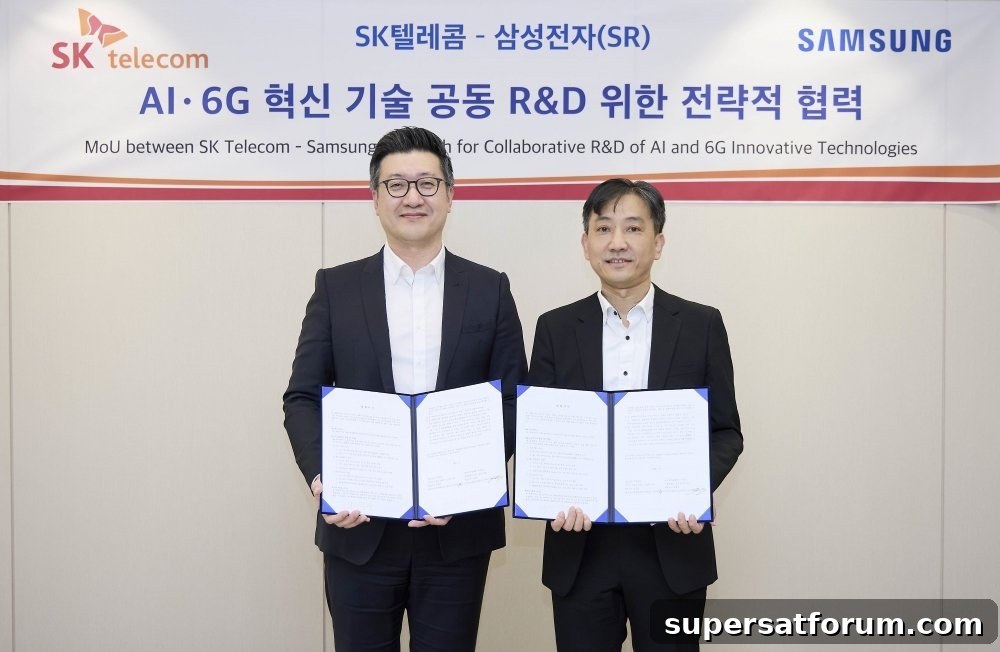
JinGuk Jeong, Executive Vice President and Head of the Advanced Communications Research Center (ACRC) at Samsung Research, said that field-focused collaboration with SKT will enable verification of AI-based wireless technologies in real-world settings and help secure key AI‑RAN capabilities at an early stage.
He added that continued cooperation between the two organisations should accelerate practical 6G deployments.
Resource allocation, network efficiency, and industry standardisation
Improving network efficiency is a primary goal for AI‑RAN schedulers and next‑generation core architectures. These systems determine when, where and how data should be transmitted to optimise latency, throughput and energy use. For private networks and large Internet of Things (IoT) deployments, efficient resource allocation is critical to controlling operational costs while supporting massive numbers of connected devices without performance degradation.
Both companies are advocating their approaches within the AI‑RAN Alliance. Their joint proposal for AI-based channel estimation has been accepted as an official work item, indicating a push toward interoperable solutions rather than proprietary lock-in. They shared their research progress at the alliance’s recent all-member meeting.
Takki Yu, Vice President of SK Telecom’s Network Technology Office, emphasised that the convergence of AI and wireless communications will be a cornerstone of 6G competitiveness. The partnership with Samsung Electronics aims to secure advanced AI‑RAN technologies and position the companies to lead the global 6G ecosystem.
Samsung formed its Advanced Communications Research Center (ACRC) in 2019 and has published technical papers outlining its 6G spectrum vision in preparation for future infrastructure rollouts. The company has demonstrated AI‑RAN developments at industry events and forums to align research efforts across the ecosystem.
See also: GSMA and industry stakeholders continue to call for early coordination to avoid spectrum shortages and ensure a smooth transition to 6G-capable networks.

Learn from industry leaders: Events focused on IoT, AI, cybersecurity and related enterprise technologies continue to provide forums for practitioners to discuss deployment challenges, standards and best practices as networks evolve toward 6G.
Telecoms coverage and related enterprise technology content are produced by industry media outlets that track research, standardisation efforts and commercial rollouts to help organisations prepare for the next generation of wireless networking.