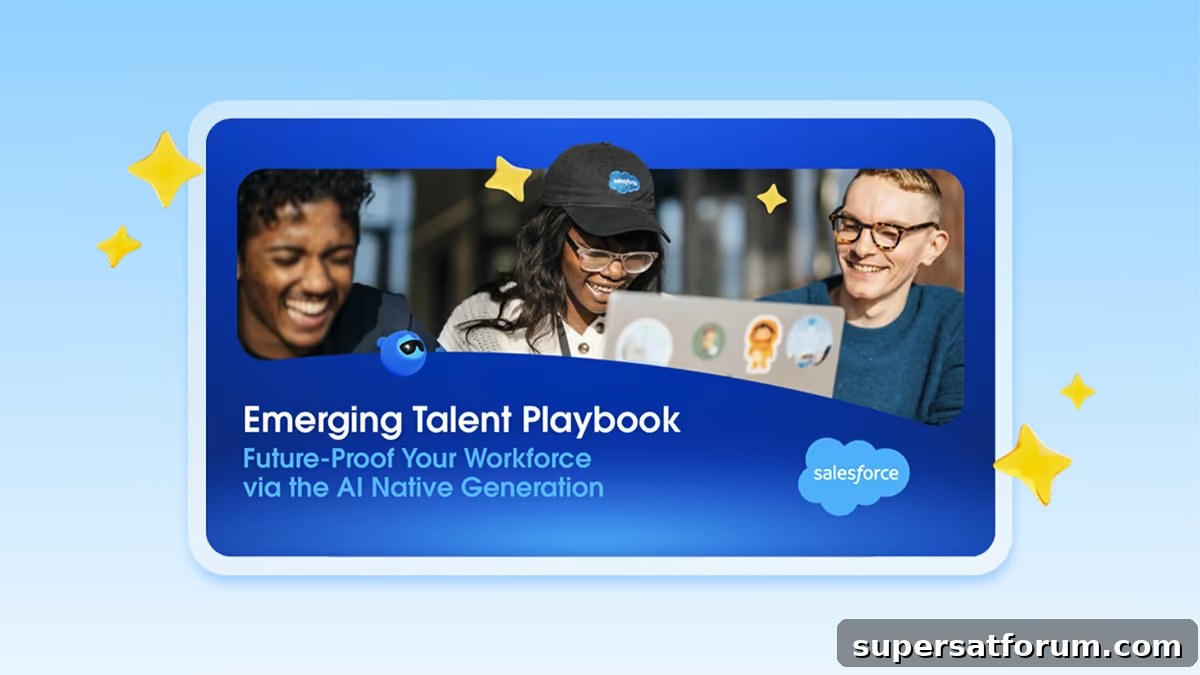
Salesforce’s New Playbook Aims to Help Companies Build AI-Ready Workforces
This year’s college graduates are entering one of the most competitive job markets in years. AI is reshaping industry after industry, and some leaders have warned that automation could displace a large share of entry-level roles. Over the past year, entry-level positions have declined as companies slow hiring and automate tasks traditionally performed in early-career roles.
Salesforce, however, is taking a different approach: investing in AI-native graduates as a strategic advantage. Its new Builder program is actively recruiting 1,000 recent graduates and interns to help develop the future of Agentforce.
The Builder initiative runs through Futureforce, Salesforce’s global university recruiting program, and is designed to quickly place AI-native talent into practical, business-critical roles across engineering, product, sales and other functions.
AI-Native Talent Is Shaping the Future of Work
Today’s graduates are not just adapting to AI — they are building it. They understand how to collaborate with AI and AI agents, reshape workflows, and help their teams evolve alongside new technologies.
Research and early experience suggest AI-native employees are far more likely to use AI tools daily, which can accelerate productivity and speed. Their skills working with AI also correlate with measurable improvements in work quality.
Voices from Salesforce
“The AI-native generation entering the workforce is not threatened by AI — they are building it. Companies can’t afford to wait for their workforce to catch up with AI developments. That’s why we’re investing in Builders now: to change how we work and to redefine our business from the inside out.”
— Nathalie Scardino, Chief People Officer at Salesforce
“Traditional boundaries around my role are blurring. With AI I no longer only pass on requirements and requests. I collaborate more deeply with engineers and designers.”
— Liz Awad, Senior Product Manager and former Futureforce participant
Lessons for Leaders
Salesforce today published a new Emerging Talent playbook — a strategic guide to help companies strengthen their organizations with AI-driven talent. The playbook draws on Salesforce’s long experience investing in early-career professionals, including the Builder initiative and the company’s commitment to recruiting and developing people at the start of their careers.
Salesforce packages these insights into a simple 3A framework: Attract, Assess and Activate. The framework is intended to help organizations build a workforce that is better prepared for rapid technological change.
Attract
Create engaging, AI-driven experiences from day one to draw in new talent: run hackathons, provide access to learning resources, and design interactive on-site or virtual experiences that showcase real AI work.
Assess
Measure AI capability and cognitive adaptability early in the recruiting process. Focus on candidates’ ability to learn quickly and apply new skills as AI technologies evolve.
Activate
Boost performance through structured onboarding, human–AI collaboration and reverse mentoring. New hires contribute fresh perspectives while experienced employees transfer domain knowledge, a combination that can improve organizational AI readiness.
Well-designed activation programs help newcomers become productive faster and support cross-generational learning, which can increase overall AI preparedness across teams.
Built on Futureforce
The playbook builds on Salesforce’s long track record of investing in emerging talent, including more than 10,000 early-career professionals hired through Futureforce. That experience informs practical advice on recruiting, training and scaling AI-native talent pipelines.
Salesforce Supernova AI Workforce Expansion 2026
Salesforce is accelerating its global AI strategy by investing in the next generation of AI-native talent through Futureforce and the Builder program. The commitment to hire 1,000 AI-native graduates highlights how enterprise AI, autonomous agents and AI-driven productivity are becoming central to the future of work and digital transformation.
What this means for Swedish companies
Swedish companies face a shift where AI skills become critical for competitiveness, innovation and efficiency. Salesforce’s initiative demonstrates that organizations investing early in AI-native workforce development, AI agents and generative AI can achieve meaningful productivity gains and faster innovation. Building AI-ready teams can also help reduce operational costs and support long-term growth.
Implications for Nordic MSPs
Managed service providers, consultants and technology partners across the Nordics will have new opportunities to support customers with AI strategy, governance, skills development and implementation of AI-driven workflows. Demand for AI-native skills, automation and agent-based solutions is expected to rise in the enterprise segment.
Risks and opportunities
Rapid AI progress brings both opportunities and challenges. Organizations that fail to invest in AI capabilities risk falling behind in digital competition. At the same time, AI enables more efficient processes, faster innovation, better decision-making and higher productivity. Key challenges include cybersecurity, data governance, regulation and talent supply.
Agentforce and the AI-enabled workplace
Agentforce represents a new generation of AI-powered work platforms where autonomous agents assist with customer service, sales, analytics, automation and business development. Salesforce positions itself as a leader in enterprise AI, intelligent automation and workforce transformation.
Futureforce and the AI-native pipeline
Futureforce serves as Salesforce’s global recruiting platform for AI talent. The Builder program creates a pipeline of employees who, from day one, work with generative AI, autonomous agents and AI-enhanced workflows — reshaping how companies hire, train and develop future workforces.
Enterprise AI and global competitiveness
Major technology vendors are investing heavily in AI-native workforce strategies and enterprise AI platforms. AI is shifting from pilot projects to mission-critical infrastructure across finance, manufacturing, public sector, retail and cybersecurity industries.
AI-driven productivity and automation
AI-native professionals use generative AI, autonomous agents and intelligent workflows to accelerate development, analysis, customer service and business processes. Organizations that integrate AI report higher productivity, quicker innovation and improved delivery quality.
Nordic AI transformation
Sweden, Norway, Denmark, Finland and the rest of the Nordics continue to expand investments in enterprise AI, cybersecurity, automation and digital transformation. AI-native workforces and autonomous agents will play central roles as people and AI increasingly work side by side.