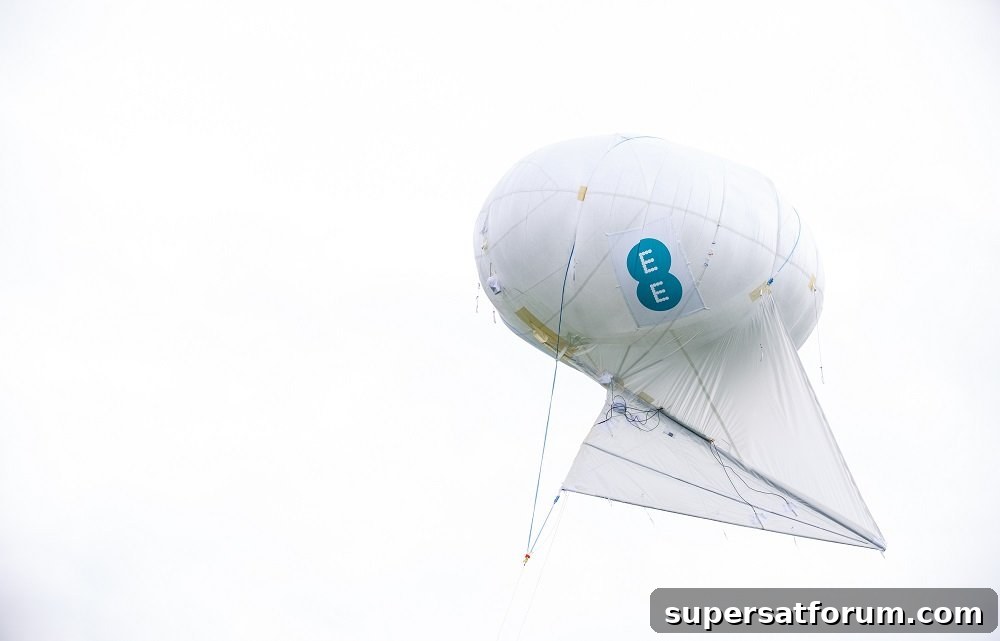
(Image Credit: EE)
EE appears to have drawn inspiration from Google’s Project Loon by developing airborne solutions—balloons, helikites and drones—to extend mobile coverage in rural locations and to provide short-term capacity boosts.
Project Loon once seemed like just another ambitious experiment, but it has matured and recently reached a milestone by improving the ability to hold balloons in position for extended periods. That technology demonstrates how airborne platforms can offer stable connectivity where traditional infrastructure is impractical or too costly.
In many remote and sparsely populated areas, terrain and economics make conventional mobile deployment difficult. Airborne systems can bridge that gap, enabling people in isolated communities to access mobile services for the first time and helping operators deliver coverage where building masts would not be viable.
“We are going to extraordinary lengths to connect communities across the UK. Innovation is essential for us to go further than we’ve ever gone, and deliver a network that’s more reliable than ever before,” says EE CEO Marc Allera. “Rural parts of the UK provide more challenges to mobile coverage than anywhere else, so we have to work harder there – developing these technologies will ultimately help our customers, even in the most hard to reach areas.”
EE plans initial deployments that are temporary and highly flexible. For major events such as Glastonbury or large sporting fixtures, balloons and helikites can supply extra capacity to handle spikes in demand that otherwise overwhelm local networks. In cases of network outages, drones can be deployed quickly to restore service while engineers work on a permanent fix.
“Looking ahead, I see innovations like this revolutionising the way people connect. We’re developing the concept of ‘coverage on demand’,” Allera adds. “What if an event organiser could request a temporary EE capacity increase in a rural area, or a climber ascending Ben Nevis could order an EE aerial coverage solution to follow them as they climb?”
To develop these aerial coverage solutions, EE worked with a number of specialist partners, each contributing key technologies and expertise:
- Nokia supplied lightweight, compact and portable Flexi Zone small-cell base station solutions suited for rapid deployment.
- Parallel Wireless provided self-configuring and self-optimising base station technology with in-band backhaul capability and network meshing techniques to simplify deployments.
- Avanti enabled fast, reliable satellite backhaul to connect airborne platforms to the core network where terrestrial backhaul is unavailable.
- VoltServer delivered touch-safe, flexible Digital Electricity power-over-data-cable tethers to power aerial units safely and efficiently.
- uVue refined drone designs to meet the specific demands of delivering mobile coverage from the air.
- Allsopp Helikites supplied the Helikite solution that provides a stable, high-altitude platform for sustained service.
EE’s aerial strategy also complements its commitment to public safety. The operator signed a contract in 2015 to help provide nationwide coverage for the Emergency Services Network (ESN), which supports police, fire and ambulance communications. According to an EE spokesman, helikites will be deployed by a specialist fleet of 32 rapid-response vans to deliver temporary coverage for emergency services at short notice, helping ensure resilient communications during incidents in remote areas.
Airborne coverage technologies are not intended to replace traditional cell towers, but they offer a practical, scalable option for temporary events, emergency response and serving hard-to-reach communities. By combining small cells, satellite backhaul, power-over-tether, and purpose-built airborne platforms, operators can deliver reliable mobile connectivity where it was previously impractical or too expensive.
What are your thoughts on EE’s plan to use balloons and other airborne platforms for coverage? Let us know in the comments.