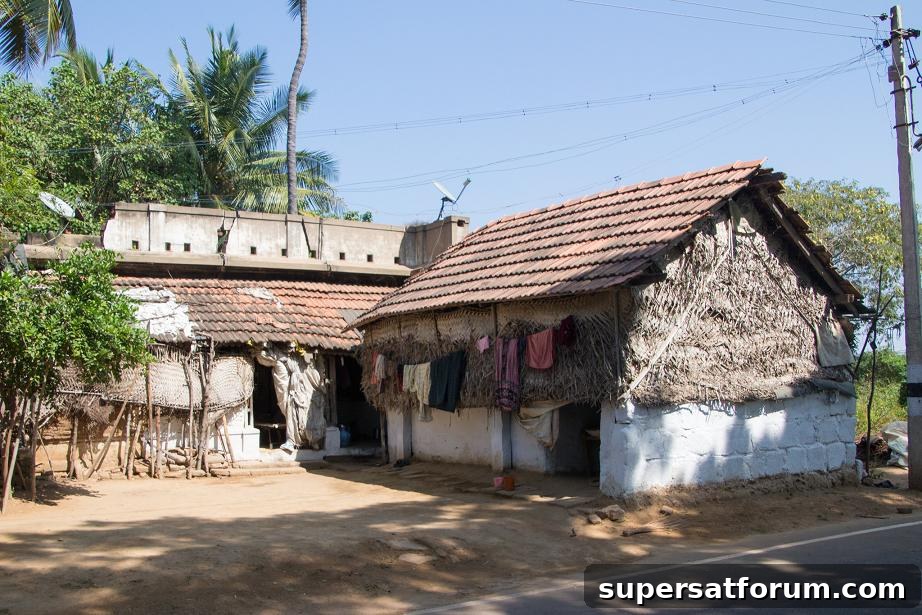
(Image Credit: Bill Bourne)
While projects like Google’s ambitious initiatives aim to tackle rural broadband with large-scale, costly solutions, a compact chip developed by Saankhya Labs in Bengaluru offers a practical and immediate way to bring internet access to underserved communities. The Pruthvi chip leverages unused portions of television broadcast spectrum—commonly called TV White Space—to deliver broadband where traditional fixed-line infrastructure is impractical or too expensive.
Designed specifically to reach households that can receive TV signals but lack fixed broadband, Pruthvi is part of a broader Meghdoot system that combines a base station with user-side modems to provide wireless rural broadband across the 400–800 MHz TV White Space band. Because signals in this band penetrate obstacles better than higher-frequency alternatives, the technology does not require line-of-sight and achieves extended coverage ranges. Depending on antenna height and transmit power, a single base station can serve areas within a 10–15 km radius, and coverage can be increased further by deploying taller or higher-power antennas.
Saankhya Labs, the company behind Pruthvi, recently received the 40th ELCINA-EFY 2015 Award for “Excellence in Innovation.” The company is also a member of the WhiteSpace Alliance, which develops industry standards and promotes rapid deployment of TV band internet solutions. The Alliance’s specifications—such as Wi-FAR™ and WSAConnect™—support interoperability, reducing time-to-market and improving product reliability for member companies.
“Development of technical specifications and interoperability testing provides significant time-to-market and product reliability benefits to our members,” said Dr. Apurva N. Mody, Chairman of the WhiteSpace Alliance. “This is accelerating availability of cost-effective broadband access solutions in underserved regions of the world.”
Pruthvi itself is roughly the size of a postage stamp, enabling low-cost manufacturing and integration into compact network equipment. The Meghdoot system, built around the chip, aims to provide affordable internet connectivity to villages, schools, health centers and small businesses that are currently off the grid. Because the design adheres to industry standards like Wi-FAR, deployments can be adapted for use in other countries where TV White Space policies permit operation, making the solution potentially scalable beyond India.
Field trials are planned in collaboration with several Indian Institutes of Technology including IIT Bombay, IIT Delhi and IIT Hyderabad, and Saankhya Labs has been in discussions with Microsoft to run tests in Srikakulam, Andhra Pradesh. These trials will evaluate real-world performance, range, reliability and ease of deployment in diverse rural settings.
By exploiting lower-frequency TV bands, Pruthvi and the Meghdoot system offer a complementary approach to existing rural connectivity efforts. They can extend coverage without the expense and delay of laying fiber or building dense cellular networks, and they provide a practical path toward connecting communities that today lack reliable internet access.
Do you think Pruthvi could help solve rural broadband coverage challenges? Share your thoughts in the comments.