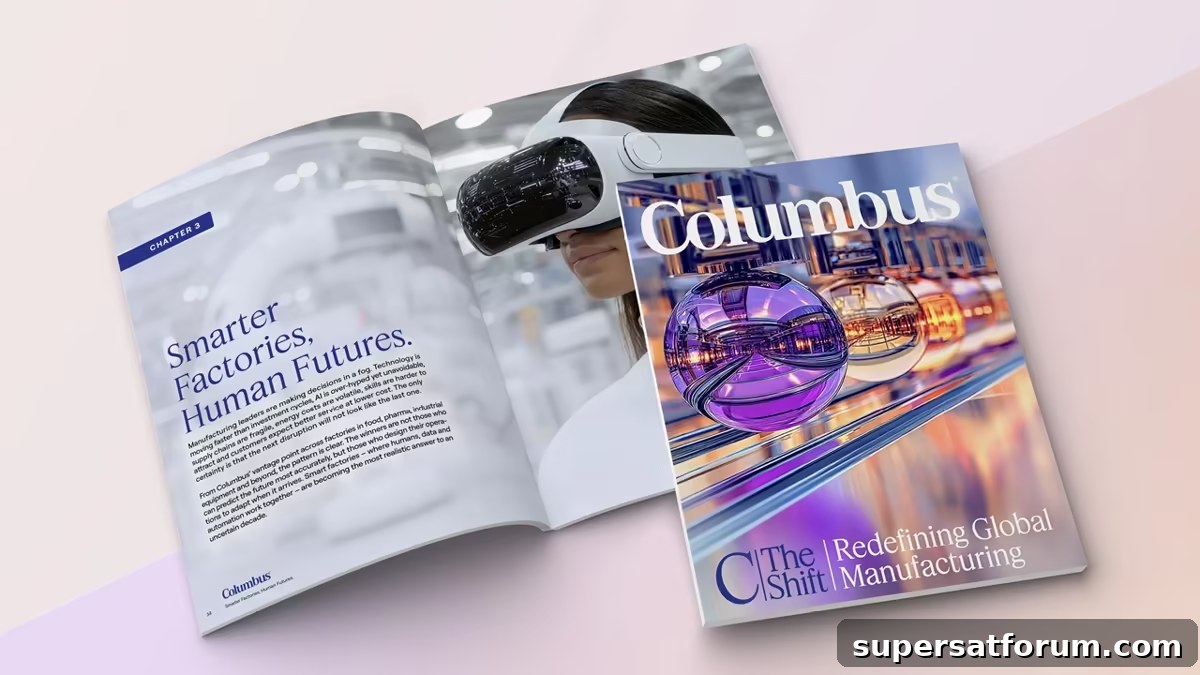
The future of manufacturing is shaped by rapid technological shifts, rising sustainability demands and a growing skills shortage. At the same time, the industry is entering a more uncertain era where new requirements and changing conditions are redefining competition.
This is highlighted in the report “C the Shift: Redefining Global Manufacturing”, published by the publicly traded IT consultancy Columbus, headquartered in Denmark.
The report is based on interviews with industry leaders, researchers and experts and identifies five major shifts—data, AI, security, skills and sustainability—that are now shaping industrial competitiveness.
The first shift concerns data. Many companies collect large volumes of information but lack structure, quality and clear ownership. That slows decision-making and digital initiatives, says Toby Mankertz, head of manufacturing strategy at Columbus.
“Organizations rely on local documents and spreadsheets, undocumented workarounds and metrics that measure activity rather than progress. You need to build a foundation you can actually trust,” he says in the report.

The second shift is AI, which the report frames as a change-management challenge rather than purely a technology project. Kasper Lynge Jacobsen, AI director at the Danish Chamber of Commerce, warns that layering new technologies on top of outdated working methods risks embedding inefficiencies rather than removing them.
The third shift involves increasingly connected value chains that become more vulnerable as products receive digital identities and must be traceable across their lifecycle. This raises the demand for systems that can exchange data securely.

Christine Charlotte Akselsen, CEO of the Norwegian cloud company Kezzler, explains that systems must “speak the same language.” Without shared standards and interoperable architectures, even well-structured data will remain trapped in silos instead of flowing between suppliers, logistics partners and customers.
“Trust can’t be bolted on later. It must be built into the architecture from the start,” she says.

The fourth shift concerns skills. The workforce is aging while competition for technical talent is intensifying. Greta Braun, a researcher at Chalmers University of Technology, calls it a structural issue when an entire generation is approaching retirement and too few young people choose industrial careers.
She argues that simply recruiting more people is not enough—companies must create workplaces that make people want to stay.
“Getting more women into technical programs won’t fix the problem by itself. A workplace culture that encourages them to remain does,” she says.
The fifth shift is sustainability. Companies that reduce energy use, material waste and resource consumption improve both profitability and competitiveness.

Steve Evans, professor of industrial sustainability at the University of Cambridge, notes that many companies make the transition more expensive than necessary.
“There’s a misconception that sustainability requires costly technology investments. The biggest gains often come from using common sense to stop waste in the factories,” he says.

Miying Yang, professor of sustainability at Cranfield University, urges companies to consider not only the value they create but also the value they lose, and to explore opportunities in repair and reuse.
“It’s important to understand the value you generate, but you also need to see what value you are missing out on,” she says.

The report concludes that there is no one-size-fits-all model. Different industrial companies will need different paths. Those that become most competitive will be the ones that understand their operations, adapt quickly and demonstrate that changes deliver measurable results.
The future of manufacturing – AI, data, cybersecurity and the skills gap
The next wave of manufacturing in Sweden and the Nordics will be driven by AI, data, digitalization and sustainable production. Industrial companies face rapid transformation where smart manufacturing, Industry 4.0 and digital supply chains become decisive for competitiveness.
The Columbus report, “C the Shift: Redefining Global Manufacturing”, identifies five critical shifts: data, AI, cybersecurity, skills and sustainability. These forces are reshaping business models, technical architectures and global value chains.
AI in industry and data-driven transformation
AI enables automation, predictive analytics and production optimization. Companies adopting data-driven strategies and AI platforms gain higher efficiency, lower costs and better decision-making.
Cybersecurity and the digital supply chain
With connected factories and IoT devices, cyber threats to industry are growing. Cybersecurity for supply chains and industrial systems is essential to protect critical infrastructure and business data.
Skills shortage and the workforce of the future
The shortage of talent in AI, IT and industrial engineering is one of the biggest challenges in the Nordics. Companies must invest in training, employer branding and retention to secure future skills.
Sustainable production and ESG
Sustainability is central to industrial transformation. Through energy efficiency, reduced material waste and circular business models, companies can strengthen both profitability and sustainability credentials.
What this means for Swedish companies
Swedish industrial firms must accelerate digital transformation, implement AI and strengthen cybersecurity. Those that act quickly can secure leading positions in Europe and globally.
What this means for MSPs in the Nordics
Managed service providers play a key role in delivering cloud services, cybersecurity and AI solutions to industry. Demand for managed services in industrial IT and security is rising sharply.
Risks and opportunities
Risks include cyberattacks, skills shortages and poor AI implementations. Opportunities lie in increased innovation, productivity and new business models enabled by digitalization.
IT-Branschen is a Nordic B2B IT platform with reach in Sweden, Norway, Denmark, Finland, Germany, the Netherlands and international markets. The platform covers AI, cybersecurity, cloud services, datacenters and digital transformation.