MiniMax released the weights for its MiniMax M2.7 model on April 12, 2023, amid a wave of open weight releases from Chinese labs that significantly influenced the competitive AI landscape.
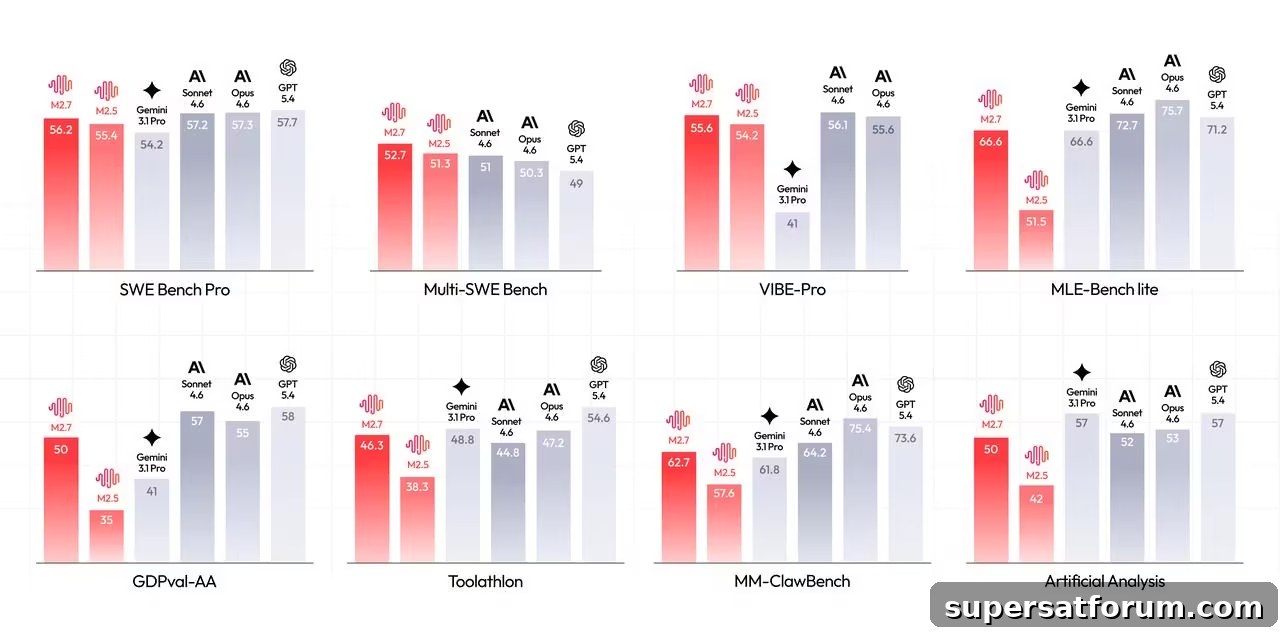
This release followed a broader trend in China, where multiple companies rushed to publicize their latest advances. MiniMax M2.7 was first announced in March and achieved 56.22% on the SWE-Pro benchmark, a score comparable to GPT-5.3-Codex. It also recorded 55.6% on the VIBE-Pro benchmark, performance nearly on par with Opus 4.6 in project delivery across web, mobile and simulation tasks. The model obtained the highest ELO rating of 1495 on the GDPval-AA evaluation among open-source models, highlighting its competitiveness in public leaderboards.
Weights for MiniMax M2.7 are now available on Hugging Face and the model is supported on NVIDIA platforms. However, the release drew criticism for license terms that prohibit commercial use without prior written permission, a restriction some community members argue undermines its classification as open source. MiniMax described M2.7 as the first model to participate in its own lifecycle via an approach it calls “self-development,” a process the company says informed subsequent iterations.
MiniMax’s rollout followed other notable releases in April. On April 7, Zhipu AI published an open-source build of its GLM-5.1 under the MIT license; that model reportedly contains 754 billion parameters and was demonstrated performing extended technical tasks autonomously for up to eight hours. Around the same time, Alibaba released its API model Qwen 3.6 Plus on April 2, a move that generated speculation about the firm’s stance on open-source availability. As of April 11, Qwen 3.6 Plus remained free on OpenRouter, although its long-term accessibility is unclear.
Attention is also turning toward the upcoming DeepSeek V4 model, which sources indicate was expected for late April. DeepSeek’s founder Liang Wenfeng said the model would run on Huawei’s Ascend chips, reinforcing China’s push for semiconductor self-reliance. V4 is reported to target roughly one trillion parameters and to use a Mixture-of-Experts architecture with a context window on the order of one million tokens. The plan reportedly includes multiple variants, including a Vision mode for multimodal capabilities. Despite two delays, early stress tests suggest a public launch could be imminent.
These rapid developments reflect a dynamic period in large-model research across Chinese AI labs. Companies are balancing open releases, licensing choices, and hardware partnerships as they race to scale model size, expand context windows, and integrate multimodal features. The community response to licensing—particularly the debate over what qualifies as genuinely open—remains a central theme. As groups publish weights and benchmarks, users and organizations must weigh performance gains against legal and commercial constraints when adopting new models.
For practitioners and researchers, the recent wave of releases offers both opportunity and complexity: access to high-performing weights lets teams reproduce results, fine-tune models for domain-specific tasks, and experiment with novel architectures, but restrictive licenses can limit deployment in commercial products. Meanwhile, the proliferation of large models also stresses the importance of compatible hardware and optimized runtimes—factors that influence real-world adoption as much as raw benchmark scores. Observers will be watching closely to see which projects prioritize fully permissive licenses, which favor controlled distribution, and how hardware alliances shape future launches.
In summary, MiniMax M2.7’s public weight release is part of a broader surge in high-profile model announcements across China, each with different trade-offs in licensing, hardware support, and claimed capabilities. As the field evolves, community scrutiny of license terms and the technical details behind claimed results will remain essential for transparent, reproducible progress.