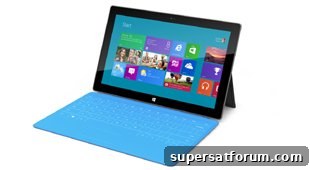
Many of the rumors surrounding Microsoft’s product launch in Los Angeles were confirmed last night when the company officially entered the tablet market with its new Surface line of tablet computers.
Challenging a sector long dominated by Apple’s iPad and contested by Amazon’s Kindle Fire and numerous Android tablets, the Surface faces a difficult task in winning both consumer and enterprise loyalty. Even so, Microsoft introduced several distinctive features that set the Surface apart from its rivals.
The Surface models feature a 10.6-inch display — larger than the iPad’s screen — and support stylus input. They also offer a range of magnetic Touch Covers, just 5 mm thick, which attach to the tablet magnetically and serve both as protective covers and as keyboards with integrated trackpads. These covers double as kickstands, allowing the device to be used on a desk or lap like a traditional laptop.
Microsoft says the pressure-sensitive Touch Cover enables faster, more natural typing than on-screen keyboards, positioning the Surface as “a new kind of PC” capable of running standard desktop applications such as Microsoft Office.
There are two distinct versions of the Surface. One uses ARM-based processors and runs Windows RT, a version of Windows optimized for ARM architecture. The other runs Windows 8 Pro on Intel processors and offers full compatibility with legacy Windows desktop applications. Microsoft indicated the Windows 8 Pro model will arrive about three months after the Windows RT version.
“We took the time to do something that is very different and very special,” said Steve Ballmer at the Hollywood launch. “Because of Windows 8, the Surface is a PC, is a tablet, is something new that we think people will love.”
Microsoft did not provide final pricing at the event; prices were expected to be announced closer to the October on-sale date. The company suggested that pricing would be competitive with comparable ARM tablets and Intel Ultrabook-class PCs.
The Surface launch represents a broad strategy aimed at both consumer and commercial markets. Brightly colored Touch Covers and stylus-based “Digital Ink” support make the device appealing for education and personal use, while Office compatibility and the availability of a full Windows Pro edition target business and enterprise users. The real test will be how each market segment responds to Microsoft’s latest hardware.
Among the Surface innovations, the Touch Cover stands out as a notable attempt to narrow the gap between tablets and laptops. Unlike the iPad, which relies on separate accessories for keyboard input, Microsoft’s keyboard-cover integration offers a built-in approach that may appeal to users seeking more productivity from a tablet form factor.
Adoption of Windows 8 will likely influence the Surface’s success. Windows 8 introduces a significantly different user experience compared with previous Windows versions, and users’ willingness to adopt that new interface could determine how well Surface gains traction. While some analysts question whether the Surface can siphon market share from established products like the iPad and Kindle Fire, Microsoft’s entry with a well-designed device gives it a solid chance to attract new customers in a rapidly expanding market.
How the Surface will perform in the market remains to be seen, but its combination of stylus input, integrated keyboard covers, and full Windows compatibility positions it as a compelling option for users seeking a device that blends tablet convenience with laptop productivity.