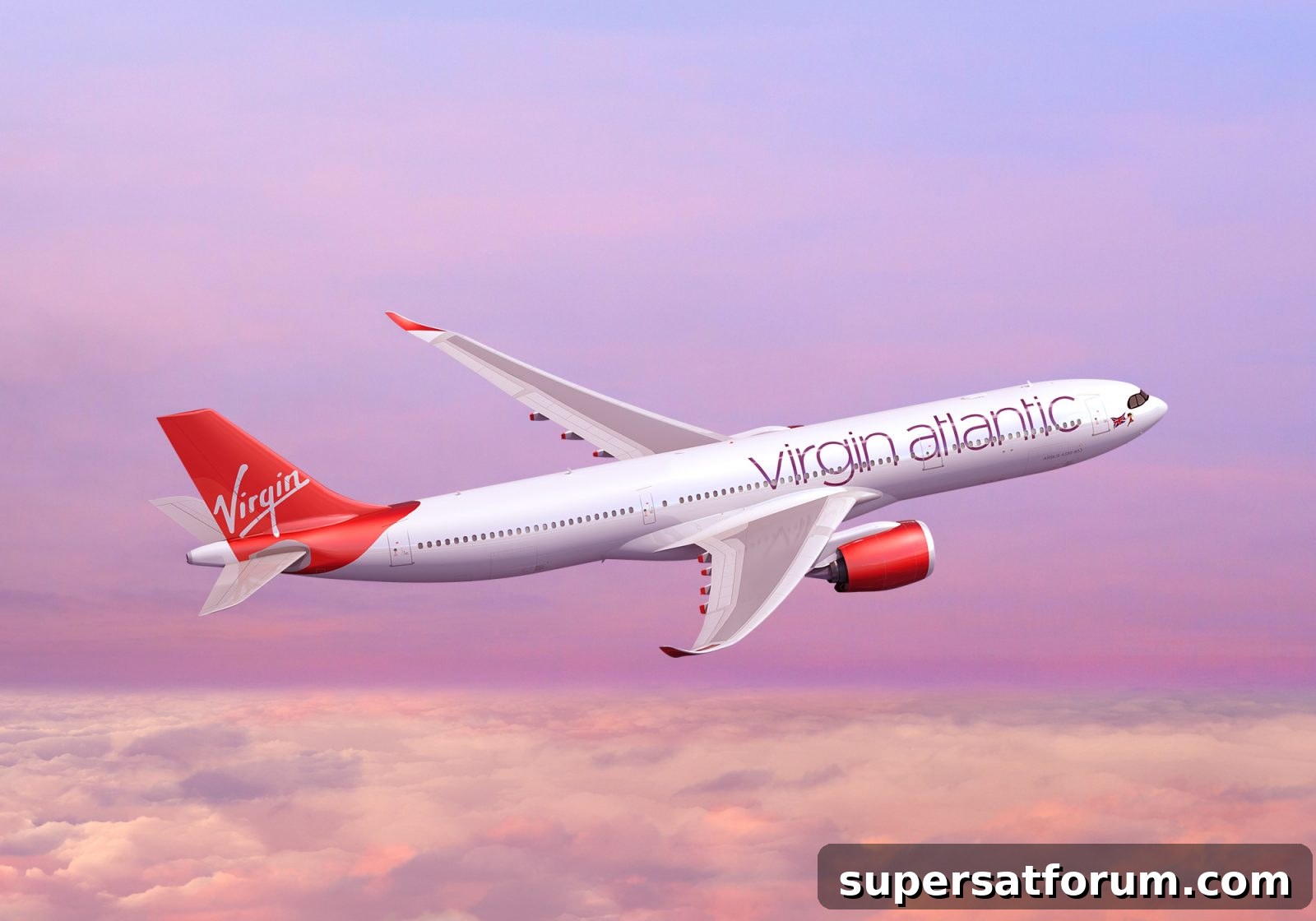
Global satellite communications company Viasat has been chosen by Virgin Atlantic to provide in-flight connectivity for its new aircraft.
Three of Virgin Atlantic’s newest planes, the A330neo (Airbus A330-900), are scheduled for delivery in September. The airline ordered 14 of these aircraft to replace its older A330-300 fleet.
With a 64-metre wingspan, Virgin Atlantic says the A330neo will be among the most efficient aircraft in the sky, capable of flying farther and faster. The airline also promises an improved in-cabin experience for passengers.
Each Upper-Class Retreat Suite includes an ottoman that doubles as an extra seat, allowing up to four people to dine together in private or watch entertainment on a 27-inch touchscreen. All Upper-Class customers can also use “The Loft,” a social area with a self-service fridge and drinks dispenser for refreshments and conversation.
“When it comes to innovating for our customers, we never stand still. Our desire to create memorable experiences means we’ll continue to imagine with fresh ideas. We care about every detail of the cabin design and every step of our customer’s journey,” said Corneel Koster, Chief Customer and Operating Officer at Virgin Atlantic.
“We’re proud to unveil our state-of-the-art A330neo and show the evolution of our customer experience, with each of our customers receiving a premium experience regardless of the cabin they travel in. They’ll be better connected with their fellow travellers and our amazing crew in the air, and with their friends and family on the ground.”
While some onboard luxuries may be out of reach for many travelers, in-flight WiFi is a more accessible amenity that can enhance most flights.
Traditional in-flight WiFi that depends on ground-based terminals can be slow and unreliable, often leaving passengers frustrated and choosing to forgo connectivity while airborne.
Satellite-based systems, by contrast, typically deliver faster and more reliable in-flight internet. They reduce the frustration associated with ground-based services and enable passengers to work, stream, and stay connected until the plane lands.
“We’re thrilled that Virgin Atlantic – an airline with innovation and customer service at its core – has chosen Viasat as its IFC partner on its new Airbus aircraft,” said Don Buchman, Viasat’s VP and GM of Commercial Aviation.
“We have a strong history of delivering quality in-flight connectivity on long-haul flights and look forward to bringing our technology and service capabilities to Virgin Atlantic and its customers.”
Passengers on the A330neo will connect to Viasat’s network of owned and partner Ka-band satellites. The onboard equipment has been designed to be forward-compatible with Viasat’s next-generation satellite constellation, ViaSat-3.
(Image Credit: Virgin Atlantic)
Interested in improving your digital transformation strategy? Learn more about Digital Transformation Week and explore practical approaches to make your digital initiatives more effective.