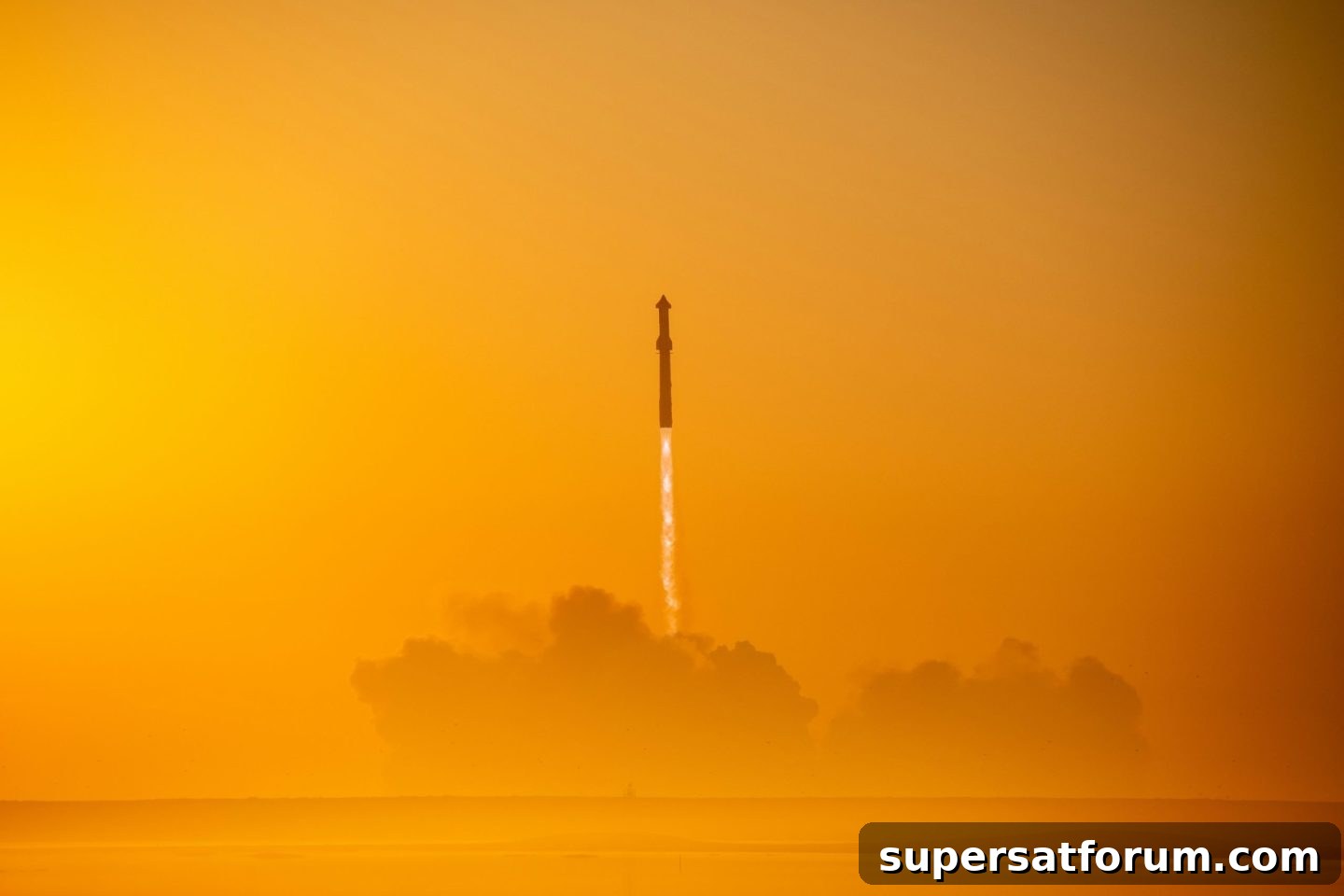
SpaceX conducted its ninth Starship test launch on May 27 from its Starbase facility in Texas. The launch followed two recent unsuccessful attempts, and this flight aimed to demonstrate Starship’s ability to carry test payloads, survive reentry, and operate with a previously flown Super Heavy booster.
About 30 minutes into the mission, the vehicle lost control. A fuel leak during the coasting phase led to structural instability, and the spacecraft broke apart over the Indian Ocean. Although the flight proceeded normally at first, the outcome echoed the failures of the January and March tests earlier this year.
These repeated setbacks matter for a program that has attracted intense interest from NASA, telecommunications companies, and the wider space community. Elon Musk has stated his continued aspiration to send Starship to Mars, but significant technical and regulatory hurdles remain.
Technical issues and the fuel leak behind the disintegration
The launch began successfully, with the Super Heavy booster lifting off and performing nominally. After stage separation, the booster was planned to splash down in the Gulf of Mexico while Starship continued toward its target orbit.
During the coasting phase, telemetry indicated a fuel leak in Starship’s propulsion system. The leak produced increasing instability until the vehicle could no longer maintain structural integrity and disintegrated over the ocean. No injuries or damage on the ground were reported, but the failure eliminated SpaceX’s chance on this flight to demonstrate a complete mission profile.
This was the third consecutive test flight to fail before meeting mission objectives. While several elements of launch operations have worked, the recurring mid-flight problems point to persistent challenges SpaceX must resolve before attempting crewed or deep-space missions.
What’s at stake: Mars, the Moon, and mission deadlines
Musk has long promoted Starship as the vehicle to carry humans to Mars, beginning with uncrewed test missions. He has targeted late 2026 for an initial attempt, but repeated early-term failures make that timeline increasingly difficult to achieve.
NASA has also selected Starship as the lunar lander for Artemis III. For that role to be realized, SpaceX must demonstrate reliable launch, in-orbit refueling, and safe lunar descent and ascent. Each failed test adds uncertainty and pushes schedules outward.
Delays affect more than ambition: contractual commitments and coordination with partners depend on predictable timelines. Shifts to launch schedules can ripple across programs and stakeholders, increasing pressure on SpaceX to produce a successful full-duration test flight soon.
FAA oversight and expanding launch safety measures
SpaceX operates under Federal Aviation Administration (FAA) oversight, which reviews and approves each test. After the eighth flight’s failure, the FAA temporarily paused launches to investigate. That inquiry concluded just days before this ninth flight.
For Flight 9, new safety zones were established around the launch site and along the anticipated flight corridor, expanding hazard areas to keep ships and aircraft clear. The FAA is expected to undertake another review following this most recent failure. SpaceX has said it accepts regulatory scrutiny while pushing to accelerate testing. Finding the right balance between speed and safety remains a major challenge for the program.
From test flights to telecom: Starship’s role in global internet plans
Beyond exploration, Starship has commercial uses—most notably deploying large batches of Starlink satellites for SpaceX’s broadband constellation. With its greater payload capacity, Starship could place many more satellites per launch than Falcon 9, speeding Starlink deployment.
Flight 9 was slated to carry eight Starlink test payloads, all of which were lost in the failure. SpaceX is also working on direct-to-cell services in partnership with companies such as T-Mobile and has secured regulatory approvals to deliver cell coverage via satellites. If Starship can reliably deliver and deploy new satellite models, it could significantly expand global mobile connectivity.
Internationally, SpaceX has agreements with telecom providers in countries including Canada, Australia, and New Zealand, where Starlink is seen as an economical way to serve areas that lack traditional infrastructure.
Why Starship still matters despite the risks
Despite recent failures, many in the space industry continue to view Starship as a potentially transformative vehicle. Its combination of reusability, high payload capacity, and long-range capability is unique among systems under development today.
NASA’s Artemis program still counts Starship as a central element of its lunar plans, lending SpaceX both credibility and responsibility. A successful Starship would reshape mission planning and the types of assets agencies and commercial customers rely upon.
On the commercial side, SpaceX intends for Starship to take on missions currently served by Falcon 9—launching satellites, cargo, and potentially private flights. A single, versatile vehicle capable of handling many roles could lower costs and simplify launch operations over time.
Looking ahead: What’s next for the program and its timelines
Musk has reiterated that failures are part of the development process, noting on social platforms that each flight yields lessons. Engineers are now analyzing Flight 9’s telemetry to pinpoint the leak’s cause and identify fixes. Addressing the fuel leak is only one element; teams must also validate safe long-duration coasting, controlled reentry, and precision handling throughout flight.
Work is already underway for the next test flight. The upcoming launches will be closely watched: a successful full-duration mission by the end of 2025 would restore confidence in timelines for Moon and Mars missions, while further setbacks would likely lead to additional scrutiny and schedule slippage.
Whether Starship ultimately achieves its goals or not, its progress will influence how government agencies and private companies plan future space missions and the expansion of global connectivity.
(Photo by Unsplash)
See also: Starlink approved to launch services in Congo after policy reversal
Looking to revamp your digital transformation strategy? Learn more about Digital Transformation Week taking place in Amsterdam, California, and London. The event is co-located with IoT Tech Expo, AI & Big Data Expo, Cyber Security & Cloud Expo, and other leading technology conferences.
Explore other upcoming enterprise technology events and webinars powered by TechForge.