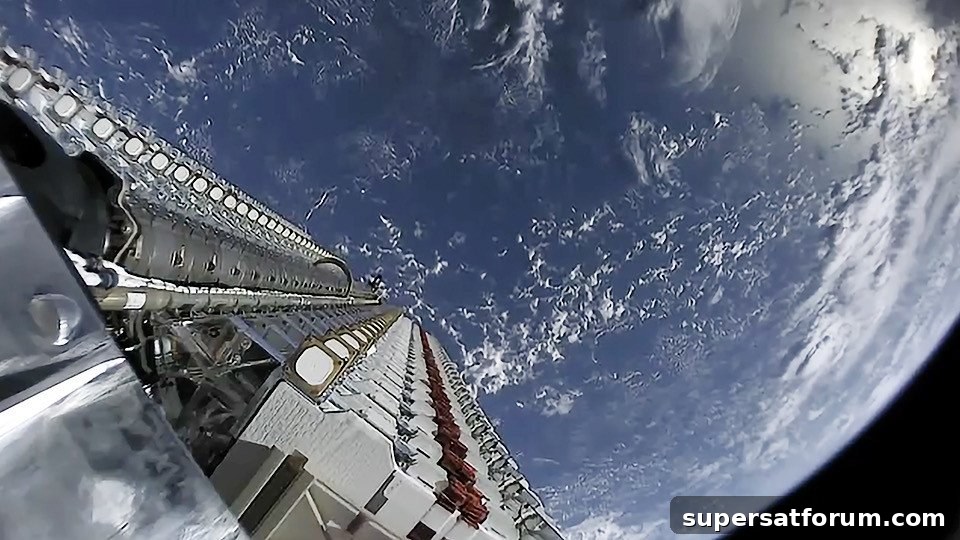
SpaceX has successfully launched 60 upgraded Starlink satellites that include several important improvements.
The most significant enhancement is increased spectrum capacity for end users by making full use of both Ka- and Ku-bands. Earlier Starlink satellites supported only Ku-band antennas, so this update expands available bandwidth and improves overall network performance.
To address concerns about space debris, SpaceX has redesigned components so a larger portion of each satellite will fully burn up in Earth’s atmosphere at the end of its operational life. While the original series aimed for 95% demisability, the new design ensures that key elements are 100% demisable, further reducing the risk of long-lived orbital debris.
In its press materials, SpaceX stated:
“Since the most recent launch of Starlink satellites in May, SpaceX has increased spectrum capacity for the end-user through upgrades in design that maximise the use of both Ka- and Ku-bands.
Additionally, components of each satellite are 100% demisable and will quickly burn up in Earth’s atmosphere at the end of their life cycle — a measure that exceeds all current safety standards.”
These satellites use ion thrusters for in-orbit manoeuvres, a technology that enables precise positioning, station-keeping and controlled deorbiting at the end of life.
Astronomers have raised concerns that Starlink satellites reflect more sunlight than expected and can interfere with ground-based astronomical observations. Some satellites have been observed shining as brightly as stars, creating streaks in long-exposure images and complicating research.
In June, the Royal Astronomical Society warned that the large constellations proposed by companies such as SpaceX, Amazon and OneWeb present a significant challenge to ground-based astronomy. The society noted that widespread satellite networks could make it harder to capture clear images of the sky without streaks associated with satellites, potentially compromising scientific research.
SpaceX says it is collaborating with the National Radio Astronomy Observatory and leading astronomy organizations worldwide to explore design changes that reduce the satellites’ impact on astronomical observations. One proposed mitigation is darkening the base of future satellites to reduce reflected sunlight when viewed from the ground. That modification has not been applied to this latest batch, so observers with clear skies may still see the satellites passing overhead in train-like formations, similar to previous launches.
Each new satellite weighs approximately 260 kg (573 lb). Together the 60 satellites formed SpaceX’s heaviest payload to date, stacked in the Falcon 9’s upper compartment and nearly filling the rocket’s usable payload volume.
Interested in hearing industry leaders discuss topics like these? Attend co-located industry events such as IoT Tech Expo, Blockchain Expo, AI & Big Data Expo, and Cyber Security & Cloud Expo World Series, which host conferences in locations including Silicon Valley, London and Amsterdam.