
The use of AI agents in customer service is accelerating worldwide. A new Salesforce survey shows that the share of organizations using AI agents rose by 69 percent in just one year. Surprisingly, the biggest improvement reported is not greater efficiency or faster response times, but higher customer satisfaction.
Customer service is undergoing a significant transformation. What a year ago was largely testing, pilots and future-looking experiments has now become an integrated part of daily operations for many organizations.
This is documented in Salesforce’s new report, State of Service: AI Agents Edition, based on responses from 3,075 customer service professionals and leaders across North America, Latin America, Europe and the Asia-Pacific region.
AI agents quickly becoming standard in customer service
According to the report, the proportion of customer service organizations using AI agents increased from 39 percent in 2025 to 66 percent in 2026. Additionally, 70 percent of organizations that deployed AI agents report achieving measurable business benefits within the first 60 days.
When respondents were asked which areas improved most after implementing AI agents, traditional metrics like response time, productivity or case handling did not top the list.
Instead, customer satisfaction showed the largest positive effect.
This indicates that AI technology is increasingly contributing directly to better customer experiences, rather than only streamlining internal processes.
“In Denmark, customers are known for high expectations and low tolerance for poor service. It is therefore a strong signal that AI agents primarily improve customer satisfaction rather than just internal metrics. It shows the technology has reached a level where it genuinely delivers what customers expect, and that is ultimately what matters most,” says Thomas Grønholt, Regional Sales Director at Salesforce Denmark.
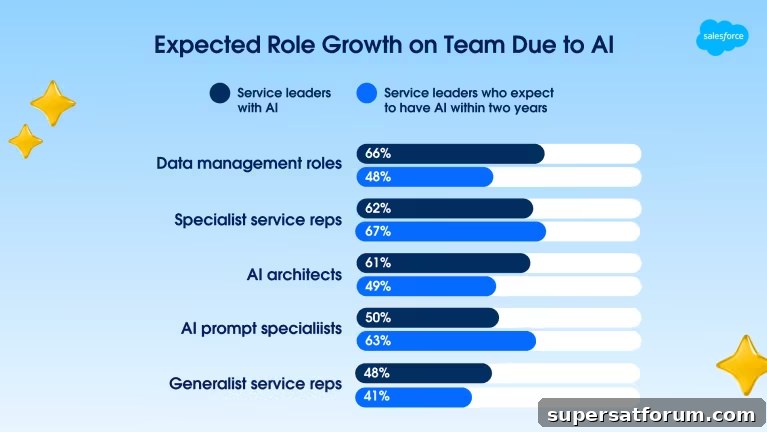
AI is reshaping the entire service organization
The report also shows that AI’s impact reaches far beyond the customer interaction itself.
Today, 85 percent of service organizations use at least one form of AI. Among organizations using AI agents, 77 percent report the technology is used both in direct customer contact and for internal workflows.
Nearly all customer service leaders, 97 percent, believe AI is changing how teams are built and organized. The shift is creating new skill areas and roles such as AI architecture, data governance and information management.
Data quality remains a challenge
Despite rapid adoption, the survey reveals many organizations still struggle with data-related challenges.
There are also clear differences between management and day-to-day staff perceptions. While 59 percent of leaders see data preparation as a barrier to AI initiatives, 72 percent of employees who work with data daily identify it as a challenge.

“Many Nordic companies have already come far in digitizing customer service, but the results also show a need for better internal coordination. Leadership often underestimates the data challenges employees face day to day. Organizations that invest in both data quality and internal dialogue will be much stronger as they continue their AI journeys,” says Thomas Grønholt.
Additional insights from the report
The survey also shows that:
- 40 percent of AI-driven case handling is now carried out entirely autonomously without human intervention.
- 83 percent of service organizations with AI agents deploy them across five or more customer channels.
- 88 percent of customer service agents say AI reduces the time spent switching between systems and tools.
- 89 percent of employees who work alongside AI agents believe expanded AI use would benefit their organization.
- 92 percent of service leaders using AI report that the technology improves their ability to coach and develop staff.
AI moving from experiment to business value
The findings indicate that AI agents have rapidly evolved from a future technology into a central component of modern customer service. The report highlights that successful AI adoption depends not only on the technology itself, but on data quality, internal processes and organizations’ ability to adapt how they work.
For companies aiming to strengthen both customer experience and operational efficiency, the trend suggests AI agents will play an increasingly important role in the coming years.
About the survey
The survey was conducted between March 9 and April 4, 2026. A total of 3,075 responses were collected from customer service professionals across North America, Latin America, Europe and the Asia-Pacific region.