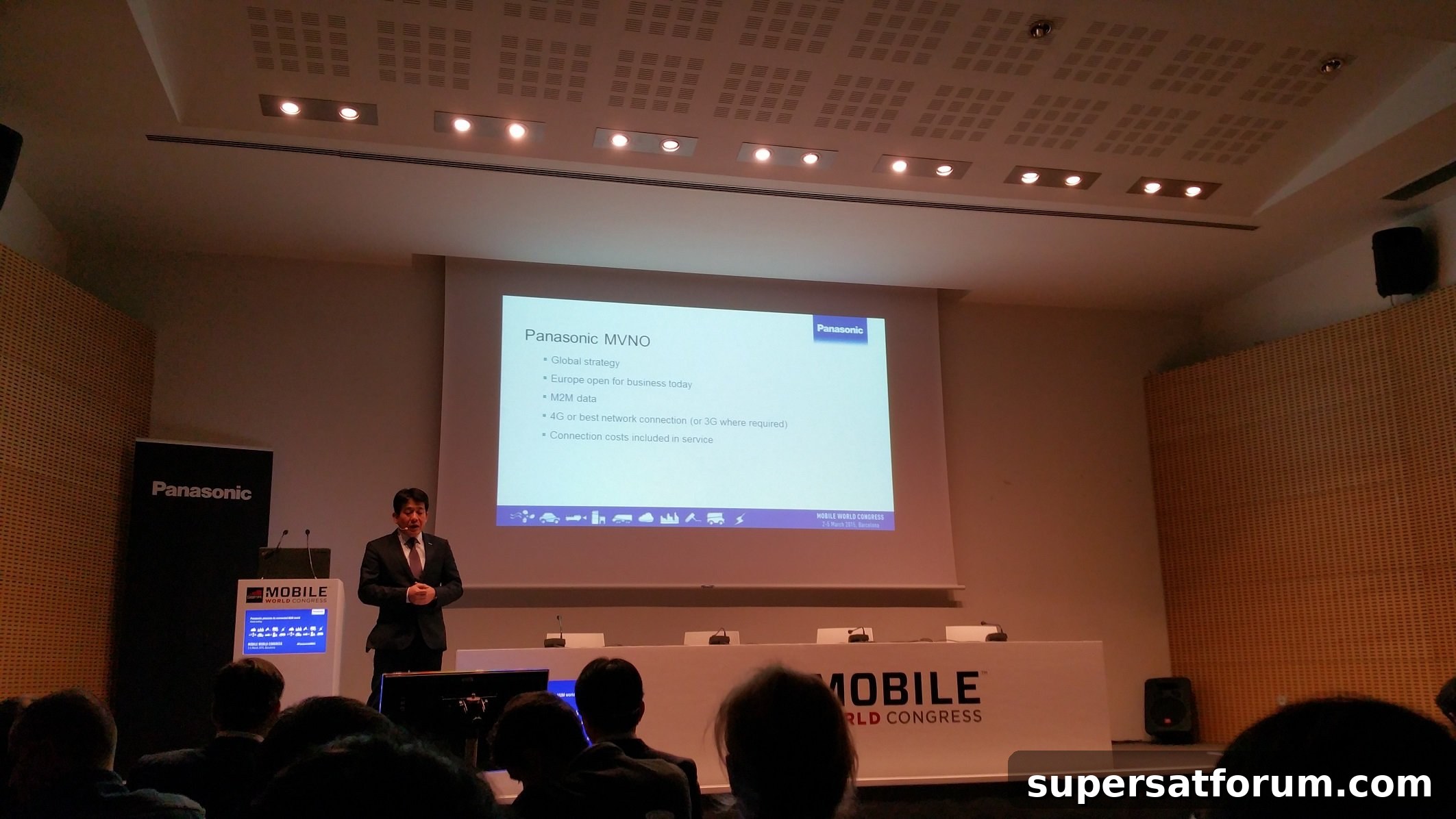
“When most people think of Panasonic, they think of televisions,” admitted a company executive on stage at Mobile World Congress. That candid remark prefaced a bolder announcement: Panasonic is extending beyond consumer electronics and entering the connectivity space with its own MVNO service.
In partnership with Vodafone, Panasonic will offer a single flat-rate tariff delivering connectivity across more than 40 countries. The aim is simple: ensure that all Panasonic devices that benefit from being online remain reliably connected wherever their users are.
Yoshiyuki Miyabe, President of Panasonic AVC Networks, emphasized the company’s commitment: “I commit to you we will start to implement connectivity across all our suitable product ranges. So we serve our customers wherever they are, whatever they’re doing.”
Panasonic plans to integrate machine-to-machine (M2M) data from devices on its MVNO into a centralized “Smart Cloud.” That cloud platform will analyze device data to optimize efficiency, improve maintenance routines, and enable predictive actions that reduce downtime. The first product to use this M2M connectivity is the recently announced Panasonic Nubo, an industry-first 4G monitoring camera designed for mobility and remote oversight.
Tojmen Vos, COO of Panasonic Cloud Management, shared a personal story about his child’s hospitalization and the stress of being physically separated. He explained how a portable connected camera like the Nubo would have allowed him to monitor his child remotely, providing reassurance and peace of mind during a difficult time.
Nubo is designed to integrate with the broader Internet of Things ecosystem. It can work alongside smart locks that automatically open the door on arrival, thermostats that adjust heating based on presence, and a growing array of internet-connected smart devices. This interoperability highlights Panasonic’s push to tie its hardware into useful, user-focused automation scenarios.
Beyond consumer convenience, Panasonic is applying cloud analytics to its commercial M2M products, including heating and cooling systems. By collecting and analyzing data in the Smart Cloud, the company can predict faults, schedule preventive maintenance, and prepare necessary parts or personnel in advance—efforts that keep systems running smoothly, reduce costly downtime, and minimize user frustration.
Laurent Abadie, CEO of Panasonic Europe, described the company’s broader business strategy: “The establishment of Panasonic Business Software Solutions Europe is an important step towards our strategy of offering business customers a one-stop-shop for the design, roll out and operation of their business solutions.”
Abadie added that by combining connected products, a virtual mobile network, software and services, Panasonic supplies essential building blocks for advanced M2M solutions. “When combined with our direct account approach and project management capabilities, our enterprise customers can roll out their solutions faster and with less risk. We think this is unique in the industry.”
Panasonic’s move into the MVNO and cloud-managed M2M services signals a strategic shift: hardware alone is no longer the full offering. By bundling connectivity, device management, analytics and service delivery, Panasonic aims to deliver complete solutions that simplify deployment for businesses and improve everyday experiences for consumers. The company’s approach focuses on real-world benefits—reliable connectivity across borders, predictive maintenance that reduces downtime, and devices that integrate smoothly into users’ lives.
As Panasonic expands its Smart Cloud capabilities and brings more products like the Nubo online, the company will be tested on execution: maintaining reliable global connectivity, ensuring robust data privacy and security, and delivering the promised reductions in operational risk and cost. If successful, Panasonic’s integrated MVNO model could become a compelling blueprint for other manufacturers looking to convert connected hardware into full-service offerings.
Do you think Panasonic is leading the way with the launch of an MVNO service? Let us know in the comments.