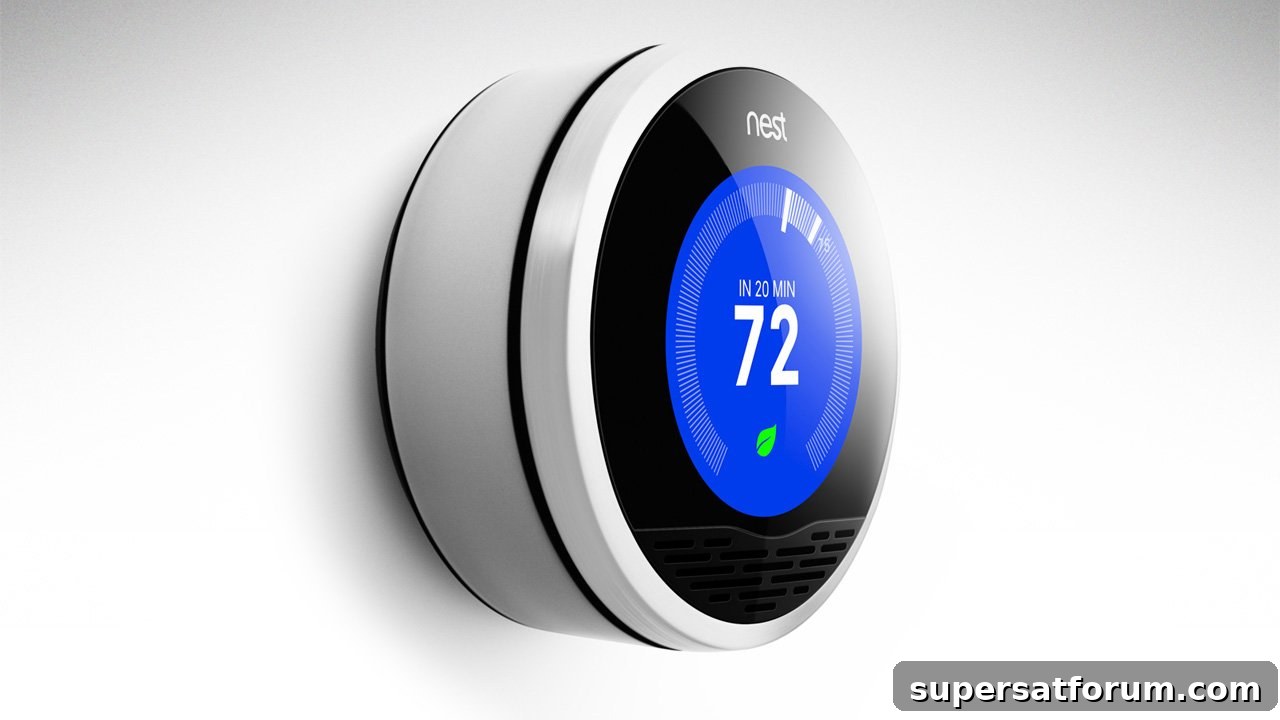
You have to admire Nest. The small IoT startup began with a simple mission: take the unloved products in your home and create simple, beautiful, and thoughtful devices. From the start, that vision paid off with the much-lauded Nest Thermostat, a product praised for its design and intuitive functionality.
After the thermostat, Nest expanded its lineup to include a smart smoke detector. The most transformative moment in the company’s history came when Google acquired Nest for a staggering $3.2 billion earlier this year. That deal prompted criticism from some who felt Nest had “sold out,” but building a credible smart-home platform capable of competing with ecosystems such as Apple’s HomeKit arguably required integration with a large company like Google.
So far, Nest’s products and design philosophy have remained recognizable despite the acquisition, but change may be coming. At I/O 2014 Nest unveiled “Works with Nest,” a program enabling third-party hardware and software to integrate directly with its platform.
The company highlighted a range of practical integrations to demonstrate the potential. Mercedes vehicles, for example, can inform Nest when you’re on your way home, allowing the thermostat to reach a comfortable temperature by the time you arrive. Similarly, a Jawbone fitness tracker can detect when you wake up and prompt the Nest Thermostat to warm the house so you don’t face a cold shock in the morning.
Lighting specialist LIFX can synchronize smart bulbs with Nest Protect so they flash red if smoke or dangerous carbon monoxide levels are detected. When you’re away, LIFX lights can also alternate on and off to simulate occupancy and deter potential break-ins.
Appliance maker Whirlpool can use Nest’s status to protect clothing: if the house is empty, a washing machine can keep a garment on a “refresh” cycle or pause drying to prevent clothes from overdrying and wrinkling once a wash cycle ends.
Other companies participating in the “Works with Nest” initiative include Chamberlain, Logitech, and IFTTT, among others. The breadth of early partner support gives Nest an advantage over Apple’s HomeKit by securing heavyweight integrations before many rival platforms have publicly announced similar partnerships.
Unsurprisingly, Google’s predictive assistant Google Now is also integrated. Google Now aims to anticipate your needs and present helpful information proactively; with Nest in its portfolio, Google can position Now as a central intelligence for automated home experiences and IoT-driven services.
However, the expansion of Nest’s platform also raises security concerns. A published exploit demonstrates a potentially serious vulnerability: an attacker could exploit the device’s DFU (Device Firmware Update) mechanism to gain control at the bootloader level and execute unsigned code without restriction. The exploit requires physical access via USB, which limits the risk in many home environments but remains a meaningful threat in other contexts.
For most homeowners—where only trusted individuals enter the house—the immediate risk is lower, though it’s sensible to remain cautious around any visitors, contractors, electricians, or plumbers with physical access to devices. Businesses and public-facing locations may be more vulnerable, since an unauthorized person could conceivably plug in a compromised USB device, run the exploit, and learn when a space is unoccupied.
Nest’s push to open its ecosystem through “Works with Nest” shows clear potential to deliver more responsive, interconnected home experiences. The integrations highlighted so far point to convenient, safety-minded use cases that could make everyday routines smoother. At the same time, the disclosed security flaw illustrates the importance of rigorous safeguarding as smart-home devices become more central to daily life.
Do you think Nest and Google are building a compelling IoT platform? Share your thoughts in the comments.