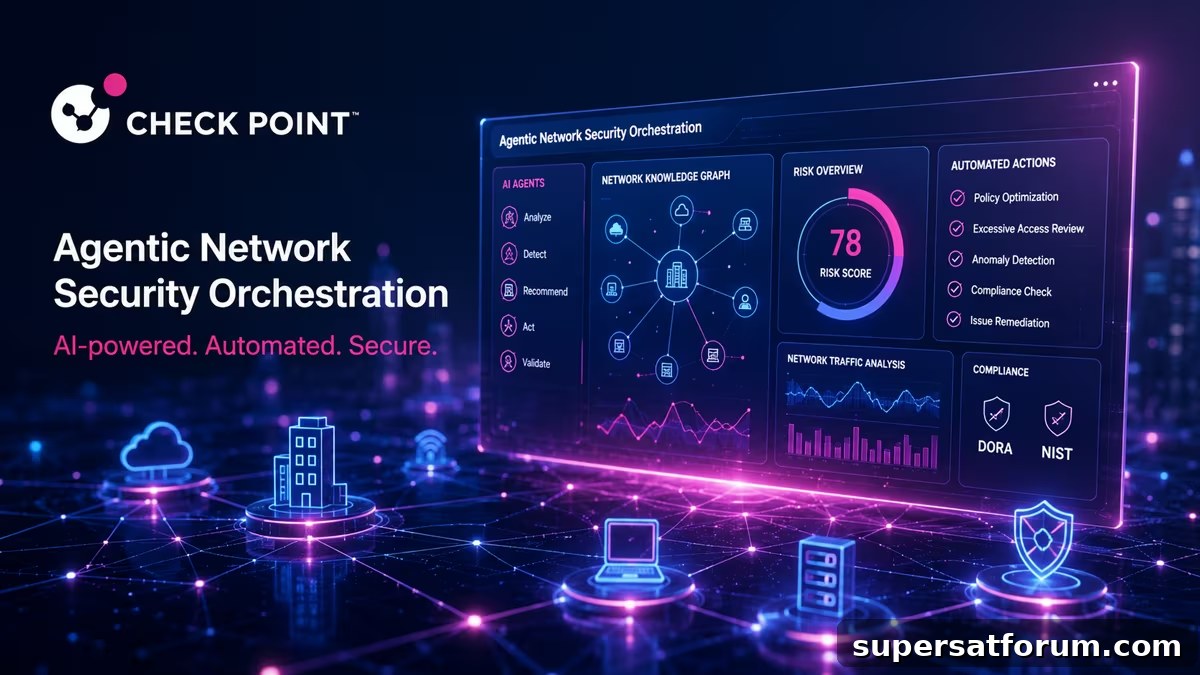
Security company Check Point Software has launched Agentic Network Security Orchestration, a new AI-driven platform designed to automate and simplify enterprise network security management. The solution aims to reduce the manual administration that has long burdened security operations and to help organizations respond more quickly to threats in complex IT environments.
As organizations expand hybrid cloud environments, connect more devices and integrate AI across their operations, networks are becoming increasingly difficult to map and protect. According to Check Point, a single policy change can today take weeks to implement, while misconfigurations and overly broad access rights often leave organizations exposed.
The new platform leverages AI agents to automatically analyze network traffic, detect risks and recommend or carry out security measures according to business requirements. It is built on a continuously updated Network Knowledge Graph — a real-time model of the organization’s network, assets and traffic flows. Capabilities include automated policy management, detection of excessive access rights, network troubleshooting and support for regulatory compliance with standards such as DORA and NIST.

“Corporate networks have become too complex to manage manually at the pace required by today’s threat landscape,” says Fredrik Sandström, security expert at Check Point Software. “With this platform, security teams can concentrate on business priorities while AI agents handle operational tasks within clear boundaries and under human oversight.”
As part of the initiative, Check Point has also agreed to acquire the team and intellectual property from Deepchecks, a company specialized in testing and monitoring AI systems. The acquisition is intended to strengthen the platform’s ability to validate and continuously improve its AI agents over time.
By combining an up-to-date network model with autonomous AI agents, Check Point’s offering seeks to shorten response times, reduce human error and ensure consistent policy enforcement across hybrid and cloud-native infrastructures. The platform’s automated workflows can help organizations streamline routine tasks like policy updates and access reviews, while surfacing risky configurations and anomalies that require human attention.
Enterprises adopting Agentic Network Security Orchestration should expect a shift in how security operations prioritize and execute work: fewer repetitive administrative tasks, faster remediation of configuration issues, and improved alignment between security controls and business objectives. The technology also aims to support compliance programs by providing traceable, auditable changes and continuous monitoring aligned with regulatory frameworks.
Check Point emphasizes that AI agents operate under human supervision and within defined policies to avoid unintended actions. The company positions the platform as a tool to augment security teams, enabling them to focus on strategic risk management rather than day-to-day device and rule maintenance. The integration of Deepchecks’ expertise is expected to enhance ongoing testing and governance of the AI components to maintain reliability and safety as the system evolves.