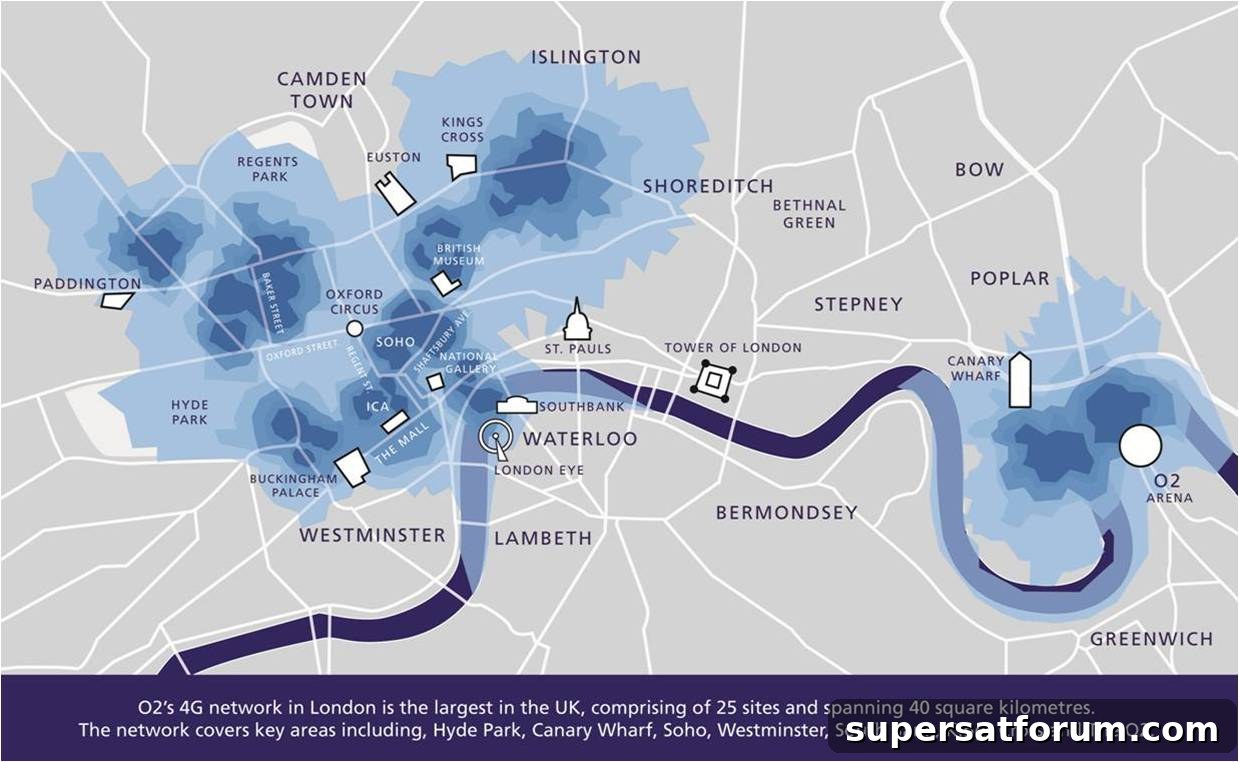
O2, the UK division of European telecoms giant Telefónica, has launched the first 4G LTE trial in London, offering mobile broadband speeds of up to 150 Mbps to a select group of around 100 participants.
More than 25 4G sites will be activated across London this month, covering a combined area of approximately 40 square kilometres. The rollout will continue through to summer 2012 and will target key districts including Canary Wharf, Soho, Westminster, South Bank and King’s Cross.
As with previous 3G rollouts, headline speeds are ideal peak figures and real-world download rates are likely to be lower. However, comparable trials in Finland have shown peak speeds up to 48 Mbps with average rates near 36 Mbps, indicating that users should still experience significantly faster data performance than current 3G services provide.
The London trial uses the 2.6 GHz spectrum. Test participants have been provided with Samsung B3730 mobile broadband dongles for use with laptops and notebooks. A limited number of mobile handsets have also been issued for the trial, although LTE-capable phones are not yet widely available in the UK.
The lower 800 MHz band, which offers better coverage and building penetration, remains occupied by outgoing analogue television transmissions that are due to be cleared this year.
“Our work in London will give us a better understanding of the capabilities of 4G technology and will allow us to explore the superfast benefits it will bring to people and industry across the UK,” said Ronan Dunne, Chief Executive Officer of Telefónica UK. “This 4G trial is the next step on our journey to a smarter network—a network that offers a seamless, connected experience across multiple devices, locations and services.”
Several countries, including Sweden, Finland and Germany, as well as the US, Canada and South Korea, have already begun deploying LTE networks, leaving the UK somewhat behind this early wave of rollouts.
UK regulator Ofcom says that, despite earlier delays, it remains on course to hold auctions for LTE spectrum licences at the end of next year. Some observers, including the Culture, Media and Sport Select Committee, have suggested that disagreements between operators over auction format have contributed to the delays.
Operators Vodafone and O2 have argued that Ofcom’s plan to allow a smaller operator, Three, to obtain a portion of the spectrum at a minimum price could amount to state aid, and they have threatened legal action.
Ronan Dunne said that O2 is actively engaged in preparations for the auction. The company supports “a fair process that meets the Government’s and Ofcom’s planned timeline,” he commented.
“The forthcoming spectrum auction is a watershed moment for the UK mobile industry,” Dunne added. “It will release airwaves capable of powering a wide range of next-generation mobile services.”
For those tracking LTE developments, industry events and conferences will continue to highlight technical progress and deployment strategies as operators and regulators move toward wider commercial rollouts.