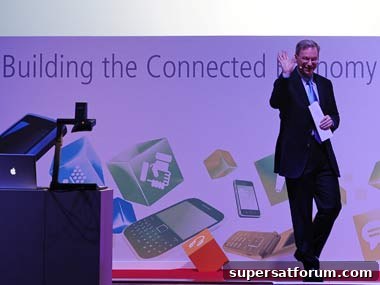
It’s increasingly challenging to operate as a mobile wireless carrier today, said Eric Schmidt, chairman of Google, citing regulatory pressures and the high costs of upgrading to 4G networks that are creating serious difficulties for telecom companies worldwide.
“It is very difficult to be a telecom operator right now,” Schmidt told a packed Mobile World Congress audience during his keynote. He noted that carriers must invest heavily to upgrade equipment to 4G while customers consume ever larger amounts of scarce bandwidth. At the same time, governments often impose heavy regulations and charge steep fees for new spectrum.
Schmidt urged closer collaboration between industry and regulators. “We’re very aware of the problems carriers face,” he said, emphasizing the need for constructive engagement to address the challenges.
During the keynote, Schmidt unveiled the new Chrome browser for Android Ice Cream Sandwich, highlighting a seamless browsing experience that bridges users’ home desktops and their phones. The updated browser includes several features designed to improve usability, including deep synchronization with the Chrome desktop: after browsing on a PC, users can open Chrome on their phone and find the same windows and recent browsing history available from the cloud.
“We know we really got the UI right this time,” he said, reflecting confidence in the browser’s design and usability improvements.
Much of the keynote focused on connectivity and technology’s impact on society. Schmidt discussed the role of connectivity in events such as the Arab Spring and described how expanding access to networks will reshape relationships with the world. He painted a near-future vision in which people can remotely experience events through robotic avatars that provide audiovisual and tactile feedback, making remote presence feel more immediate and immersive.
Schmidt stressed the transformative potential of cloud computing for small businesses. With access to powerful cloud-based applications for accounting, design, and other functions, smaller enterprises can scale and succeed more quickly than before. The cloud, he said, is already proving its ability to level the playing field for entrepreneurs and growing companies.
He portrayed a future uplifted by connectivity. “The web is pretty amazing with just two billion people online, right?” he observed. “Think how amazing it would be if we could get the other five billion people connected too.”
Schmidt noted that initial steps in many regions need not rely on large central networks; mesh networks can let communities connect directly with one another. He suggested even nomadic populations will adopt technology—as they did with satellite TV—so smartphones and related services will find adoption across diverse lifestyles.
Addressing the developer community in the audience, Schmidt praised their work, calling developers “the engineers of human freedom,” and arguing that their innovations expand people’s choices and capabilities.
“We’re beginning to see science fiction becoming a reality,” he said. “Technology disappears as it becomes part of everyday life and people start to trust it more. Before long, the web will become like electricity.”