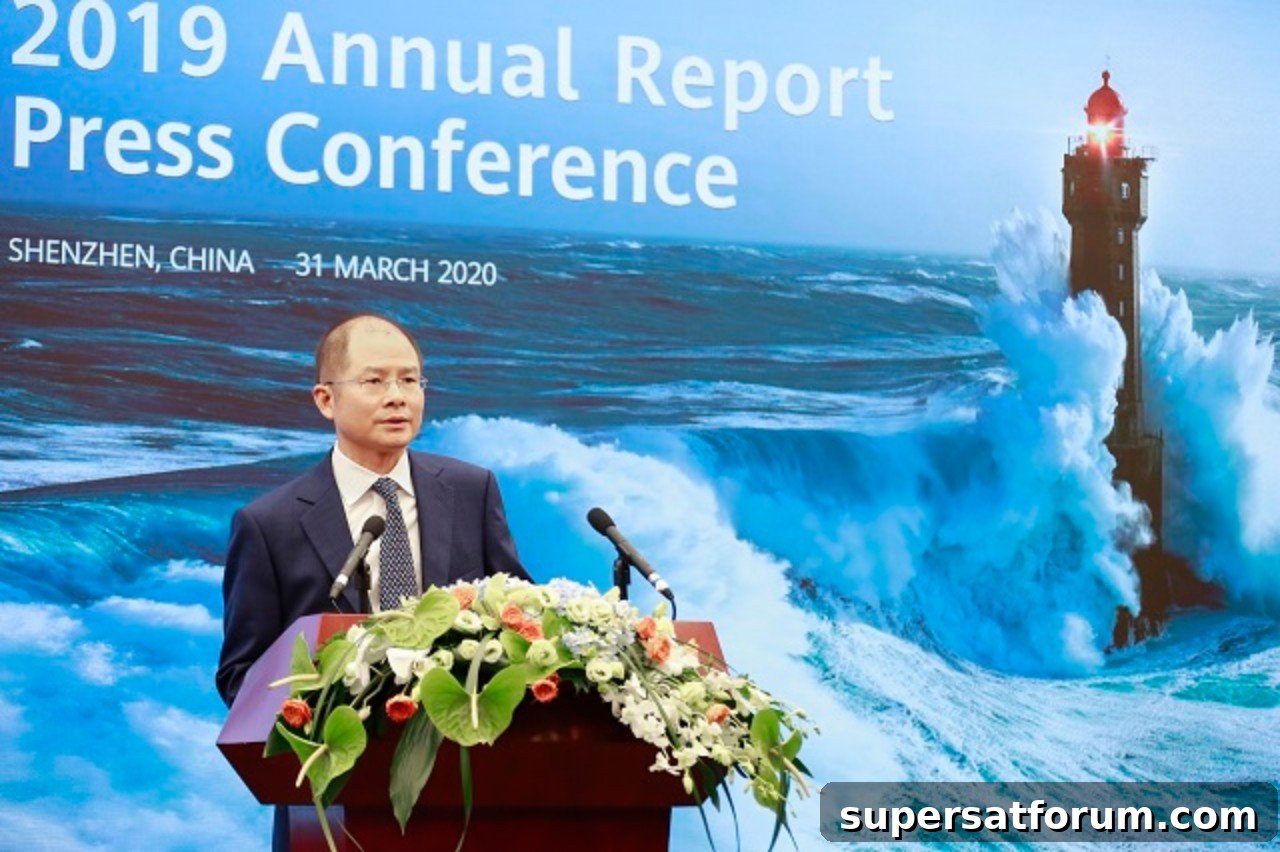
Huawei held a virtual press conference to release its 2019 annual report amid the global coronavirus pandemic.
The past year posed significant challenges for Huawei. U.S. sanctions combined with growing international pressure to exclude the vendor’s equipment from national networks strained the company, and the pandemic added further market disruption.
“2019 was an extraordinary year for Huawei,” said Eric Xu, Huawei’s Rotating Chairman. “Despite enormous outside pressure, our team forged ahead with a singular focus on creating value for our customers. We worked hard to earn their respect and trust, as well as that of our partners around the globe. Business remains solid.”
Huawei reported total revenue of ¥858.8 billion ($120.9 billion) for 2019, a 19.1 percent increase year-on-year. Net profit rose 5.6 percent to ¥62.7 billion ($8.8 billion).
Although a number of countries, including Australia, have moved to restrict Huawei from national 5G infrastructure, the company’s global market share continued to expand. Industry data places Huawei as the largest vendor by market share—around 35.3 percent—well ahead of competitors such as Nokia, which holds roughly 16.1 percent.
Still, the full impact of key geopolitical and policy decisions may not be reflected in this report.
Observers closely watched the United Kingdom as a major U.S. ally and intelligence partner to see how it would approach Huawei equipment. After a multi-year security review, the UK government announced a conditional policy to allow Huawei gear in certain parts of its 5G networks.
Under the UK policy, Huawei equipment may be used in up to 35 percent of British access networks—the elements that connect customer devices to mobile masts—but it is excluded from critical infrastructure and sensitive locations such as nuclear sites and military bases. All vendor equipment will continue to be evaluated at the dedicated Huawei Cyber Security Evaluation Centre in Banbury.
Following that decision, Huawei Vice President Victor Zhang said the company was “reassured” that it could keep working with customers to maintain the 5G rollout. He described the decision as evidence-based and predicted it would help deliver more advanced, secure, and cost-effective telecoms infrastructure.
Many operators are hesitant to sever ties with Huawei because replacing existing hardware is costly and can cause lengthy delays. Even with limits placed on Huawei’s equipment, some carriers expect significant extra expense. For example, BT estimated the UK restrictions could cost it around £500 million over five years, and slower 5G deployment can have wider economic and competitiveness consequences.
Huawei’s consumer business also faces headwinds. U.S. sanctions compelled Google to suspend some cooperation with Huawei, meaning new smartphones—such as the P40 flagship announced this week—may ship without Google services like the Play Store in some markets.
Additional U.S. measures under consideration could further restrict Huawei’s access to chips produced using American technologies by expanding rules like the Foreign Direct Product Rule.
Despite these pressures, Huawei’s consumer division grew strongly in 2019, expanding roughly 34 percent. By comparison, the enterprise business grew 8.6 percent and the carrier business increased 3.8 percent.

“The external environment will only get more complicated going forward,” Xu cautioned. “We need to keep enhancing the competitiveness of our products and services, promoting open innovation, and creating greater value for our customers and society at large.”
“This is the only way we can seize the historic opportunities presented by the digital and intelligent transformation of industries, and maintain robust growth in the long run.”
A full copy of Huawei’s 2019 annual report is available in PDF form from the company.
Interested in hearing industry leaders discuss topics like this and share use cases? Consider attending events in the IoT Tech Expo, Blockchain Expo, AI & Big Data Expo, Cyber Security & Cloud Expo, and 5G Expo World Series, which feature upcoming conferences in Silicon Valley, London, and Amsterdam that explore the future of enterprise technology.