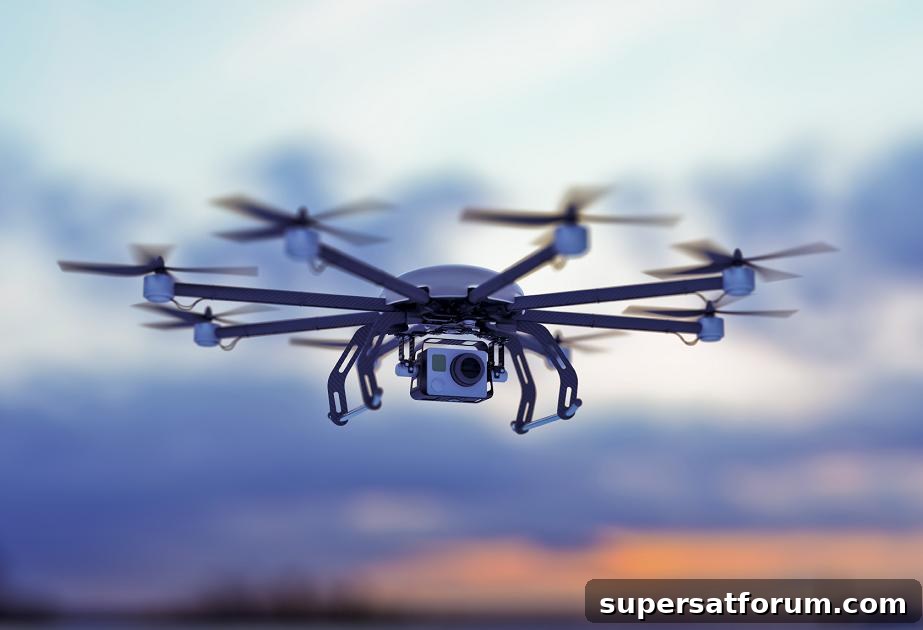
(Image Credit: iStockPhoto/mailfor)
Matthew Key, BT’s Head of Customer Innovation, has outlined plans to use drones for essential repair and maintenance work in rural and hard-to-reach areas where sending an engineer would be slower. In a blog post he wrote, “With a little creativity, drones could change the world.”
That transformation is already underway. Nokia Networks has deployed drones in the UAE to support critical network tasks. In Dubai, Nokia’s drones assist with tower inspections, radio planning, line-of-sight testing, and network optimisation ahead of large events.
Using drones for site inspections is not only safer than sending personnel to heights, it is often far quicker than assembling safety equipment to scale a tower. While drones must be adapted to withstand severe weather, they can enable surveying and inspection work that would otherwise be impractical. When performing tower inspections, drones can produce high-quality site audits with unique panoramic and top-down views captured in a single pass.
Drones also support radio-planning and line-of-sight (LoS) testing, enabling engineers to refine network performance by identifying potential issues. Drones can help determine whether certain frequencies are affected by foliage, evaluate if increasing antenna power would extend coverage without excessively increasing latency, and simulate performance changes resulting from adjustments to antenna height or placement.
Although Nokia’s drone deployments currently focus on testing and survey tasks, BT is exploring the use of drones for actual repairs and for delivering urgent parts to field teams. Key said, “We could use drones to deliver urgent parts for our network. This would be especially useful for rural, hard-to-reach areas across the UK. It would be a much faster way to get things to where they need to be and improve the customer experience.”
He added, “If your network is damaged by a flood or another natural disaster, drones could fly over and assess what needs to be done — and we could get you back online as quickly as possible.”
The potential applications for drones are only beginning to be explored. In future scenarios, Key envisions drones providing temporary internet access when networks are disrupted, broadcasting connectivity at large events, and helping customers address logistical, agricultural, and energy-sector challenges through tailored drone deployments.
As with many emerging technologies, drones are subject to strict regulation. In the UK, current rules require a drone to remain in the operator’s direct line of sight. Given present security concerns, including the elevated threat of terrorism, regulatory changes that would permit broader drone use may take time to be implemented, potentially slowing the pace at which drones can achieve their full operational potential.
Do you think regulatory bodies should change drone rules? Let us know in the comments.