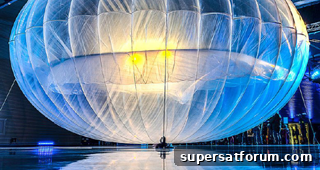
Jules Verne’s fictional Phileas Fogg needed 80 days to circle the globe in a balloon. By contrast, Google’s experimental Project Loon managed a similar global circuit in 22 days — a reminder of how far unmanned technology has advanced.
Project Loon isn’t designed to be crewed or to set speed records. Its real purpose is much more practical and ambitious: to bring internet connectivity to underserved and remote regions by using a network of high-altitude balloons.
We previously covered Project Loon and its potential to deliver connectivity to people in hard-to-reach areas and developing countries. Extending reliable internet access can stimulate local economies, increase educational and business opportunities, and contribute to poverty reduction.
Launching and operating devices in the stratosphere presents difficult technical challenges, and the recent around-the-world trip required improvements before it could succeed. The balloon that completed the journey, designated Ibis-167, benefitted from advances the team described on the project’s Google+ page.
“Since last June, we’ve been using the wind data we’ve collected during flights to refine our prediction models and are now able to forecast balloon trajectories twice as far in advance. In addition, the pump that moves air in or out of the balloon has become three times more efficient, making it possible to change altitudes more rapidly to quickly catch winds going in different directions.”
“There were times, for example, when this balloon could have been pulled into the polar vortex — large, powerful wind currents that whip around in a circle near the stratosphere in the polar region — but these improvements enabled us to manoeuvre around it and stay on course.”
Project Loon is developed within Google’s X division, the research lab known for tackling far-ranging, exploratory projects. X Labs has also been behind devices like the experimental wearable Google Glass.
The team has already launched Ibis-167 on a second voyage to continue testing durability and performance; the balloon has now logged some 311,000 miles, helping validate system resilience ahead of broader deployment.
While technical, regulatory, and logistical hurdles remain before widespread service becomes a reality, Project Loon illustrates a creative approach to expanding internet access. By combining improved wind forecasting with more efficient altitude control, the project aims to deliver stable, long-duration coverage from the stratosphere without relying on ground infrastructure.
What are your thoughts on this kind of ambitious effort to extend connectivity to underserved regions?