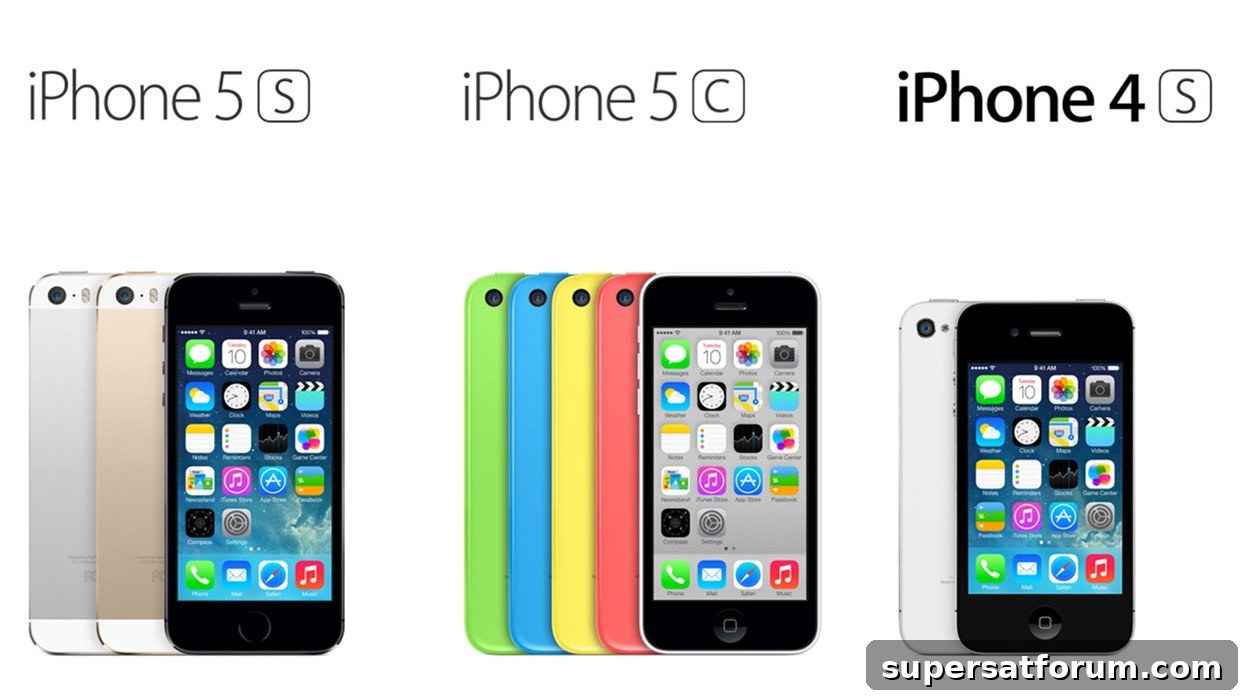
The Cupertino-based mobile phone maker Apple unveiled two new iPhone models on September 10: the premium iPhone 5S and the more affordable iPhone 5C. Alongside these launches, Apple retired the iPhone 5 and replaced it with the 5C. With both a colorful, lower-cost option and a high-end successor now on the market, here is a clear, well-rounded look at what each model offers and how they compare to the iPhone 5.
Improved Battery Life
The original iPhone 5 offered solid battery performance for its time: around 8 hours of talk time, up to 225 hours (roughly 9 days) of standby, about 10 hours of web browsing over Wi‑Fi, 40 hours of audio playback, and roughly 10 hours of video playback. The iPhone 5S and 5C bring modest but noticeable improvements. Both newer models advertise approximately 10 hours of talk time and web use over Wi‑Fi, and up to 250 hours (about 10 days) of standby time. Tear-down reports show slight differences in battery capacity between the two: the 5C’s battery measures around 5.73 Whr, while the 5S uses a slightly larger 5.96 Whr cell. In practice, Apple managed to increase runtime within the same overall chassis dimensions, reflecting engineering refinements in battery design and power management.
Stronger Processing Performance
One of the most notable upgrades is the iPhone 5S’s move to a 64-bit A7 chip. Historically, 64-bit processors were a desktop-class feature, enabling more efficient handling of RAM-intensive tasks. By bringing a 64-bit architecture to a smartphone and integrating it with iOS 7—whose kernel and built-in apps were reworked for 64-bit—Apple positioned the 5S to run next-generation apps and games with improved performance. Early demonstrations, including graphics-intensive titles like Infinity Blade III, showcased visuals that brought mobile gaming closer to console-quality experiences.
The 5C uses the proven A6(X)-class architecture with an SGX 543MP3 GPU and a clock speed around 1.3 GHz. While not as forward-looking as the A7, this configuration remains efficient and capable—optimized for current apps and well suited to the majority of everyday tasks. The 5C represents a sensible balance of performance and cost for users who want capable hardware without the newest flagship silicon.
Enhanced Camera Features
Apple built a strong reputation for smartphone photography with the iPhone’s 8-megapixel iSight camera. For the 5S, Apple refined the camera system to improve low-light performance and image quality. The 5S features a wider f/2.2 aperture, an improved back-illuminated sensor, a dual-LED flash designed to better match ambient light, and a Hybrid IR filter. These updates, together with smarter automatic adjustments, allow the camera to capture clearer, more color-accurate photos across a wider set of conditions.
The 5C received thoughtful improvements as well. Its front-facing FaceTime camera was upgraded to 1.2 megapixels with enhanced light sensitivity, producing sharper and clearer video calls. The rear camera carries many of the same practical features expected from a modern iPhone camera: an LED flash, a five-element lens, a ƒ/2.4 aperture, back-side illumination, face detection, and panorama mode. These enhancements make the 5C a strong choice for casual photographers and frequent video callers.
Touch ID, Siri, and Security
Security and convenience received special attention in the 5S with the introduction of Touch ID. Integrated into the Home button, Touch ID is a fingerprint sensor that unlocks the phone with a touch. It supports multiple fingerprints and reads from various angles. Crucially, fingerprint data is stored securely on the device rather than in iCloud, keeping biometric information private. Touch ID adds both convenience and an additional security layer for device access and potential future authentication uses.
The 5C does not include Touch ID, but it fully supports Siri, Apple’s voice-activated assistant. Siri enables hands-free interaction such as setting reminders, placing calls, scheduling events, composing messages, and answering questions—features that remain useful and familiar to many users.
Positioning and Market Strategy
Apple’s introduction of two distinct models reflects a strategic move to address different segments of the market simultaneously. The 5S targets buyers seeking the latest innovations—faster processing, improved camera performance, and biometric security—while the 5C targets value-oriented customers who want a reliable, colorful iPhone experience without the newest flagship hardware. Financial analysts described the updates as “evolutionary, not revolutionary,” but Apple has nonetheless made meaningful upgrades that put the 5S in stronger competitive alignment with high-end Android models, while making the 5C a compelling mid-range option.
Time will determine how broadly these changes are received, but both phones demonstrate Apple’s continued focus on marrying performance, design, and user experience. The 5C stands out for its approachable pricing and bright design, while the 5S introduces features—particularly Touch ID and a 64-bit processor—that hint at where smartphone capabilities may head next.
About the Author:
Allie Cooper is a technology enthusiast, pet lover, and tech blogger who follows the latest social media developments, gadget releases, and lifestyle trends. She regularly covers hardware updates, app news, and consumer tech insights.