Apple’s iPhone sales in China rose 8% year-over-year in the second quarter of 2025, but that growth came largely through aggressive pricing and temporary support measures, raising questions about its sustainability.
Preliminary data from Counterpoint Research’s China Smartphone Weekly Sales Tracker show that Apple’s gains relied heavily on steep discounts and government subsidy programs rather than a clear rebound in consumer demand in the world’s largest smartphone market.
During May 2025, Apple cut iPhone prices by as much as one-third on major Chinese e-commerce platforms and took part in government subsidy schemes that offered up to 500 yuan off select models. While Counterpoint Associate Director Ethan Qi described the timing as “well timed and well received,” the approach highlights pressure on Apple’s pricing power and brand premium in China.
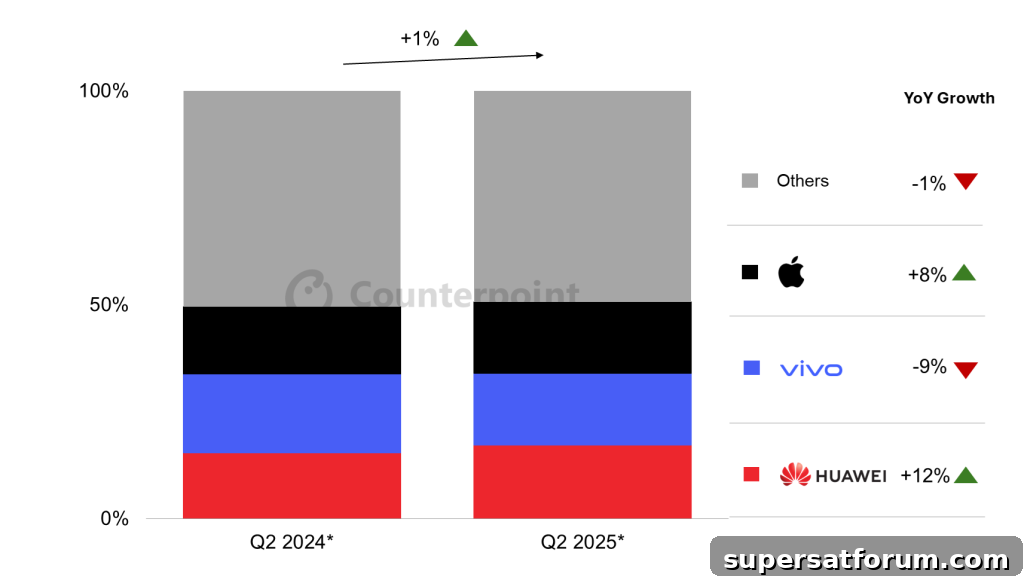
More worrying for Apple’s long-term prospects is Huawei’s strong performance, which overshadowed iPhone gains. Huawei claimed the top spot in China’s smartphone market and delivered 12% year-over-year growth, signaling growing consumer preference for domestic brands.
The contrast is stark: Apple needed heavy discounts to secure modest growth, while Huawei’s momentum appears driven by genuine consumer preference and loyalty. Counterpoint Senior Analyst Ivan Lam noted that “Huawei is still riding high on the loyalty of its core users as they replace their old phones with new Huawei releases.”
This loyalty creates a structural challenge for Apple in China, suggesting that more Chinese consumers are choosing domestic alternatives over premium international brands.
The limited impact of the promotional period further underscores Apple’s challenge. Despite heavy discounts on iPhone 16 Pro and Pro Max models, the overall 618 sales period remained flat year-over-year, indicating weak underlying demand. Even though Apple captured the top spot during the sales event, doing so required significant margin concessions and government support—an approach that may not be sustainable.
Analysts have issued cautionary forecasts for Apple’s near-term outlook in China. As reported by the South China Morning Post, Lam warned that “iPhone sales in China will stumble amid weak consumer spending and an ageing iPhone 16 cycle, while tepid iPhone 17 upgrades won’t spark demand” in the second half of 2025. This suggests that Q2 results may be a temporary reprieve rather than the start of a true recovery.
The competitive landscape is tightening as Chinese manufacturers push further into the premium segment. According to Counterpoint data, Huawei was China’s largest smartphone vendor by sales in the first quarter of 2025 with a 19.4% market share, while Apple’s position looks more precarious.
Regulatory and product feature gaps also put Apple at a disadvantage. Chinese rivals have introduced AI features in their devices, while Apple continues to wait for regulatory approval to launch its Apple Intelligence service in China. That delay reduces Apple’s ability to compete on AI-driven experiences, an increasingly important differentiator among buyers.
The government subsidy program that boosted Apple’s Q2 results is expected to be scaled back, removing a key support. Counterpoint Senior Analyst Mengmeng Zhang warned the program “will be scaled back during the latter half of the year,” adding that this creates risk given the recent uneventful sales season.
Absent continued subsidies and deeper discounts, Apple could face renewed pressure on market share. Research firm IDC has forecast a 1.9% decline in Apple’s Chinese smartphone shipments for 2025, a sign that the headwinds could persist.
Wider market conditions are also challenging: China’s smartphone shipments fell 21.8% in May 2025 amid weak consumption, pointing to systemic demand issues that affect all vendors.
For Apple, Q2 2025 in China appears to reflect a struggle to maintain relevance in its third-largest market. The headline 8% growth masks deeper issues—eroding pricing power, dependence on temporary government support, and intensifying competition from domestic brands. Such factors suggest Apple’s Chinese smartphone business faces a difficult path ahead.
The coming quarters will show whether Apple can convert this short-term momentum into a sustainable recovery or whether the Q2 surge marks the high point of a fragile rebound as Huawei and other domestic competitors continue to strengthen their positions in a highly competitive market.
(Image by Zhiyue)
See also: Apple’s pivot to India: What $900M tariff hit means for Western markets

Looking to revamp your digital transformation strategy? Learn more about Digital Transformation Week, an event series held in Amsterdam, California, and London, co-located with IoT Tech Expo, AI & Big Data Expo, Cyber Security & Cloud Expo, and other industry events.
Explore other upcoming enterprise technology events and webinars powered by TechForge.