Since its first broadcasts in 1928, television has continued to captivate and entertain audiences worldwide. This article traces the medium’s development from the era of black-and-white sets to today’s high-definition flat screens and handheld tablets, highlighting key programmes, technological milestones, and cultural moments that shaped TV history.
The 1950s
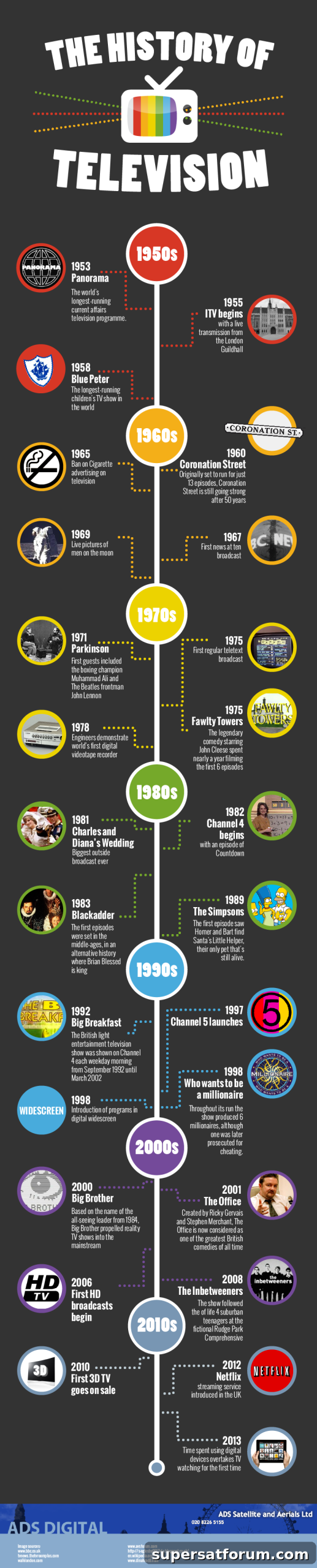
The 1950s marked the arrival of landmark programmes and the expansion of commercial broadcasting. In 1953 Panorama launched and went on to become the longest-running current affairs programme globally. Over the years it made television history with interviews such as the first with a member of the Royal Family, Prince Philip, and won recognition for its coverage of major events, including the Cuban Missile Crisis. Panorama also staged one of television’s most memorable April Fools’ jokes with the famous “spaghetti trees” broadcast.
That decade also saw the launch of ITV, which began live transmissions from the London Guildhall in 1955, and the debut of the children’s institution Blue Peter in 1958—now one of the world’s longest-running children’s programmes.
The 1960s
The 1960s brought further iconic firsts. Coronation Street premiered in 1960 and became a staple of British drama, while News at Ten first appeared in 1967, changing prime-time news delivery. Regulatory change also arrived: a ban on cigarette advertising was implemented in 1965, reshaping commercial television content.
Television’s power to unite viewers worldwide was never clearer than in July 1969, when millions watched the live coverage of the Apollo 11 moon landing. UK broadcasters across BBC1, BBC2 and ITV provided extensive coverage of those historic days, bringing the event into homes across the country.
The 1970s
The 1970s produced enduring entertainment and technical advances. Parkinson, the influential chat show, launched and hosted major figures such as Muhammad Ali and John Lennon. In 1975 Fawlty Towers introduced John Cleese’s comic creation, filmed partly in Torquay, and quickly became a cult classic.
Technological progress included the first regular teletext service, Ceefax, which delivered text-based news and information to viewers, and demonstrations of the world’s first digital videotape recorder—signalling the slow shift toward digital production and transmission.
The 1980s
The 1980s featured both grand public events and fresh channels and formats. The 1981 wedding of Prince Charles and Lady Diana was a massive outside broadcast for the BBC and drew an estimated global audience of 750 million, one of television’s most watched live events.
Channel 4 launched in 1982, bringing new programming and formats to UK audiences; its debut programme Countdown would become a long-running fixture. Popular comedies and animated shows also left their mark—Blackadder first aired in 1983, introducing characters and catchphrases that entered everyday language, and The Simpsons arrived in 1989, eventually becoming a global cultural phenomenon.
The 1990s
The 1990s introduced energetic daytime and youth programming and marked the continued expansion of channel choice. The Big Breakfast, which began in 1992, revitalised morning television and launched the careers of presenters such as Chris Evans and Gaby Roslin. Channel 5 launched in 1997, widening viewing options further, and the same year saw the debut of Who Wants to Be a Millionaire?, a quiz show that captured national attention.
Technological evolution continued, and by 1998 broadcasters were experimenting with digital widescreen formats, paving the way for higher-resolution and more cinematic television presentation.
The 2000s
The new millennium brought reality television into the mainstream and a wave of influential comedy. Big Brother debuted in 2000 and became synonymous with reality TV’s rise. The Office followed, introducing a mockumentary format that—while fictional—felt rooted in everyday life and later became celebrated as one of Britain’s greatest comedies.
Other popular scripted comedies such as The Inbetweeners, which launched in 2008, portrayed teenage life with irreverent humour and strong cultural resonance. Technological progress included the rollout of high-definition broadcasts, which began in earnest in 2006 and improved picture clarity for viewers.
The 2010s
This decade was defined by shifts in how audiences consume television more than by any single programme. In 2010 the first 3D TVs were offered to consumers, and streaming services began to change viewing habits. Netflix became available in the UK in 2012, introducing on-demand streaming as a mainstream alternative to scheduled broadcasting.
By 2013, the time people spent on digital devices such as smartphones and tablets overtook time spent watching traditional television—a turning point for the industry that continues to influence content creation, distribution, and monetisation. As viewing becomes ever more flexible and personalised, the future of television will be driven by technology, viewer behaviour, and new forms of storytelling.
From the early days of black-and-white broadcasts to on-demand streaming on portable screens, television has continually evolved. Its history reflects advances in technology, changes in regulation, and shifting audience preferences—yet its central role in shaping public conversation and cultural life remains unchanged.