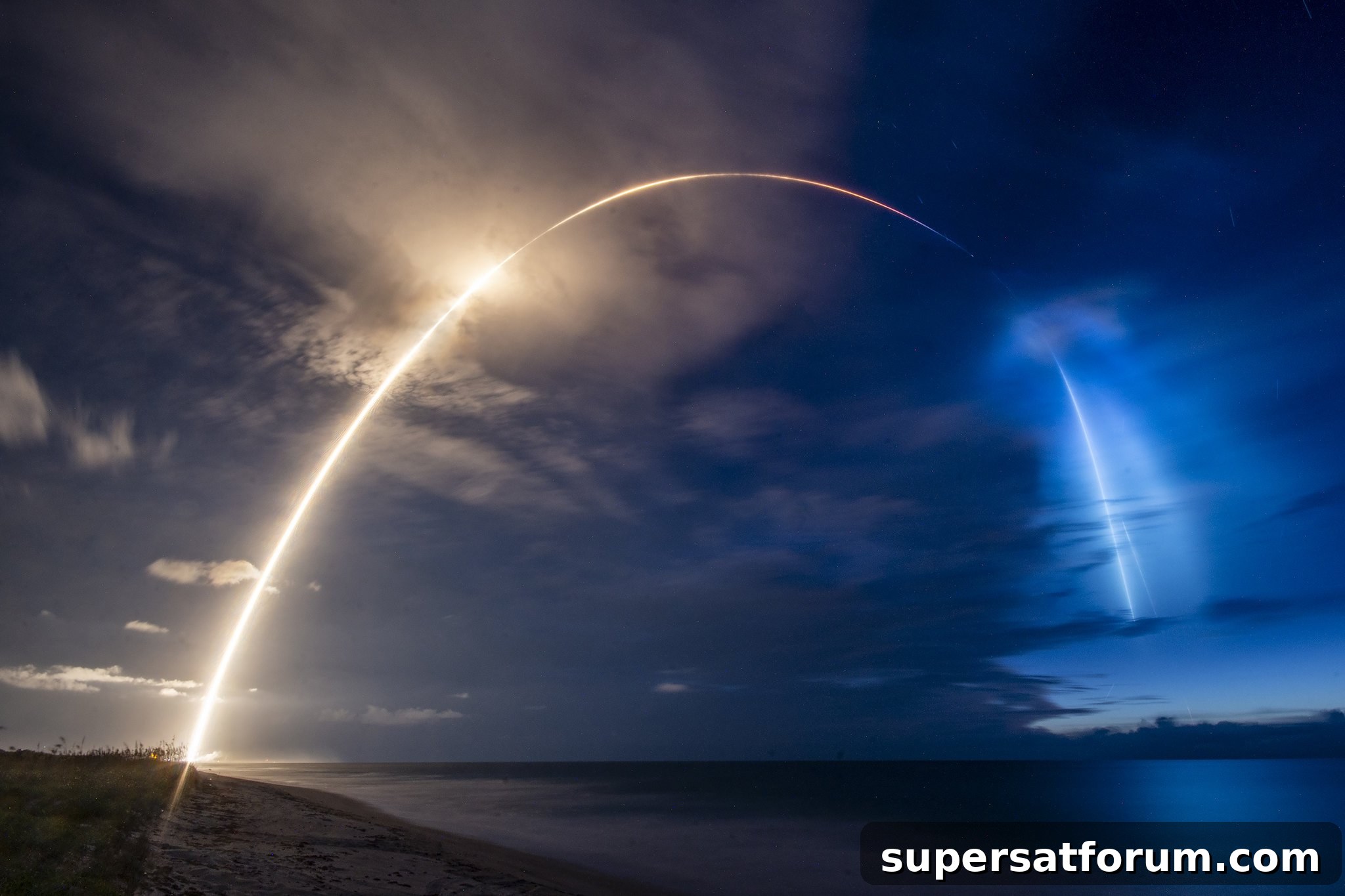
Researchers at the Radionavigation Laboratory, University of Texas, propose using SpaceX’s Starlink constellation to deliver navigation signals that are both more accurate and far less susceptible to interference than conventional GPS.
In a preprint paper published on arXiv, Todd Humphreys and Peter Iannucci outline a practical approach to upgrade low-Earth-orbit (LEO) communications satellites so they can augment existing Global Navigation Satellite System (GNSS) services. Rather than launching an entirely new navigation constellation, their method leverages Starlink’s large, growing network of satellites through software and signal processing improvements.
Traditional GPS, owned and operated by the U.S. government, began operation in 1978 and relies on a relatively small number of medium-Earth-orbit satellites that broadcast weak timing and positioning signals from about 20,000 km altitude. Other GNSS systems—Russia’s GLONASS, Europe’s Galileo (operational since 2016), and China’s BeiDou—have been developed over recent decades to offer independent and complementary services. Those national systems also reflect strategic priorities, such as reducing reliance on foreign navigation signals for military uses.
Starlink’s constellation already includes roughly 700 operational LEO satellites at about 550 km altitude, with thousands more planned. Each Starlink satellite carries capable payloads, including onboard GNSS receivers that utilize advanced algorithms to determine the satellite’s own position with centimeter-level precision. Crucially, Starlink links between satellites and ground stations support data downlinks measured in megabits per second—orders of magnitude higher than the handful of bits per second provided by legacy GNSS signals.
Humphreys and Iannucci describe a concept they call “fused LEO navigation.” In this design, LEO satellites such as those in Starlink would transmit navigation-related measurements alongside their communications traffic. By combining timing and ranging data from LEO satellites with traditional GNSS signals, receivers on the ground could achieve positioning accuracy on the order of decimeters—roughly 70 centimeters in typical scenarios—while dramatically improving resistance to jamming and spoofing because the LEO signals arrive at much higher power and from different geometries.
The researchers emphasize that the approach requires no new dedicated satellites. Instead, incremental software upgrades to existing communication satellites would allow them to share precise timing and ranging measurements. Their analysis estimates the navigation functionality would consume a trivial fraction of Starlink’s available downlink capacity (well under 1%) and a negligible portion of energy resources (under 0.5%). That makes the proposal cost-effective and rapid to deploy compared with building a separate global navigation satellite system.
Beyond Starlink, other LEO broadband networks could adopt the same enhancements. For example, the UK-backed OneWeb constellation—currently smaller but expanding—could also be upgraded to provide fused LEO navigation, giving another resilient, commercially operated source of precise positioning. Such developments could support civil, commercial, and military applications that demand high accuracy and robust anti-jam capability.
Adoption of fused LEO navigation would address several known weaknesses of existing GNSS: susceptibility to intentional interference, vulnerability to spoofing, and limited signal strength at the surface of the Earth. By combining measurements from GEO/MEO GNSS satellites and numerous LEO transmitters, receivers gain improved geometry and stronger signals, reducing both error and the risk of interruption.
Policy and industry trends also make this concept timely. Governments and private operators are increasingly comfortable partnering on space-based services, and upgrading commercial LEO constellations for navigation would avoid the expense, time, and orbital congestion associated with launching an entirely new navigation-specific fleet. The paper’s proposal therefore represents a pragmatic path to faster, more resilient positioning services that build on existing infrastructure.
(Image Credit: Starlink Mission by SpaceX)
Explore related industry discussions: Events such as 5G Expo, IoT Tech Expo, Blockchain Expo, AI & Big Data Expo, and Cyber Security & Cloud Expo convene experts who discuss advances in satellite communications, navigation, and resilience. Attendees at these events examine how commercial space systems can evolve to support next-generation positioning and timing services.