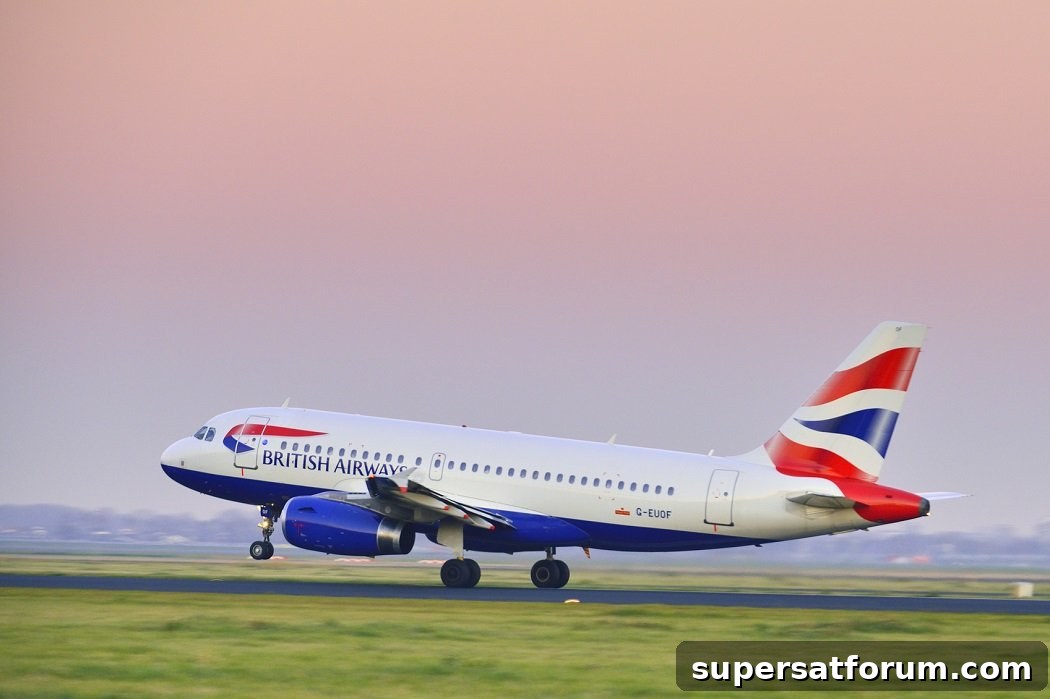
(Image Credit: iStockPhoto/Sjoerd van der Wal)
Select airlines within the International Airlines Group (IAG) — including British Airways — will soon offer passengers hybrid satellite and 4G broadband on short‑haul flights across Europe. This service combines a satellite link with a ground-based LTE network to deliver faster, more reliable in-flight internet access.
Inmarsat will provide the infrastructure for the new offering, building on a partnership with Deutsche Telekom to deliver the European Aviation Network (EAN). The agreement between IAG and Inmarsat has been developed over the past two years and aims to significantly improve air-to-ground connectivity for millions of travellers on regional routes.
Leo Mondale, President of Inmarsat Aviation, described the EAN as a “game changer” for passengers who have previously experienced limited or inconsistent broadband access while flying in Europe. He highlighted the strength of combining Inmarsat’s satellite capabilities with Deutsche Telekom’s ground network, and confirmed plans to work with IAG carriers Aer Lingus, British Airways, Iberia and Vueling during rollout.
IAG plans to equip 341 Airbus A320 family aircraft with the hybrid connectivity system starting in 2017. The breakdown by airline is 132 aircraft for British Airways, 125 for Vueling, 45 for Iberia and 39 for Aer Lingus. The group’s target is to have 90 percent of its short‑haul fleet fitted with the new service by 2019.
The first short‑haul aircraft to feature the system will be a British Airways A321, scheduled to enter service the following summer. IAG says the new in-flight Wi‑Fi will offer bandwidth sufficient for multiple devices to be used simultaneously and connection speeds comparable to what passengers expect on the ground.
“We are giving our customers the fastest connectivity you can get on any aircraft,” said IAG chief executive Willie Walsh. He noted that, following the rollout of Wi‑Fi on long‑haul aircraft earlier in the year, the airline group is now bringing high‑quality broadband to its short‑haul services. Walsh stressed that connectivity is a customer expectation and that IAG will be the first European airline group to offer high‑quality air‑to‑ground Wi‑Fi on short‑haul flights.
The EAN is a hybrid network that pairs a dedicated S‑band satellite with a continent‑wide ground LTE network. Inmarsat will use a soon‑to‑be‑launched S‑band satellite in combination with Deutsche Telekom’s ground stations to provide seamless coverage over busy European routes. By shifting traffic between satellite and terrestrial 4G where appropriate, the network is designed to increase capacity and maintain strong, consistent speeds across crowded air corridors.
Technically, combining satellite and ground‑based LTE connectivity allows carriers to manage network load more efficiently. On densely travelled regional routes where ground stations are available, aircraft can make use of high‑capacity 4G links; when flying over areas without ground coverage, the satellite connection maintains continuous service. This hybrid approach aims to outperform many long‑haul satellite‑only solutions by leveraging the strengths of both technologies.
For passengers, the expected benefits include reliable streaming, faster web browsing, and improved performance for multiple simultaneous users on a single flight. Airlines hope the enhanced connectivity will support both leisure and business travellers who increasingly treat inflight internet access as essential rather than optional.
Deployment across IAG’s short‑haul fleet represents a major investment in passenger experience and digital services. If the rollout meets expectations, other carriers operating within Europe may adopt similar hybrid systems to stay competitive and meet rising customer demands for fast, always‑available internet while in the air.
Are you impressed with IAG’s plans to use the EAN for in‑flight Wi‑Fi? Share your thoughts in the comments.