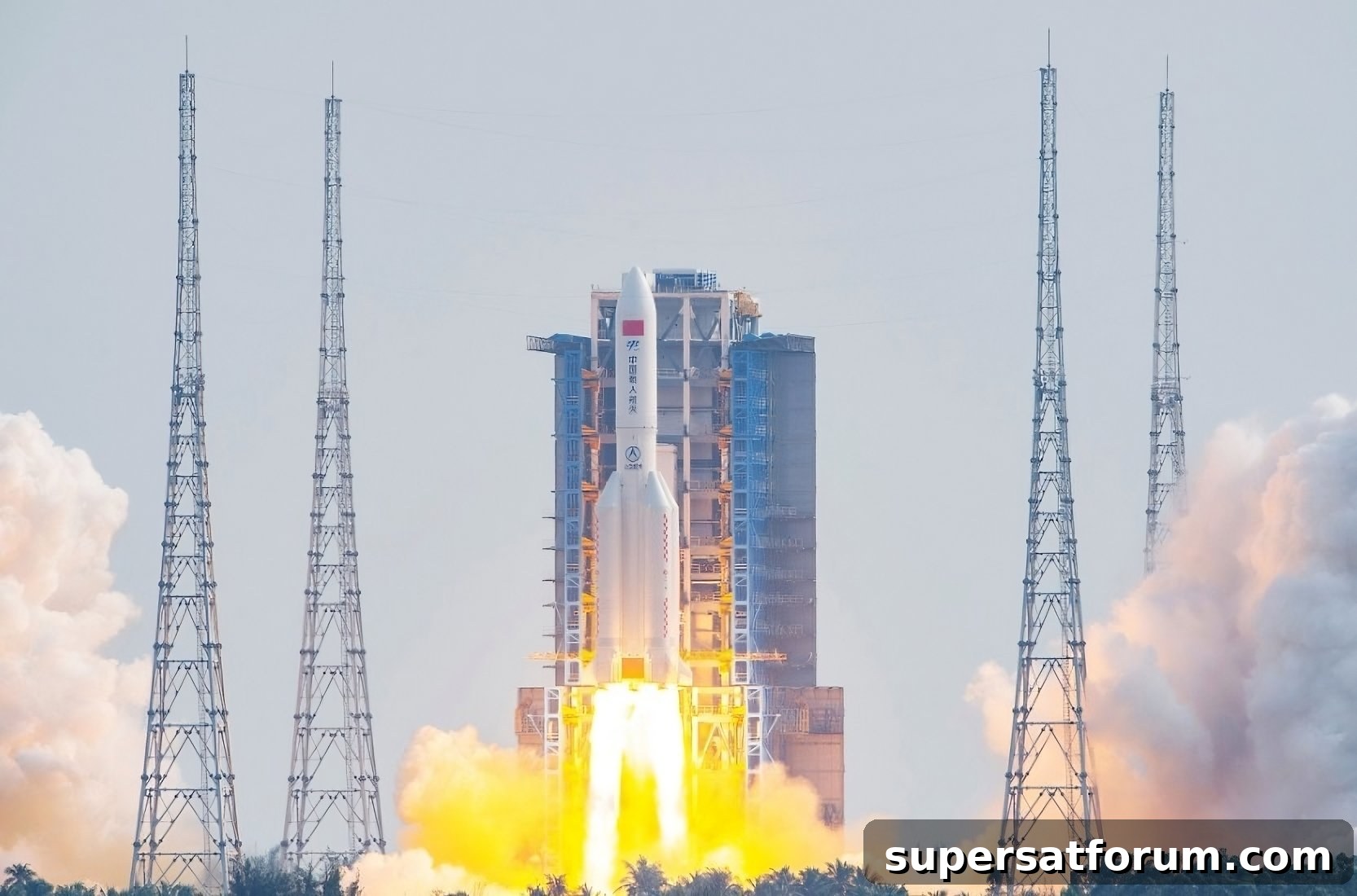
A batch of GuoWang satellites was launched aboard a Long March-5B rocket from the Wenchang spaceport in southern China. After reaching orbit, the satellites were successfully maneuvered into their planned low-Earth orbit.
Chinese state news agency Xinhua reported the mission as a success, confirming that 10 GuoWang satellites reached their predetermined orbital positions.
GuoWang: A “national network” for China
GuoWang, which translates as “national network,” was first announced in 2020 when China filed its proposal with the International Telecommunication Union (ITU). The plan outlines a massive satellite constellation intended to provide large-scale broadband coverage.
The proposed system would ultimately include nearly 13,000 satellites, making it one of the largest planned constellations in the world and comparable to commercial systems such as SpaceX’s Starlink. Though Chinese officials have not explicitly framed GuoWang as a response to Western commercial projects, analysts view the program as a direct attempt to match or counter such initiatives.
GuoWang is positioned to meet technological and economic goals while also addressing national security priorities. The project reflects Beijing’s ambition to narrow technological gaps with Western countries and to become a global leader in advanced space infrastructure.
Many technical specifics about the GuoWang satellites remain undisclosed. China has confirmed that the satellites will function as broadband relay nodes in the constellation, but details on their exact designs, capabilities, and deployment schedule have not been publicly released.
The satellites were developed by the China Academy of Space Technology (CAST), a subsidiary of the state-owned China Aerospace Science and Technology Corporation (CASC). Government ownership highlights the strategic importance of the project for national interests.
GuoWang joins other Chinese satellite investments
GuoWang is one among several Chinese investments in space-based internet infrastructure. Earlier this year, China launched the first satellites for another broadband-focused program called Qianfan, or “Thousand Sails.”
Qianfan is smaller in initial scale than GuoWang but is nonetheless ambitious. Chinese officials have described an initial deployment of roughly 1,300 satellites for Qianfan, with the potential to expand to a larger constellation over time.
Observers believe GuoWang and Qianfan could operate in complementary or partially overlapping roles, though the exact relationship between the two projects has not been clarified. Coordination could enable broader coverage or differentiated services, depending on technical and strategic decisions made by Chinese authorities.
Global satellite competition intensifies
China’s expanding satellite efforts come as global competition in the commercial space sector accelerates. SpaceX’s Starlink has become the most visible player, with tens of thousands of satellites launched and widespread adoption that includes use in remote regions and conflict zones.
Other major players include Amazon’s Project Kuiper and collaborative initiatives such as the European Union’s Iris² program. These efforts reflect a mix of commercial ambition, technological development, and geopolitical strategy as countries and companies vie for influence in space-based connectivity.
For China, large-scale constellations offer several strategic advantages: improved connectivity across underserved domestic regions, potential expansion of technological exports to developing markets, and reduced dependence on foreign satellite infrastructure that might be vulnerable during international tensions.
At the same time, the deployment of thousands of satellites raises serious questions about governance, orbital safety, and long-term sustainability. The increasing number of satellites heightens concerns over orbital congestion, collision risk, and the generation of space debris.
China’s prominent role in the constellation race adds pressure on international bodies to address these risks. However, the opaque nature of some state-backed programs can complicate efforts to achieve coordinated, transparent solutions at the global level.
A long road ahead
While the successful launch of GuoWang’s first satellites marks an important milestone for China’s space ambitions, it represents only an early step in a complex, multi-year effort. Reaching the goal of nearly 13,000 satellites will require overcoming technical challenges in hardware design, launch logistics, and low-Earth orbit traffic management.
Domestically, GuoWang could help reshape connectivity by improving internet access in rural areas and supporting economic development. Internationally, the constellation’s impact will depend on Beijing’s ability to attract users and markets beyond its borders, a task that may be influenced by geopolitical dynamics and competition from established providers.
The latest launch underscores China’s determination to expand its presence in space. Whether the program can deliver on its ambitious promises remains uncertain, but the entry of GuoWang into orbit certainly intensifies the global race for space-based broadband supremacy.
Looking to revamp your digital transformation strategy? Learn more about Digital Transformation Week events held in Amsterdam, California, and London. The event series is co-located with IoT, AI & Big Data, cybersecurity and cloud expos, and other industry gatherings designed for enterprise technology professionals.