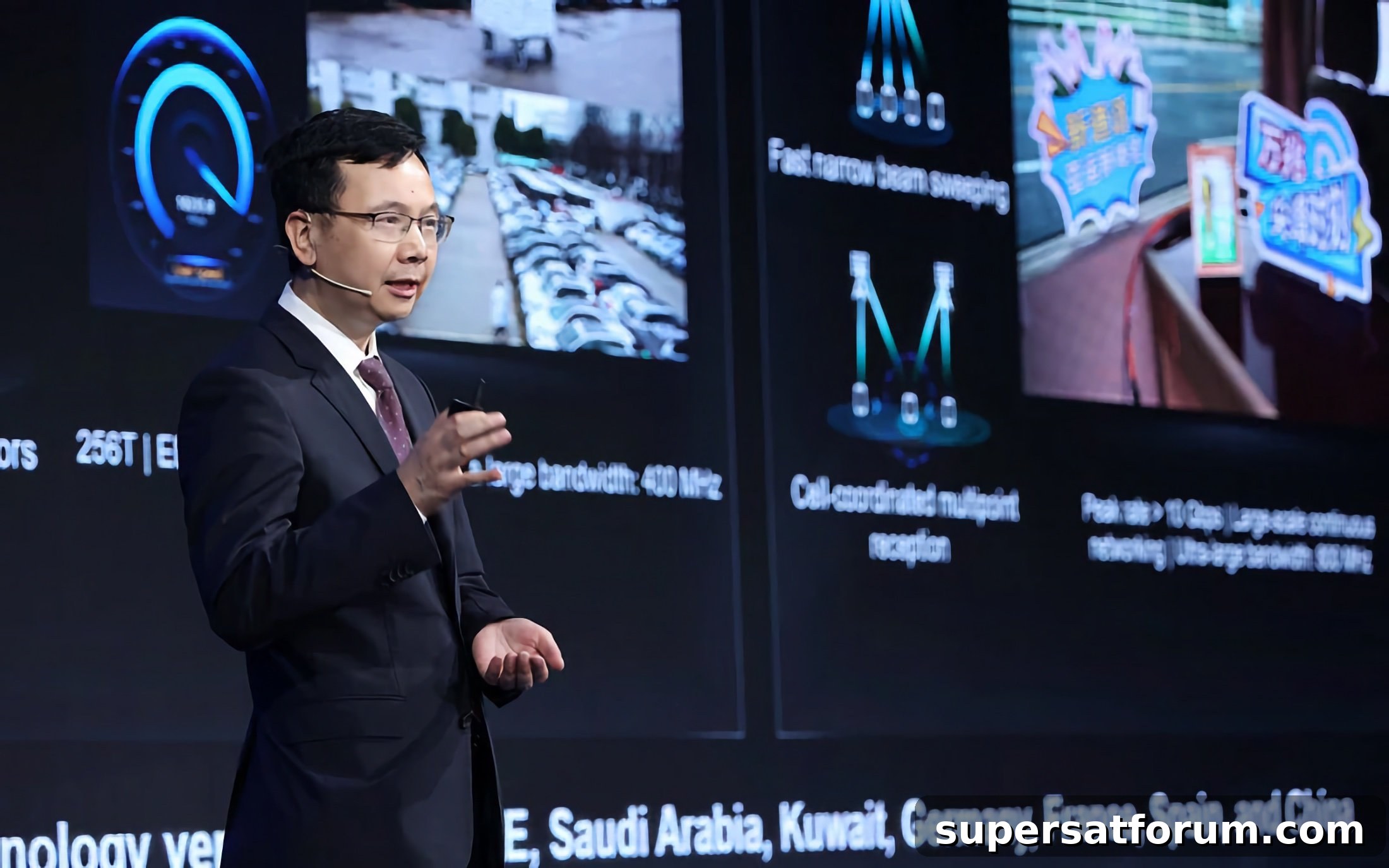
During MWC Shanghai, Huawei announced plans to supply a full set of components for what it calls a “5.5G” network as early as next year. The company says the rollout will mark the start of a new era in mobile networks, but industry bodies have not formally defined the term “5.5G.”
Yang Chaobin, director and president of ICT Products & Solutions at Huawei, described the roadmap for the new offering and framed it as the next step after current 5G deployments. Huawei’s messaging emphasizes enhanced performance, wider use of millimetre-wave spectrum, and deeper integration of AI across network functions.
Despite Huawei’s phrasing, the 3rd Generation Partnership Project (3GPP) — the standards organization that develops 5G specifications — does not recognise “5.5G” as an official term. 3GPP’s current work focuses on Release 18, commonly referred to as “5G-Advanced,” which aims to improve capacity, latency, and peak speeds and adds features such as more extensive mmWave use and potential multi-gigabit capabilities.
Huawei appears to be positioning Release 18 enhancements and related innovations under the “5.5G” label for marketing and strategic clarity. The company says its 5.5G portfolio will include AI-native capabilities designed to boost network performance, reliability, and automation across radio access and core network elements.
“With a clearly defined standardisation schedule, the 5.5G Era is already poised for technological and commercial verification,” Yang said. He added that Huawei plans to introduce a full set of commercial 5.5G network equipment in 2024 to support early deployments and trials.
Huawei asserts that its approach will enable pervasive AI features throughout the network, from intelligent radio optimization to automated orchestration and predictive maintenance. These capabilities are presented as ways to improve spectral efficiency, reduce operational costs, and deliver better service quality to end users.
However, Huawei’s long-standing geopolitical and security controversies remain a significant obstacle to broad adoption. Several governments have restricted or banned the company’s 4G and 5G equipment from national networks over security concerns, which is likely to limit the potential customer base for any Huawei-branded 5.5G solutions outside certain markets.
Domestically, and in some developing nations, Huawei may find stronger interest due to competitive pricing and established vendor relationships. Customers in those regions could be more willing to trial or deploy Huawei’s proposed equipment if it delivers promised gains in performance and automation.
Ultimately, while Huawei’s announcement signals an aggressive commercial timetable and highlights the role of AI and advanced radio technologies in next-generation networks, the “5.5G” label remains a vendor-led term rather than a formally standardised category. The technical advances and product roadmaps Huawei describes may align with work in 3GPP’s Release 18, but wider industry acceptance will depend on standards convergence, interoperability testing, and market dynamics shaped by geopolitical factors.
(Image Credit: Huawei)
See also: UK Government stops publishing Huawei security reports
Looking to revamp your digital transformation strategy? Learn more about Digital Transformation Week taking place in Amsterdam, California, and London.
Explore other upcoming enterprise technology events and webinars powered by TechForge.