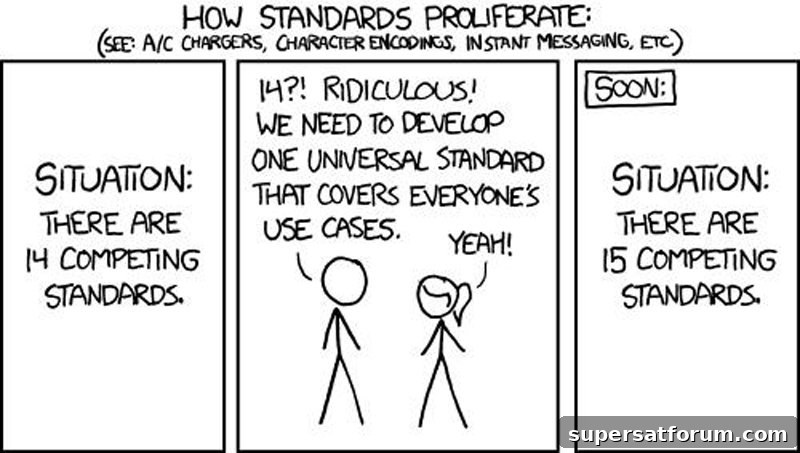
Open standards are intended to bring traditional competitors together to advance their industry, reduce confusion, and deliver a smoother experience for end users. Unfortunately, confusion about the standards themselves often prevents that ideal collaboration from taking shape.
Imagine if each country still had multiple incompatible power sockets, and every device required a different outlet. The result would be chaos. This article stems from frustration with the many Internet of Things (IoT) standards circulating today—each one representing a different “hole in the wall.”
As an editor for cloud, telecoms, and developer publications, my inbox is constantly filled with announcements about new standards and the companies backing them. Right now I count eight active initiatives, and I expect that number to rise to nine or ten by the end of the week.
When major players like Intel, Samsung, or Qualcomm back a standard, they need to choose one and commit to it until it succeeds or fails. The industry looks to these companies for leadership. Supporting multiple competing standards makes a company appear indecisive and weak.
Instead of pushing the industry forward, you are holding it back.
Just over a week ago I wrote about a new IoT alliance, the Open Interconnect Consortium (OIC). That group includes Broadcom, Intel, Dell, Samsung, Atmel, and Wind River. The OIC aims to establish a widely adopted standard for device-to-device connectivity—an important and necessary goal.
Another significant contender is the AllSeen Alliance, whose members include Haier, LG Electronics, Panasonic, Qualcomm, Sharp, Silicon Image, and TP-LINK. Those are substantial industry names as well. Which standard should the market rally behind? At least if membership didn’t overlap, the choice would be simpler.
Yesterday Nest (now owned by Google) announced Thread, another standard intended to become the preferred choice for IoT connectivity. One of Thread’s major partners is Samsung—the same company that also supports the OIC.
This overlap is just one example among many instances where major companies back multiple, competing initiatives—and it’s not limited to IoT. If I were placing a bet today, I’d favor Thread as a likely winner. Thread is already deployed in Nest thermostats, enjoys backing from Google and Samsung, and was designed specifically for IoT, supporting mesh networks of more than 250 devices if needed.
As Jim McGregor, a technology analyst at Tirias Research, observed: “Google is an 800‑pound gorilla. With their impact on the ecosystem, they could definitely influence the direction the industry goes.”
The Thread group plans to open membership to additional organizations later this year and will begin offering device certification in 2015.
Which of the current open IoT standards would you choose? Share your opinion in the comments.
To learn more about the Internet of Things, consider attending IoT Tech Expo Europe at London’s Olympia, 2–3 December 2015.