
Companies around the world are investing heavily in AI agents to automate workflows, improve decision-making and relieve employees. But as the technology matures, it is becoming increasingly clear that AI agents also create growing pains. Without coherent systems, they risk adding complexity rather than delivering business value.
This is the finding of a global survey by Salesforce, which interviewed 1,050 IT leaders. Nine out of ten said that AI agents risk creating more work than value if they are not properly integrated into the organization’s IT environment.
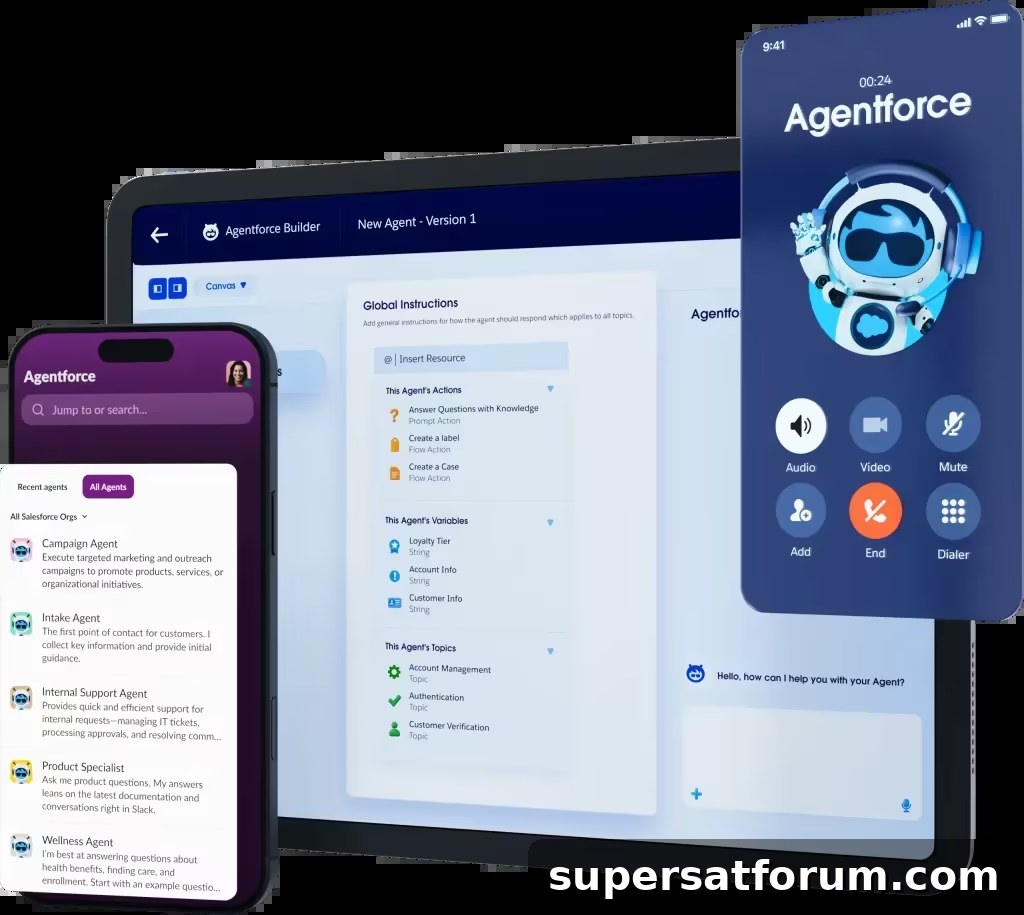
Broad use of AI agents, but often in isolation
Adoption is moving fast. Four in five IT leaders report they are already using AI agents widely across their organizations. On average, companies have around twelve AI agents in production.
At the same time, the survey shows that many of these agents operate in isolation. Half of the agents currently lack connections to other agents or to central data sources. Only 54 percent of IT leaders say they have a common governance and orchestration framework for AI agents.
That means the agents’ potential is limited despite high technical ambition.
Security and skills slow scaling
When IT leaders identify the biggest barriers to scaling AI agents, regulatory compliance and security top the list at 42 percent. Nearly as many point to a shortage of skills in AI and agent design as a decisive obstacle.
Together, these findings indicate that AI agents are no longer an experimental tech project but a structural challenge requiring governance, expertise and clear architectural choices.
Fragmented IT landscapes are the root cause
One clear explanation for the problems is the complexity of corporate system landscapes. On average, organizations use 960 different applications, yet less than a third of these are integrated.
Almost all IT leaders in the survey report difficulty getting systems to work together. The result is slow workflows, duplicated effort and AI agents that lack access to the data they need to create value.
A Swedish perspective from Salesforce
Jennifer Matheny, who leads Data Foundations at Salesforce in Sweden, recognizes the survey’s findings in her work with Swedish organizations.

“Success is not determined by how many agents or applications you have. It depends on how well the agents work together. AI agents deliver value only when they are connected to corporate data and effective workflows,” says Jennifer Matheny.
She notes that many Swedish companies still struggle to establish basic system integration.
“Companies need better order in how their systems connect. Otherwise processes become slow and work is duplicated unnecessarily,” she says.
At the same time, she sees a clear shift in the right direction.
“More organizations are investing in API-driven architectures that make it easy to link systems and share information. That enables governance and coordination of AI agents at scale,” Matheny adds.
The US and Asia lead Europe
The survey also reveals geographic differences. In the US, 48 percent of IT leaders report using AI agents in their operations. The equivalent figure in Europe is 35 percent, while Asia stands at 41 percent.
Differences appear across company sizes as well. Among medium and large US firms, 48 percent have implemented AI agents compared with 33 percent in Europe.
Large differences between industries
In Europe, the technology and media sectors lead with an adoption rate of 55 percent. The public sector follows closely at 52 percent, showing that AI agents are no longer confined to private industry.
Adoption is slowest in retail, where only 12 percent have AI agents in place. The financial sector is also relatively low at 21 percent, but rapid growth is expected: 58 percent of financial firms plan to implement AI agents within the coming year.