Amazon has announced that the first full operational flight of its Project Kuiper satellite constellation is scheduled for launch this month. The mission, designated KA-01 (Kuiper Atlas 1), will carry 27 satellites to low Earth orbit as Amazon moves into large-scale satellite broadband deployment.
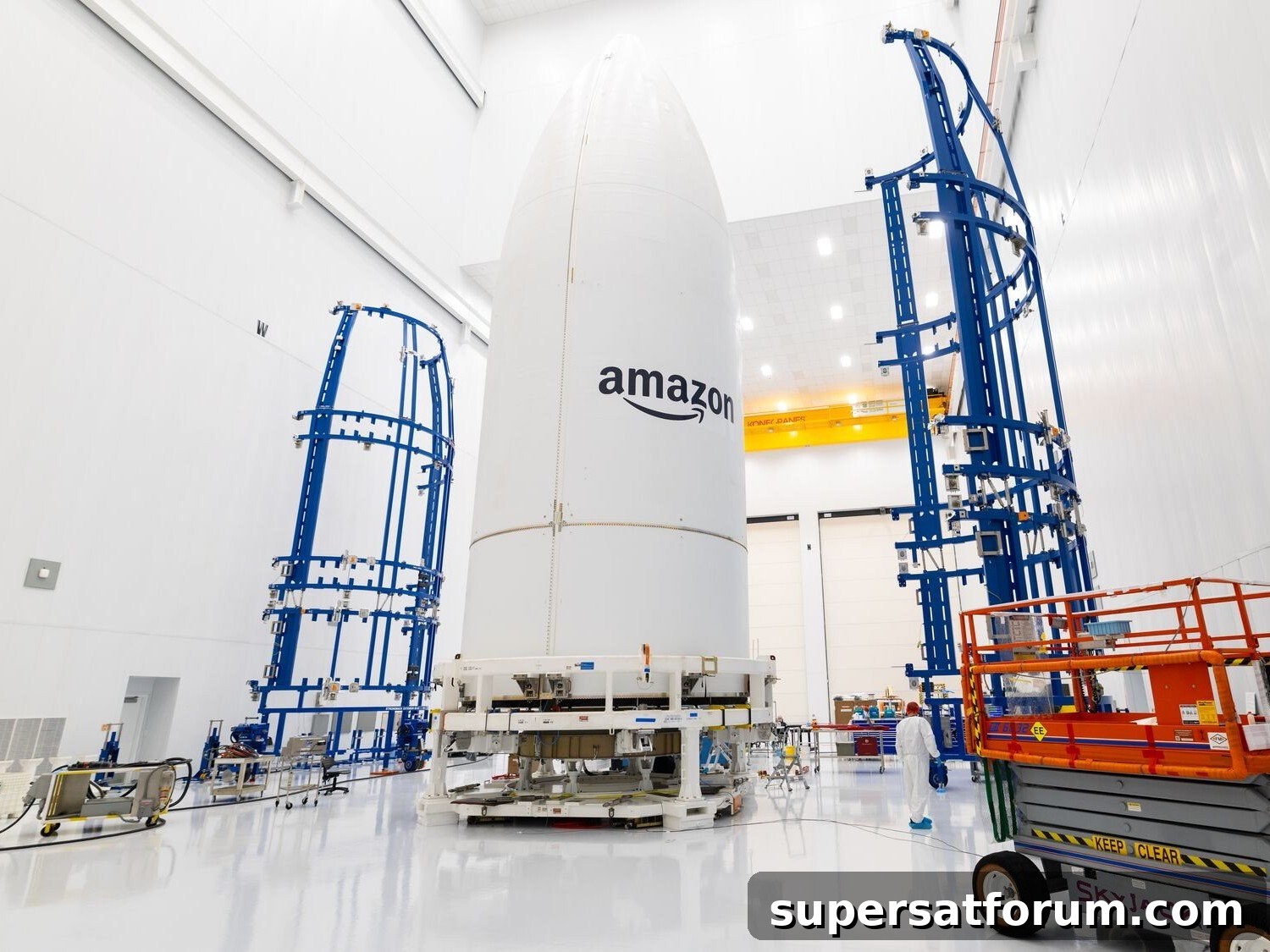
The KA-01 launch is planned for April 9, with liftoff no earlier than 12:00 p.m. EDT from Cape Canaveral Space Force Station in Florida. United Launch Alliance (ULA) will provide an Atlas V rocket in its most powerful configuration to deliver the payload to an altitude of roughly 280 miles (450 kilometres). The Atlas V for this mission will include five solid rocket boosters and a large payload fairing measuring approximately 77 feet (23.5 metres) tall and 16.4 feet (5 metres) wide to accommodate the satellite stack.
This mission represents a major milestone for Project Kuiper, Amazon’s initiative to build a global, low-latency broadband network from a first-generation fleet of more than 3,200 advanced low Earth orbit (LEO) satellites. Amazon expects initial customer service from the Kuiper network later this year as launches, production, and deployment scale up.
Amazon has contracted more than 80 launches for the initial constellation build-out. In addition to multiple Atlas V missions with ULA, the company plans further deployments using ULA’s Vulcan Centaur rocket and additional launches from other providers. Over the coming years Amazon anticipates dozens more launches from partners including Arianespace, Blue Origin, and others to complete the initial Kuiper footprint.
“We’ve designed some of the most advanced communications satellites ever built, and every launch is an opportunity to add more capacity and coverage to our network,” said Rajeev Badyal, vice president of Project Kuiper. Extensive ground testing has taken place ahead of KA-01, but this flight will be the first time Amazon will fly its final satellite design and deploy a large group of production satellites at once. The flight will validate multiple systems and provide operational data that will guide subsequent launches.
KA-01’s 27 satellites include numerous upgrades over Amazon’s two prototype satellites tested during the Protoflight mission in October 2023. Improvements span phased-array antennas, onboard processors, solar arrays, propulsion systems, optical inter-satellite links, and other subsystems designed to boost performance and interoperability across the constellation.
To reduce impact on astronomical observations, each production Kuiper satellite features a custom dielectric mirror film coating developed by Amazon. That surface treatment is intended to scatter reflected sunlight and reduce the satellites’ visibility to ground-based telescopes—an important consideration for satellite operators and the astronomy community alike.
Once the KA-01 satellites separate from the Atlas V, the Kuiper operations team in Redmond, Washington will assume control from ULA’s Advanced Spaceflight Operations Center at Cape Canaveral. Each satellite is designed to perform automated activation steps, establish communications, and use electric propulsion to raise itself to its operational altitude near 392 miles (630 kilometres). In that final orbit the satellites will travel at more than 17,000 miles per hour (about 27,359 km/h), completing an orbit roughly every 90 minutes.
The primary goal of KA-01 is to verify safe deployment, independent maneuvering, and reliable communications between the satellites and ground operations. While orbit raising proceeds, the Project Kuiper team will focus on end-to-end network validation—ensuring data can travel from ground infrastructure to the internet, up through the satellites, and down to customer terminals and back.
Following KA-01, Amazon plans to accelerate satellite production, processing, and launch cadence to support the start of customer service. The company has already begun processing satellites for the next mission, KA-02, which will also launch on a ULA Atlas V from Cape Canaveral.
ULA will provide live launch coverage for the Kuiper 1 mission, with a webcast typically beginning roughly 20 minutes before liftoff to give observers and industry watchers real-time updates as this potentially historic deployment unfolds.
(Image credit: Amazon)
If successful, KA-01 will mark the start of Amazon’s large-scale operational rollout for Project Kuiper, a program designed to expand global broadband access by delivering low-latency internet to homes, businesses, and communities that are underserved by terrestrial networks. The company’s staged approach—iterative launches, in-orbit testing, and gradual service activation—aims to ensure reliability and scalability as the constellation grows.