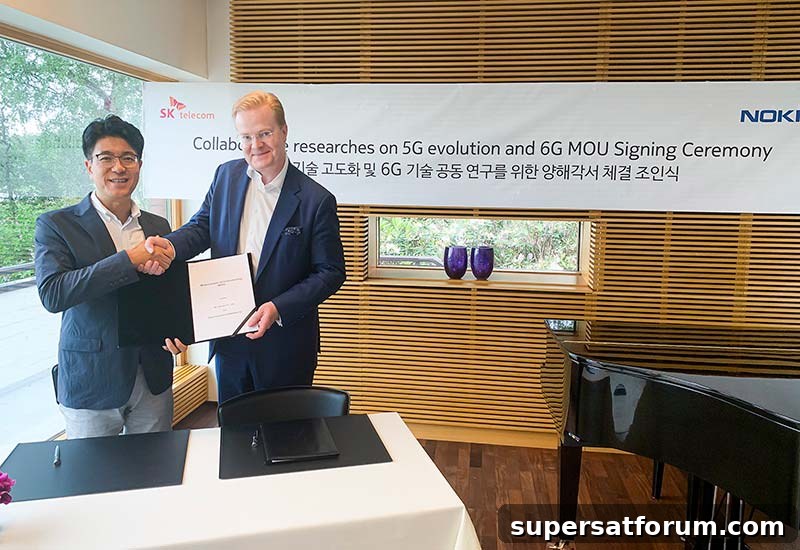
Rival vendors Nokia and Ericsson have set aside their competition to partner with SK Telecom on collaborative 6G research.
Although 5G deployments are still gaining momentum, companies and researchers are already exploring what the next generation of mobile networks might look like.
“Collaboration between companies like this will be important as the technology and standard for 6G networks is yet to be clearly defined,” SK Telecom said, emphasizing the need for joint efforts to shape future standards and capabilities.
SK Telecom is widely regarded as one of the world’s most innovative operators. While details vary by report, SK Telecom — alongside South Korean peer KT — is often credited with activating one of the first commercial 5G networks.
A partnership that brings together an inventive operator and two of the leading telecom equipment manufacturers merits attention, as it can accelerate research and practical trials that influence global standards.
Beyond 6G, the partners will research several critical topics intended for commercial deployment, including Ultra-Reliable Low-Latency Communications (URLLC), distributed Multiple Input Multiple Output (MIMO) techniques, applying Artificial Intelligence (AI) within network operations, work in the 28 GHz band, and enhancements to 5G Stand-Alone (SA) architectures.
Earlier this month, reports noted that Samsung has also launched 6G research at its Advanced Communications Research Center in Seoul. Samsung expanded its telecommunications technology team to begin leading 6G-focused studies, signaling widespread industry interest in the next-generation roadmap.
Industry experts have suggested potential peak data rates around 1 Tbps for 6G. While most current applications don’t require such extreme throughput, the timeline between generations (for example, roughly the gap between 4G and 5G) means demand and new use cases could emerge within several years.
Samsung’s early investment in 6G research may reflect a strategy to secure influence and innovation ahead of larger vendors. However, the newly announced collaboration between Nokia, Ericsson, and SK Telecom shows that long-standing suppliers remain committed to shaping and defending their positions in future network technologies.
This cooperative approach combines operator experience with vendor expertise to address technical challenges, accelerate field testing, and contribute to international standardization efforts that will determine how 6G evolves and is adopted worldwide.