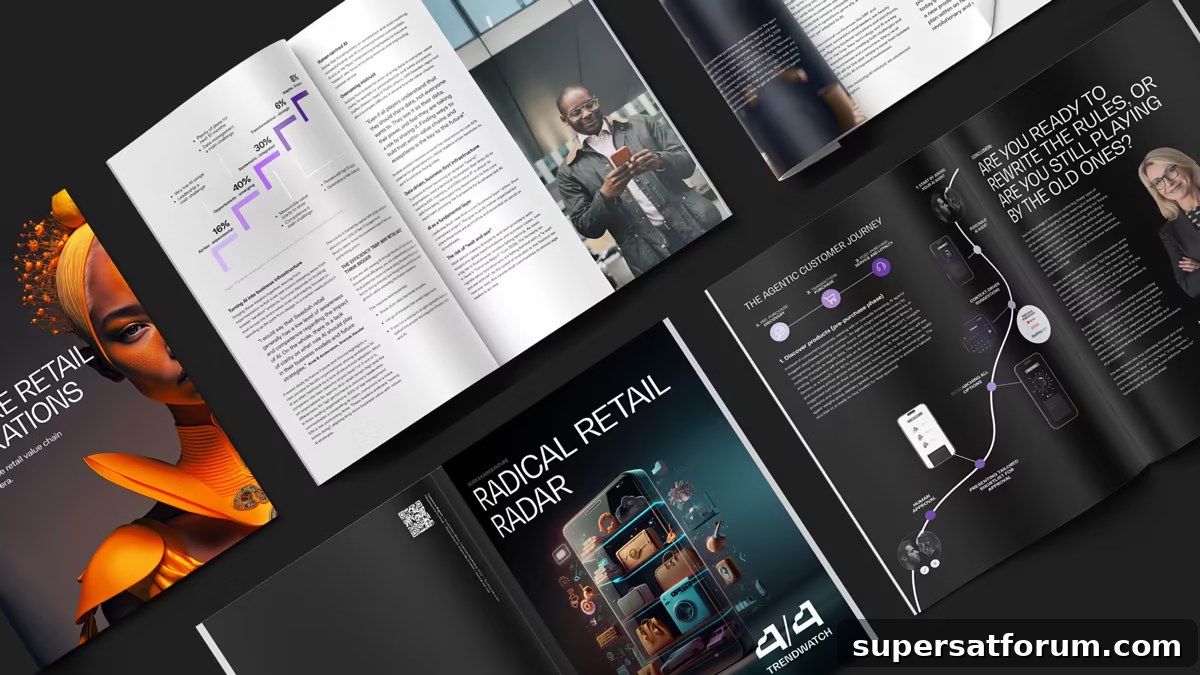
Radical Retail Radar is the latest edition in Nexer’s recurring report series on retail development, produced together with Kairos Future and leading industry experts. This edition focuses on a shift that goes beyond the digitalisation we know—where AI is no longer a parallel tool but an integrated part of how retail businesses operate.
The report describes how the retail industry is moving away from traditional e‑commerce toward what is increasingly called agentic commerce, where AI plays a greater role throughout the customer journey—from product discovery to purchase decisions. Leading global players are embedding AI at the core of their operations, transforming everything from product development and sourcing to logistics, customer interaction and decision making.
At the same time, many Nordic companies remain in an exploratory phase. While global players build AI into their business models, the Swedish market is still largely characterised by pilot projects and isolated initiatives.
“What is changing now is not only how we sell, but how decisions are made. As customers increasingly rely on AI to choose and compare, companies must rethink how they build relevance, trust and value propositions,” says Sofie Bergbom, Retail Industry Partner at Nexer.

As the technology matures, competition shifts. When AI agents can search, compare and select options in seconds, the value of mere visibility declines while demands for relevance, availability and trust increase.
Three decisive shifts shaping retail right now:
1. From customer journey to decision engine
The customer journey is being redesigned at a fundamental level. AI agents increasingly search, filter, prioritise and in some cases complete purchases. For companies, this means communicating not only with customers but also with AI proxies acting on their behalf.
2. From organisation to flow
Traditional silos are challenged as data connects in real time. Design, purchasing, logistics and sales—previously separate functions—are becoming parts of a cohesive, data‑driven flow.
3. From efficiency to repositioning
AI is no longer used solely to streamline existing processes. Leading companies use the technology to reshape how value is created—from personalised experiences to predictive decisions and entirely new business models.
A central conclusion of the report is that many organisations still treat AI as a technical initiative rather than a strategic imperative. That creates a widening gap between companies rebuilding their operations with AI as the foundation and those continuing to optimise legacy models.
“Many still try to layer AI on top of what they already have. Real impact appears only when AI is embedded in the core of the business—within data, flows and decision‑making. That’s when initiatives evolve into true transformation,” says Maria Wahlgren, Retail Industry Partner and Future & AI Strategist at Nexer.

This development places new demands on leadership. Waiting or limiting AI to isolated projects risks making an organisation irrelevant in a rapidly changing landscape.
About Radical Retail
Radical Retail is a four‑part report series that tracks developments in retail with a focus on the industry’s future and technology. The report was produced by Nexer with support from Kairos Future and industry experts, aiming to highlight the most important trends in retail and how they will shape the future. The series is intended as a practical guide for retail actors to help them navigate a changing environment.
About Nexer:
Nexer Group is an international technology company rooted in Swedish entrepreneurial spirit and innovation. Nexer has 2,450 experts across 16 countries and is part of the Danir group, a privately owned Swedish company with 9,500 employees in 31 countries. Nexer works with some of the world’s largest and most demanding companies, offering expertise in digital transformation, IT, technology and R&D.