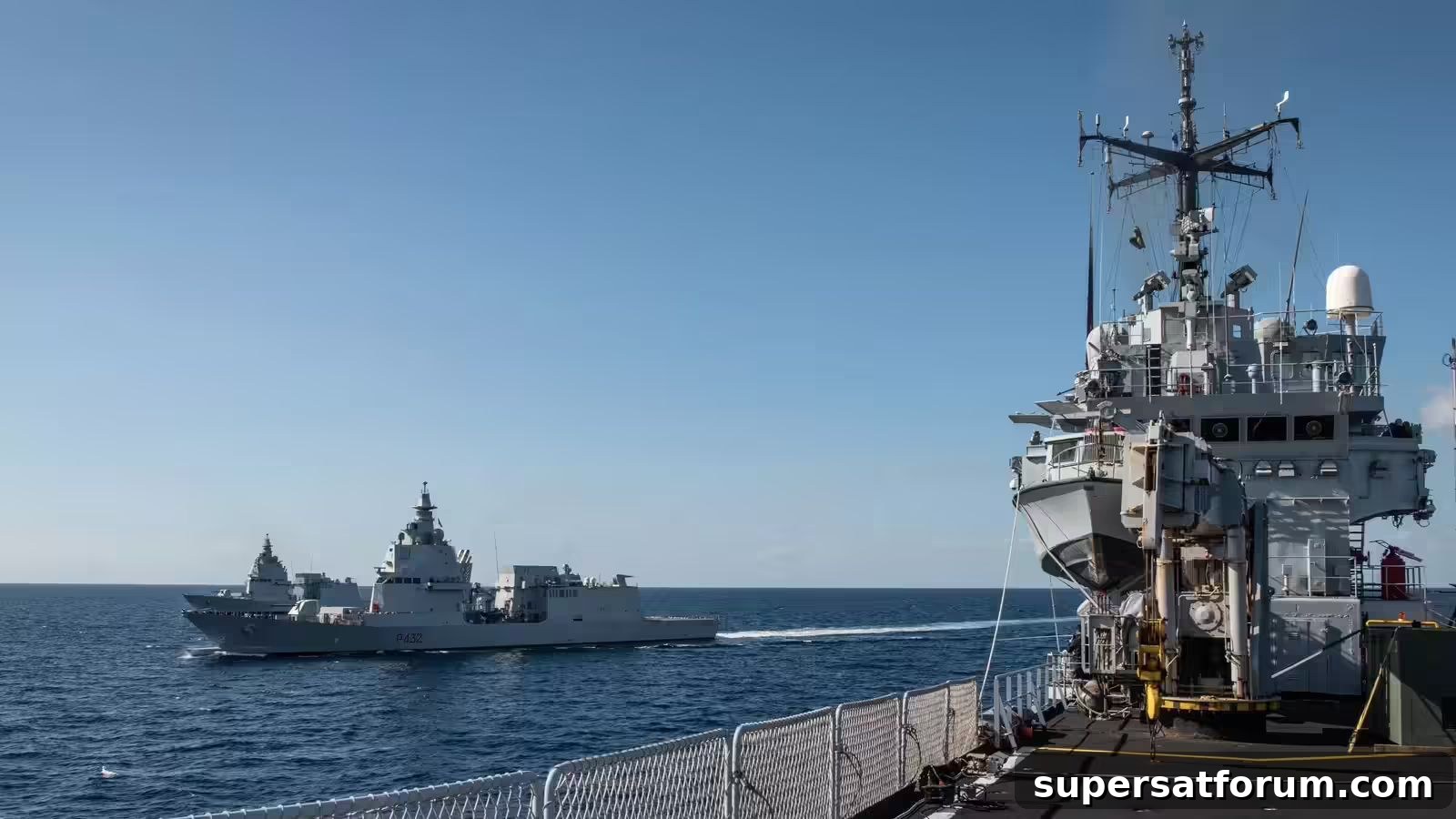
Defence company Leonardo and Ericsson have validated 5G Standalone (5G SA) capabilities for maritime operations following a joint trial with the Italian Navy. The objective was to evaluate how commercial cellular architectures can be integrated into defence and industrial environments where reliable connectivity is often challenged by harsh conditions or interference.
The trial generated practical data on deploying private networks in non-terrestrial settings. A full end-to-end 5G Standalone network was deployed aboard active naval vessels to measure throughput, latency, resilience, and encryption in a realistic maritime environment.
Using 5G SA for maritime infrastructure
The project required a dedicated private network at sea. Ericsson installed a self-contained 5G SA solution, including its Ultra Compact Core and Massive MIMO Radio Access Network, on the San Giorgio amphibious landing ship, which acted as the primary network node.
To assess range and client performance, Ericsson also fitted 5G SA customer premises equipment (CPE) on the Raimondo Montecuccoli multi-purpose combat ship. This configuration enabled the two vessels to communicate independently of satellite links or shore-based infrastructure during open-sea exercises.
Engineers tested whether 5G SA could handle modern naval data demands. The network supported real-time exchange of both classified and unclassified information and maintained situational awareness through integration with the Combat Management System.
Bandwidth trials included video feeds from 12 unmanned systems. These feeds were processed by an AI platform, which required consistent low-latency throughput. Leonardo provided the security layer using its NINE encryption solution to protect data traversing the Ericsson network.
Beyond raw speed, the maritime 5G SA trial examined spectrum management. Naval vessels often operate multiple isolated communication systems on unlicensed bands, increasing the risk of interference. The Operational Experimentation (OPEX) demonstrated that a unified 5G network can better optimise spectrum usage compared with separated legacy systems.
Such consolidation may offer a practical model for industrial maritime sectors—such as shipping logistics and offshore energy—where interference and fragmented communications are common challenges.
Operational context
Patrick Johansson, SVP and Head of Ericsson Europe, Middle East and Africa, said the Italian Navy is seeking optimal connectivity solutions and that Ericsson is proud to support that goal. He noted Italy’s central Mediterranean location and an exclusive economic zone that covers more than 500,000 square kilometres of sea, underlining the Navy’s strategic importance in the region.
The work is part of the 5G COMPAD project, and results were presented during the Italian Navy’s OPEX 2-25 exercises in the Gulf of Taranto. It follows previous maritime collaborations between Ericsson and the Italian Navy, including 2024 NATO trials where a 5G SA network was deployed at the Taranto naval base.
Freddie Södergren, Head of Mission Critical Networks at Ericsson, described the trial with Leonardo and the Italian Navy as a significant milestone in advancing defence capabilities through 5G. He emphasised that Ericsson’s 5G platform is designed to meet the rigorous demands of mission-critical operations and that the collaboration demonstrates the versatility of dual-use 5G for enhancing naval communications and operational effectiveness at sea.
The validation indicates private 5G SA networks can now support mission-intensive applications in offshore maritime environments. For operators, the ability to manage high-definition video and encrypted data streams between moving nodes without relying on fixed infrastructure provides a viable alternative to legacy radio and satellite options.
See also: Private 5G networks are increasingly being explored to address challenges around space, power and spectrum when extending connectivity into specialised environments such as ships, offshore platforms and other remote operations.
Want to learn about the IoT from industry leaders? The IoT Tech Expo brings together practitioners and vendors across Amsterdam, California and London, and is co-located with events covering AI, big data and cyber security. The series offers briefings, case studies and demos focusing on practical deployments and emerging technologies.
Telecoms coverage is produced by TechForge Media. Explore other enterprise technology events and webinars hosted by the publisher for additional insight into networking, security and industrial digitalisation.