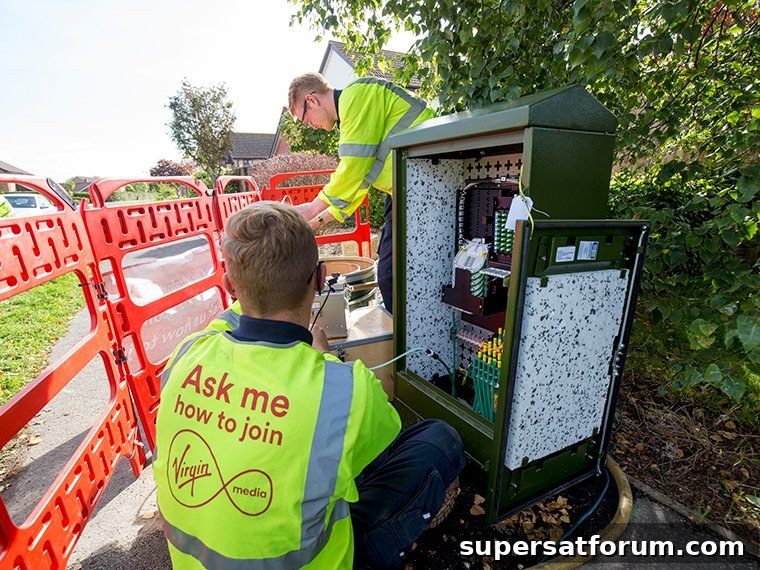
Virgin Media has committed to upgrading its entire UK broadband network to full-fibre by 2028.
Today, the operator’s infrastructure mainly uses Hybrid Fibre Coax (HFC) technology, with some Fibre-to-the-Premises (FTTP) implemented via Radio Frequency over Glass (RFoG). The network is currently being upgraded to support the DOCSIS 3.1 standard, a process due to complete by the end of this year. DOCSIS 3.1 enables much higher peak theoretical download speeds—up to 10 Gbps—and upload speeds around 1.5 Gbps.
Looking ahead, Virgin Media faces a strategic choice: invest in DOCSIS 4.0, which would substantially boost upstream capacity to around 6 Gbps, or transition entirely to full-fibre FTTP across its footprint.
Last year, Mike Fries, CEO of Liberty Global, Virgin Media’s parent company, explained the options:
“When we look at our networks, we’ve got a couple of ways to get there with DOCSIS 4.0, where we would fall right in line with the US operators, Charter and Comcast, both of whom would be pursuing a strategy like that.
And we could also use FTTP, CSPON, where we have, we think, the economics to support that kind of roadmap to 10G.”
Upgrading from DOCSIS 3.1 to 4.0 would be neither cheap nor instantaneous compared with the recent jump from 3.0 to 3.1, but it could be less invasive and faster to deploy initially than a full FTTP replacement. Still, Virgin Media argues the long-term economics favour FTTP because a fibre network reduces the need for future upgrades to successive DOCSIS standards.
The company estimates the incremental cost of extending FTTP will be roughly £100 per premise passed, while DOCSIS 4.0 upgrades are estimated around £60 per premise. Despite the higher initial pass cost, Virgin Media expects FTTP to deliver better lifetime value by removing the need for further cable-technology upgrades.
Currently, around 1.3 million homes have access to Virgin Media’s full-fibre service. By 2028, the operator expects to cover approximately 14.3 million homes with FTTP. Virgin Media highlights that FTTP is capable of delivering symmetrical 10 Gbps download and upload speeds and can scale beyond that as demand grows.
For context, BT has set an ambitious target of reaching 25 million premises with full-fibre by 2026—around 10.7 million more than Virgin Media’s goal and two years earlier. Nevertheless, Virgin Media’s expanding DOCSIS 3.1 network currently offers gigabit and near-gigabit connections that, in many areas, are faster than the speeds most customers receive from existing BT services.
Lutz Schüler, CEO of Virgin Media O2, commented on the initiative: “Our mission is to upgrade the UK, and we are doing exactly that. This major new fibre upgrade programme will see us begin the next evolution of our network, building on the investment, firepower and leadership we already have and ensuring we’re fibre fit for the future.”
He added: “Right now, we have the UK’s leading gigabit network, and this upgrade means we’ll be even stronger for the decades ahead, pursuing new opportunities and putting words into action.”
(Image Credit: Virgin Media)
Find out more about Digital Transformation Week North America, a virtual event and conference exploring advanced digital transformation strategies, taking place on November 9–10, 2021.