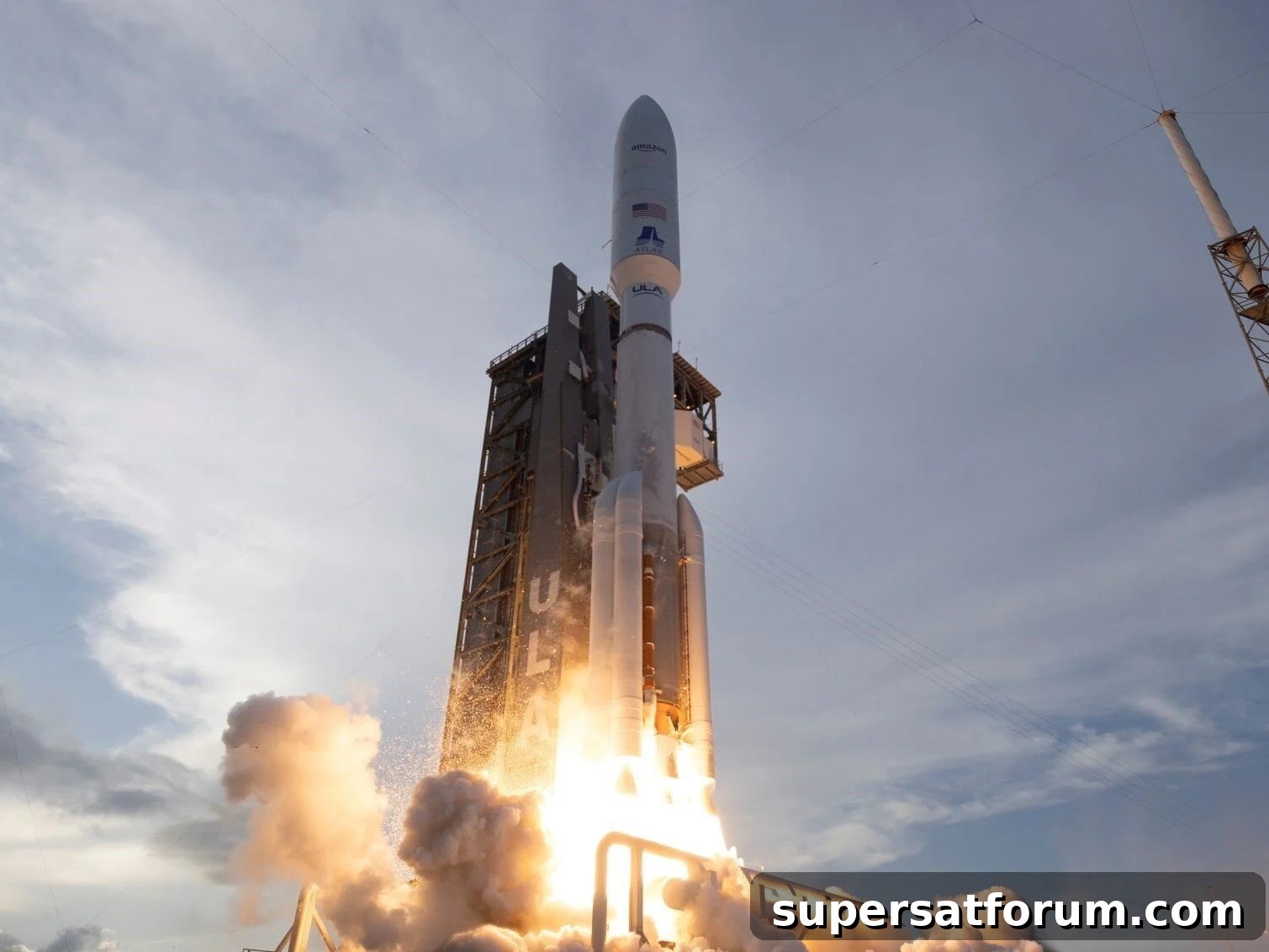
A new chapter in satellite internet services began yesterday as a United Launch Alliance (ULA) rocket deployed satellites for Amazon’s Project Kuiper.
The launch took place at 7:01 p.m. Eastern Daylight Time (EDT) on April 28 from historic Launch Complex 41 at Cape Canaveral Space Force Station, marking the start of the full-scale deployment phase for Amazon’s planned low-Earth orbit (LEO) constellation.
This mission represents more than another successful flight for the veteran Atlas V rocket; it also signals the operational beginning of one of the largest commercial space partnerships ever arranged. Amazon has contracted ULA to deliver a substantial portion of its planned LEO constellation, which is intended to provide high-speed, low-latency broadband internet to communities around the world that currently lack reliable service.
After the successful launch and testing of two prototype satellites—Kuipersat-1 and Kuipersat-2, which flew in October 2023—this Kuiper-1 mission starts the complex work of building out the operational network.
Amazon plans to deploy more than 3,200 satellites in LEO over the coming years, placing Project Kuiper in direct competition with existing megaconstellation services such as SpaceX’s Starlink and Eutelsat OneWeb.
Gary Wentz, ULA’s vice president of Government and Commercial Programs, said this launch is a significant milestone in Amazon’s effort to bring fast, reliable broadband to unserved and underserved communities worldwide. He noted that ULA has worked closely with the Project Kuiper team to place this mission into orbit and expressed appreciation for continuing the partnership.
The collaboration between Amazon and ULA is extensive. Beyond this initial Atlas V flight and seven more missions planned with the same vehicle, Project Kuiper will rely heavily on ULA’s next-generation launcher, Vulcan Centaur.
Amazon has secured 38 launches aboard Vulcan, assigning ULA the task of deploying more than half of the full Kuiper constellation. This commitment represents the largest commercial launch agreement by number of missions in history and highlights both the scale of Amazon’s ambitions and ULA’s central role in achieving them.
To support the demanding launch tempo, ULA has been upgrading its Cape Canaveral facilities. These improvements are intended to increase processing capacity and enable more rapid turnaround between missions.
Tory Bruno, ULA’s president and CEO, explained that the company has been steadily modifying launch infrastructure at Cape Canaveral to support Project Kuiper missions in ways that will benefit both commercial and government customers. He added that the addition of a second launch processing capability enables dual, simultaneous processing between integration facilities.
This enhanced capacity will be important as ULA balances its commitments to Project Kuiper with its long-standing role as a trusted launch provider for U.S. national security missions. For more than two decades, ULA has launched critical defense and intelligence satellites—often to complex or high-precision orbits.
The development and introduction of the Vulcan rocket mark ULA’s expansion into the commercial LEO market. Vulcan’s modular design aims to offer flexible, efficient launch options for a range of customers, including large constellation deployments like Project Kuiper, while continuing to serve government requirements.
ULA sees this evolution as essential to maintaining its position in an increasingly competitive launch environment. The company plans to leverage its heritage and operational experience while embracing new commercial opportunities and further technological innovations.
(Image credit: ULA)
Looking to revamp your digital transformation strategy? Learn more about Digital Transformation Week taking place in Amsterdam, California, and London. The event is co-located with IoT Tech Expo, AI & Big Data Expo, Cyber Security & Cloud Expo, and other leading industry gatherings.
Explore upcoming enterprise technology events and webinars powered by TechForge.