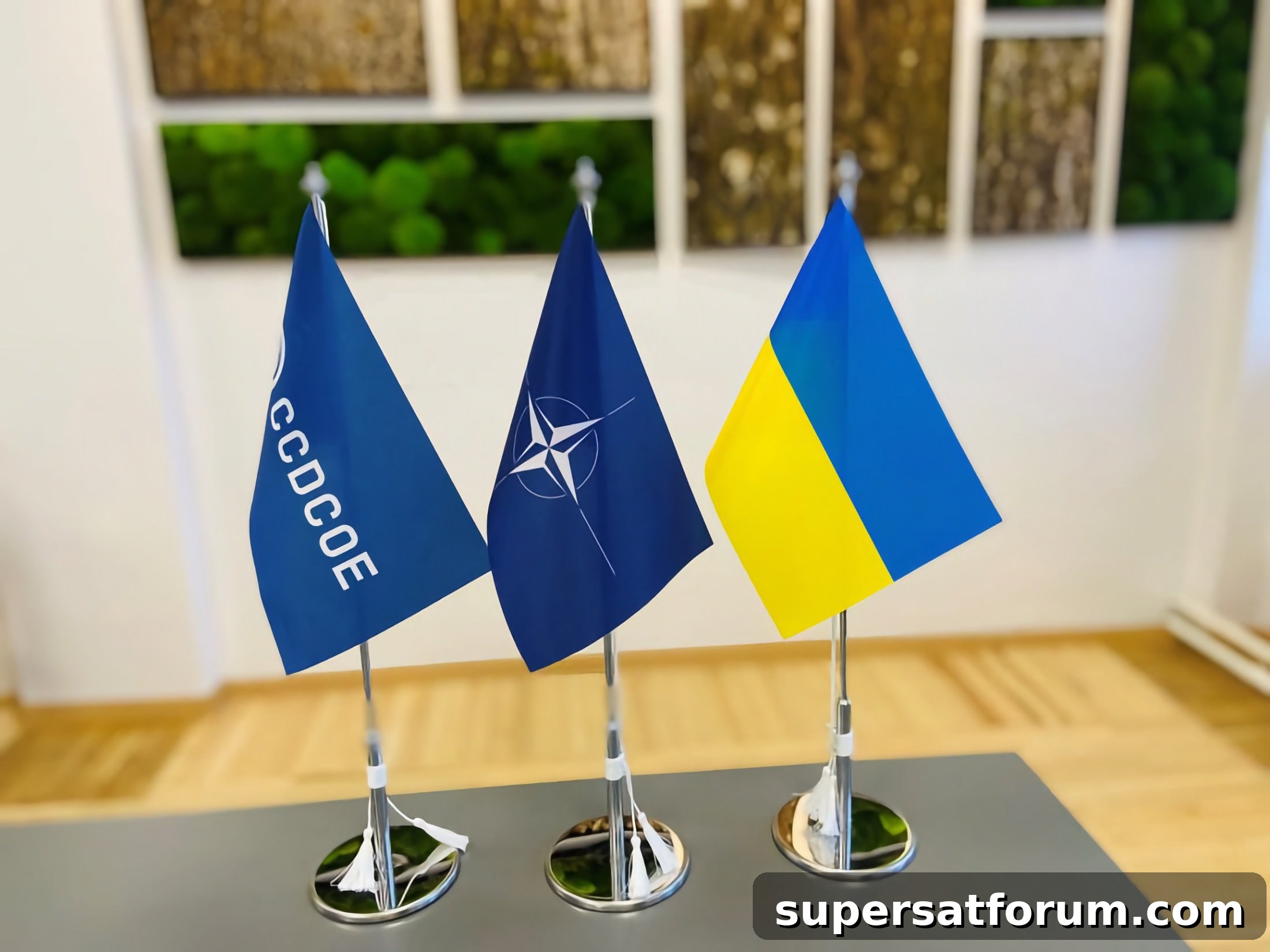
Ukraine has officially signed its accession to the NATO Cooperative Cyber Defence Centre of Excellence (CCDCOE).
Ukraine applied for CCDCOE membership in August 2021. On 4 March 2022, existing CCDCOE members unanimously voted to accept Ukraine into the organisation.
“We have been actively cooperating with the NATO Cooperative Cyber Defence Centre of Excellence for the last year,” said Yurii Shchyhol, Head of the State Special Communications Service of Ukraine.
“In November 2022, CCDCOE Director Mart Noorma and Head of International Relations Carolina Leis visited our Service to discuss our experience countering Russia’s cyber aggression, cyberspace risks to other countries, and several related topics.
“Last year, a Ukrainian delegation participated in a CCDCOE Steering Committee meeting for the first time. I hope our cooperation will strengthen further this year.”
CCDCOE members collaborate on cybersecurity issues but do not take on the same collective military commitments as full NATO members. CCDCOE membership does not confer the collective defense protections associated with Article 5.
The CCDCOE currently comprises 32 members: 27 are full NATO members and five are contributing nations that are not part of the broader defensive alliance.
Over the past year, four countries joined the CCDCOE: South Korea, Canada, and Luxembourg in May 2022, and Japan in November 2022.
Russia’s illegal, unprovoked invasion of Ukraine has prompted more countries to seek closer cooperation with NATO and its affiliated organisations.
Before this conflict, several NATO members fell short of the alliance pledge to spend at least two percent of GDP on defense. At the time, only five of the 30 NATO members met that target: the United States (~3.61%), Greece (~2.38%), the United Kingdom (~2.21%), Estonia (~2.16%), and Poland (~2%).
The invasion has pushed more NATO members to increase defense spending. Many now regard the two percent guideline as a minimum rather than a limit.
Additionally, Sweden and Finland—nations with long traditions of neutrality—have acknowledged the changing security environment and are in the process of joining NATO.
Ukraine’s membership in the CCDCOE will be valuable both for Ukraine and for the centre itself.
CCDCOE members will gain from Ukraine’s frontline experience in a conflict with Russia, a major source of state-linked cyber threats.
On the day Russia invaded, it launched a cyberattack against satellite operator Viasat to disrupt Ukrainian communications. That attack produced spillover effects that affected wind turbines in Germany.
For Ukraine, CCDCOE membership gives Ukrainian cybersecurity professionals access to international expertise and collaborative resources to better counter threats and limit the impact of successful cyberattacks.
(Image Credit: CCDCOE)
Interested in learning more about cybersecurity and cloud technologies from industry leaders? Consider attending Cyber Security & Cloud Expo, held in Amsterdam, California, and London.
Discover other upcoming enterprise technology events and webinars powered by TechForge here.