
We may be roughly halfway to 6G now that it’s 2025 and 5G was launched in 2020. For IoT, 4G was the starting signal, 5G enabled wider deployment, and 6G will eventually play its part. The term “The Internet of Things” (IoT) celebrated its 25th anniversary in 2024 — it is widely credited to British technology pioneer and computer scientist Kevin Ashton in 1999.
Despite its age as a concept, IoT continues to transform industries in innovative ways. The field is constantly evolving and has moved from a purely technical solution to a strategic necessity for businesses and organizations.
What’s happening in the IoT air?
To understand what’s unfolding in the air, we must identify the trends currently shaping the IoT space. Sustainability, security and artificial intelligence (AI) are central to IoT’s evolution and will define how we build a connected future.
AI thrives on data, and IoT produces massive volumes of it, making AI a natural partner for IoT analytics. Beyond analytics, AI can be a powerful tool to protect IoT systems against threats and vulnerabilities. AI’s role in IoT goes further than traditional data analysis — in some cases AI is becoming an integrated part of IoT devices themselves, enabling simple devices to make smarter local decisions and influencing how networks must evolve.
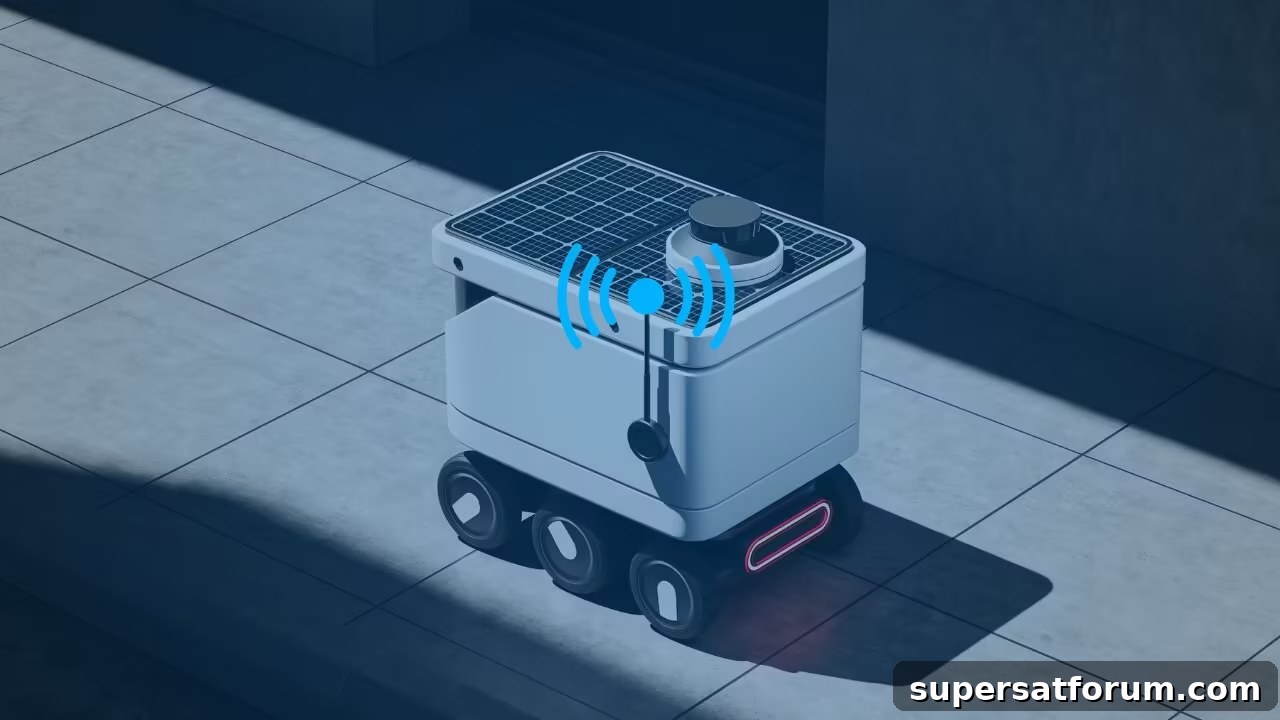
Edge data handling
Edge computing or edge processing addresses the limitations of centralized cloud solutions. By processing data close to the source, latency is minimized — crucial for applications that require uninterrupted operation and fast response times, such as autonomous vehicles or industrial automation where high reliability and resiliency are essential. Edge computing also improves energy efficiency by reducing the need for long-distance data transport. On the other hand, edge-capable devices typically consume more power than sensors that only measure and forward data, which can make long battery life harder to achieve. While many still associate battery-powered IoT sensors with decade-long battery lives and LPWAN (Low Power Wide Area Network) profiles, that view may change as edge and AI capabilities are integrated into devices.
It’s happening in the air
In 2025, many LPWAN technologies are moving into space. Non-terrestrial networks (NTN) — base stations flown in orbit — can cover remote and underserved areas worldwide. Both LoRaWAN and 5G already have satellite-capable deployments. From 3GPP Release 17, 5G can use satellites as RF repeaters without decoding packets, while Release 19 (not yet fully released) is expected to support satellites that receive and forward data packets. In 2025 it’s likely that other LPWAN RF technologies, such as Mioty, will also extend to space. Starlink is launching IoT services from satellites in 2025 using LTE CAT-1, CAT-1 Bis and CAT-4 technology, which can be considered LPWAN-class technologies though not strictly “low power.”
Security and AI are influencing how networks will evolve and increasing requirements across different technologies. At the same time, major technologies like 4G/5G and LoRaWAN appear to be converging in some respects.
5G RedCap — a new LPWAN contender?
On the terrestrial side, 5G RedCap (Reduced Capability) looks set to gain traction in 2025. RedCap sits in the middle: it isn’t the fastest and it isn’t the most power-efficient, but it delivers moderate throughput (around 150 Mbit/s) and is intended for more demanding sensor applications. RedCap could become the capacity layer that supports next-generation sensors requiring stable connectivity. It can operate on frequencies used by private 5G networks, where current 3GPP LPWAN technologies (NB-IoT and LTE-M) do not perform. RedCap offers low latency and solid transfer speeds, making it suitable for devices that process significant amounts of data locally, may run AI workloads, and must function in more demanding environments.
LoRaWAN
What about LoRaWAN? Cisco announced in late 2024 that it will exit the LoRaWAN market. From 2025 Cisco will no longer sell LoRaWAN products and support is scheduled to end by 2030. There is no planned migration path provided, which means organizations relying on Cisco’s LoRaWAN solutions must seek alternative suppliers to ensure continuity.
LoRaWAN is otherwise following broader IoT market trends, with plans for stronger encryption, easier firmware updates and local AI data handling. Many of these developments move LoRaWAN from a pure LPWAN profile toward devices with higher energy demand.
The LoRa Alliance’s roadmap also includes “crypto agility,” enabling current and future encryption methods to be layered onto LoRaWAN’s link layer without requiring structural changes. This ensures LoRaWAN can adapt to and implement new cryptographic techniques as they emerge, strengthening protection against future threats.
Supporting over-the-air firmware updates (FOTA) lets devices receive secure remote updates, reducing exposure to vulnerabilities. These enhancements underscore the industry’s focus on strengthening security protocols and protecting networks from 2025 onward. There is also ongoing discussion about integrating edge computing into the LoRaWAN architecture to boost performance and efficiency by handling data and decision-making closer to the source.
Open RAN — a more open network for future IoT
Could Open RAN be the next breakout technology? Open RAN is a network architecture that departs from proprietary, vertically integrated solutions where hardware and software are locked to a single vendor. Instead, Open RAN uses standardized interfaces and components so operators can mix and match hardware and software from different suppliers. The goal is to lower costs, increase flexibility and accelerate innovation in mobile networks.
Driven by bodies such as the O-RAN Alliance and supported by major vendors like Nokia, Ericsson and Qualcomm, Open RAN is expected to gain importance between 2025 and 2030. More operators are implementing the approach for 5G and future IoT deployments, especially in regions where cost-effective solutions are critical to expanding coverage.
For IoT, Open RAN opens the possibility of networks where technologies such as LoRaWAN and 5G not only coexist but also integrate more seamlessly. This enables new applications where different technologies must collaborate — from industrial IoT landscapes to smart cities.
Pilot projects and early implementations are already visible, particularly in areas that need affordable ways to extend network reach. As more network operators adopt Open RAN, it will create opportunities for interoperable and adaptable IoT networks that support diverse use cases.
2025 looks set to be an exciting year with a dynamic and shifting landscape. In many areas we’ll see development accelerate faster than previously anticipated, driven by the twin pressures of security and AI integration and by the move to extend connectivity beyond terrestrial bounds.