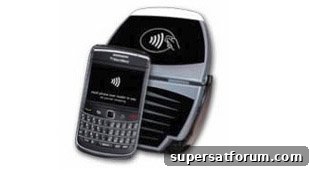
BlackBerry maker RIM has announced a partnership with Spanish telecom giant Telefónica to trial NFC mobile wallet technology across Europe.
While NFC payments are already widely adopted in parts of Asia, uptake in Western markets has been slow as the industry navigates competing interests among device makers, carriers, banks and retailers. Recently, however, several major players have begun making concrete moves to bring mobile payments to market.
This week’s announcement from RIM, detailing a collaboration with Telefónica to test a mobile wallet on BlackBerry devices, follows similar strides by other manufacturers and platforms: Nokia has said it will enable NFC across its phones, and Google has added NFC support to Android.
The trial will take place in Spain, where 350 Telefónica employees will use BlackBerry phones to make purchases from participating businesses near the company’s Madrid headquarters, including retailers, service stations and banks. Participants will also receive account balances and payment confirmations on their phones and use them to access secure areas within their offices.
If the pilot succeeds, Telefónica plans to launch a commercial “Wallet” service in 2012. The trial uses SIM-based NFC capabilities to give the operator a degree of control over transactions conducted on its network—a model designed to address carrier concerns about losing control of payments functionality.
That said, operators are not the only entrants. Google Wallet is already processing payments, and new services from non-carrier players have challenged the idea that operators would dominate the mobile-payments ecosystem. Independent research in the UK from Forrester and PayPal suggests that mobile payments could become commonplace within a few years.
“By 2016 we expect to see the real start of money’s digital transformation in the UK,” said Carl Scheible, Managing Director of PayPal UK. “Cash won’t vanish overnight, but consumers will increasingly use phones and other connected devices to pay both in stores and online. The boundary between online commerce and the high street will continue to blur. Children born today could be the UK’s first truly ‘cashless generation’—for them, paying by mobile will be second nature.”
Analysts at ABI Research have also suggested that if Apple incorporates NFC into the next iPhone, it could significantly accelerate consumer interest and market adoption. An entry from Apple would reshape the competitive landscape and might make earlier timelines for widespread adoption appear conservative.
Telefónica and RIM’s pilot highlights both the technical promise of NFC-enabled wallets and the commercial challenges that remain: aligning diverse stakeholders, securing transactions, and creating compelling consumer experiences. Trials like this one will be crucial to proving reliability, convenience and security—key factors that will determine whether mobile wallets move from niche trials to everyday use.
As manufacturers, carriers and service providers continue to test and refine NFC solutions, consumers can expect incremental rollouts and an expanding range of supported devices and services in the coming years. The pace of adoption will depend on partnerships, standards, and the consumer value delivered by mobile payment options.