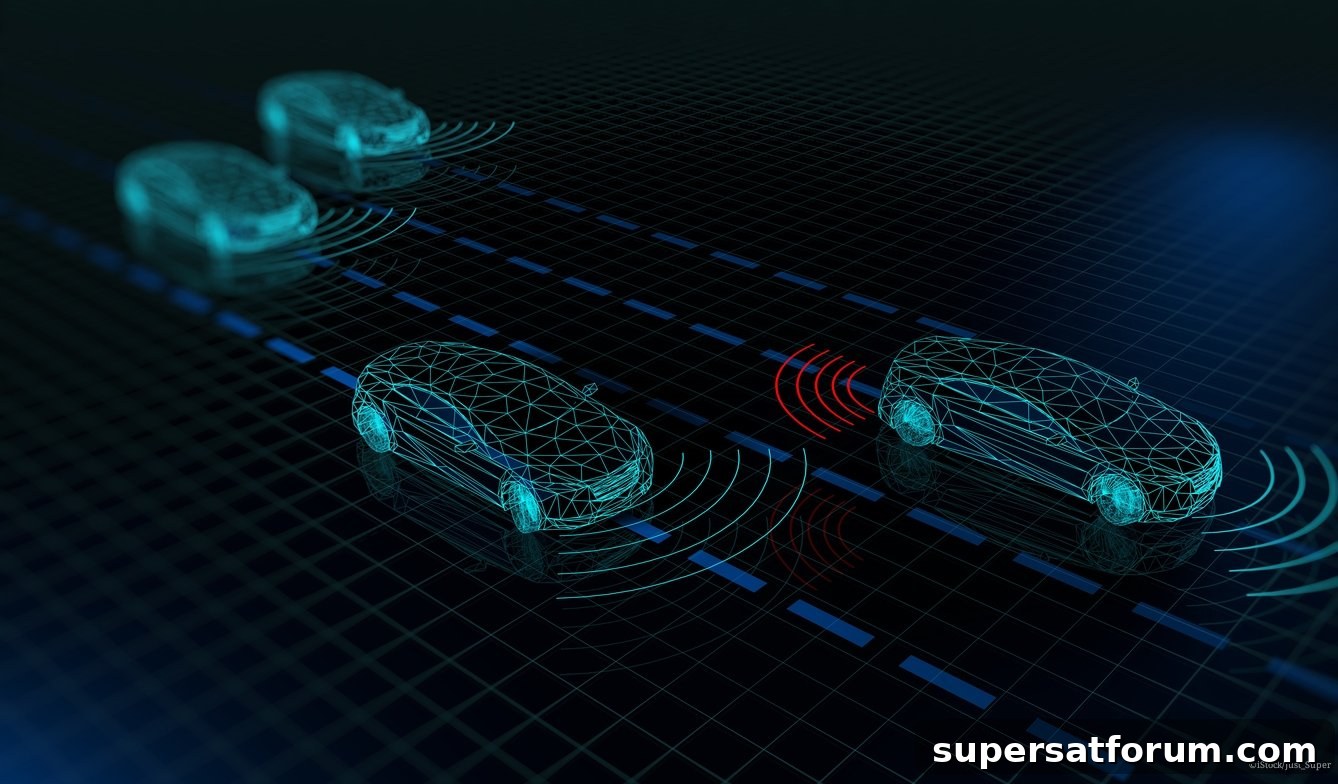
SK Telecom has successfully completed a 5G trial for driverless vehicles in collaboration with the Korea Transportation Safety Authority (KOTSA).
The trial involved two autonomous cars equipped with 5G and V2X (Vehicle-to-Everything) communication, sharing real-time traffic and safety information with each other and with a central control center. Combined with a high-resolution 3D HD map and deep-learning-based decision systems, this connectivity allowed the vehicles to navigate the test course safely and responsively.
The demonstration took place at K-City, a purpose-built self-driving vehicle test site in Hwaseong. The route spanned approximately 2 km and simulated realistic urban and highway conditions, including a school zone, a busy crossroads, and highway sections.
In the school zone scenario, the vehicles automatically reduced speed when entering the area. A life-size child mannequin was placed in the road to simulate a pedestrian hazard; a CCTV camera mounted on a streetlight detected the mannequin and sent an automatic stop message to the cars. The vehicles remained halted until the scene was clear. SK Telecom highlighted that the sub-1 millisecond latency of its 5G network is crucial for delivering such rapid warnings and preventing accidents.
On the highway segment, the system broadcast an alert about a multi-vehicle collision ahead. Upon receiving the warning, the car decelerated and changed lanes to maneuver safely through the affected area, demonstrating cooperative traffic awareness and dynamic route adjustment.
At the crossroads, both cars and the control center exchanged priority and positional data via 5G to coordinate passage through a congested intersection, deciding which vehicle should proceed first to maintain flow and safety.
“We will continuously enhance our 5G capabilities such as V2X and 3D HD mapping by leveraging the stability of our 5G network,” said Suh Sung-won, President of MNO Business at SK Telecom. “Through robust 5G technology, we will keep contributing to public safety by advancing the era of reliable self-driving.”
Last December, in collaboration with TS and Samsung Electronics, SK Telecom deployed a 28 GHz ultra-high-frequency 5G network across K-City, covering the facility’s entire 360,000 m² test area. That deployment provided the dense, low-latency connectivity required for the coordinated maneuvers and continuous monitoring demonstrated in the trial.
SK Telecom notes that this test represents the first coordinated run of multiple 5G-connected autonomous vehicles that monitored each other’s routes and shared real-time safety information throughout the exercise.
The company intends to roll out its 5G-enabled self-driving solutions on major national highways beginning in 2019, aiming to extend cooperative autonomous driving capabilities beyond controlled test sites.
What are your thoughts on SK Telecom’s latest driverless car trial? Let us know in the comments.