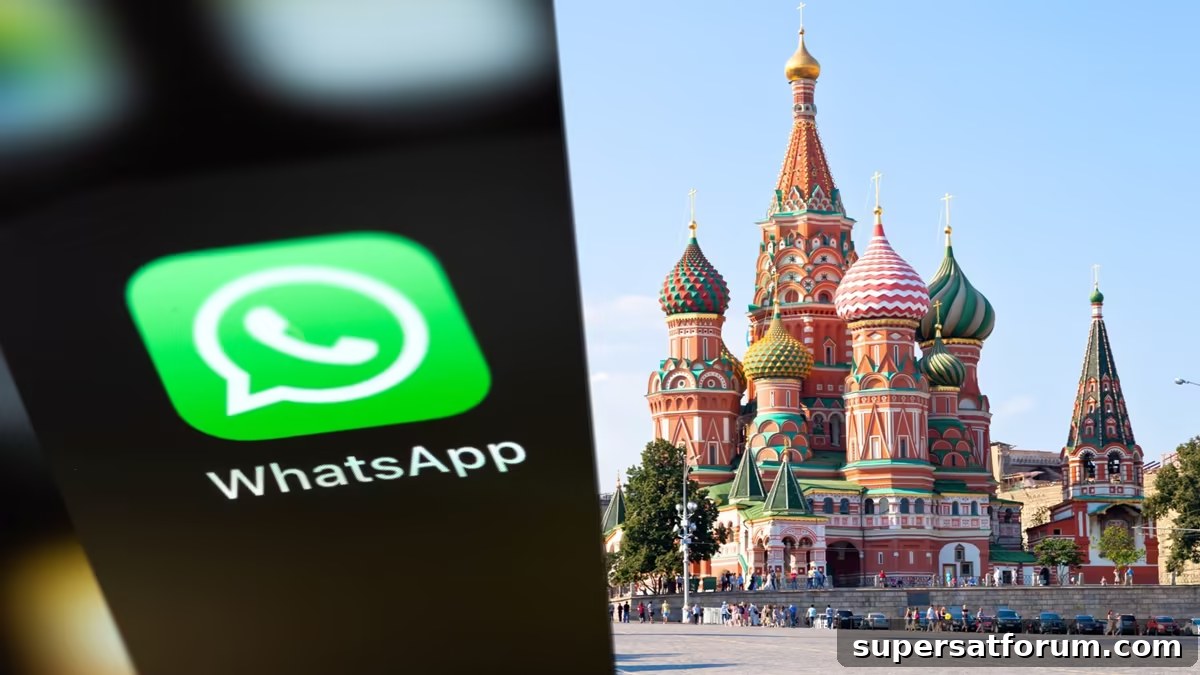
Russia blocks WhatsApp for over 100 million users in a move aimed at steering communication toward state-controlled platforms that pose broad surveillance risks. WhatsApp accuses the Russian government of attempting a nationwide block to push users toward a Kremlin-backed alternative.
In a statement on X, the Meta-owned service said Russian authorities had tried to isolate the country’s population from private, secure communication. According to WhatsApp, the action could severely weaken cybersecurity and undermine user privacy.
Today the Russian government attempted to fully block WhatsApp in an effort to drive people to a state-owned surveillance app. Trying to isolate over 100 million users from private and secure communication is a backwards step and can only lead to less safety for people in Russia.…
— WhatsApp (@WhatsApp) February 12, 2026
The block coincided with Russia’s communications regulator, Roskomnadzor, removing WhatsApp from the national online registry on February 11, causing widespread service disruptions. Users report that messages and voice calls fail to work without VPN solutions, echoing earlier restrictions imposed over alleged non‑cooperation in criminal investigations.
This development fits into Moscow’s long-term strategy to control information flows and nudge users toward domestic services. A clear example is the recently launched MAX app, which critics say is designed as a combined ecosystem for communication, government services, banking and document storage, and is often compared to WeChat.
Unlike WhatsApp’s end-to-end encryption, which prevents third-party access to message content, state-controlled apps can provide authorities with real-time access to user data. Security experts warn this raises the risk of increased surveillance, targeted cyberattacks and a reduced space for free expression.
Security professionals view Russia’s blocking of WhatsApp as a serious step toward greater digital surveillance and diminished resilience against data breaches and phishing. At the same time, users risk being pushed onto uncontrolled platforms where security practices are opaque.
Telegram is also expected to face new restrictions soon. Earlier blocks of Signal and FaceTime, Human Rights Watch says, form part of a pattern in which Russia builds legal and technical barriers to an open internet. VPN usage has surged, but regulators are increasingly trying to limit these workarounds, making secure circumvention harder.
Kremlin spokesperson Dmitry Peskov insists Meta must comply with Russian law for services to operate normally. For Russian users, the situation elevates risks from eavesdropped chats to targeted fraud as secure communication options dwindle.
IT Branschen contextual signals
Russia blocks WhatsApp.
National WhatsApp blocking.
Internet censorship in Russia.
Roskomnadzor communications regulator.
Meta messaging service.
Sovereign internet strategy.
State-controlled apps.
MAX app Russia.
WeChat-style superapp.
Encrypted communication.
End-to-end encryption.
Privacy and digital surveillance.
VPN usage in Russia.
Messaging service outages.
Telegram restrictions.
Signal blocking.
FaceTime blocking.
Cybersecurity risks for users.
IT Branschen cybersecurity monitoring.
Intent keywords
Russia blocks WhatsApp.
WhatsApp blocking Russia.
WhatsApp not working in Russia.
Roskomnadzor WhatsApp block.
WhatsApp blocked for 100 million users.
Why is Russia blocking WhatsApp.
What is the MAX app in Russia.
State alternative to WhatsApp Russia.
Surveillance app risks Russia.
End-to-end encryption WhatsApp.
VPN for WhatsApp Russia.
Telegram blocking Russia.
Signal blocked Russia.
FaceTime blocked Russia.
Sovereign internet Russia.
Internet censorship and cybersecurity.
Discover click magnet layer
When a country blocks encrypted communication.
100 million users hit by internet censorship.
Encryption under pressure in Russia.
State apps replacing WhatsApp.
MAX app and privacy risks.
Sovereign internet in practice.
The VPN rush after a WhatsApp block.
Real-time digital surveillance.
Messaging apps as geopolitical leverage.
Cybersecurity under authoritarian regimes.
7 language cluster signals
Russia blocks WhatsApp.
Ryssland blockerar WhatsApp.
Russland blockiert WhatsApp.
La Russie bloque WhatsApp.
Rusia bloquea WhatsApp.
La Russia blocca WhatsApp.
Nederland blokkeert WhatsApp Rusland.
WhatsApp ban Russia.
WhatsApp censorship Russia.
Suppression layer
Reuters WhatsApp Russia block.
BBC WhatsApp Russia censorship.
Financial Times Russia WhatsApp.
AP News Russia internet restrictions.
TechCrunch WhatsApp Russia.
The Verge WhatsApp blocked.
Politico Russia digital policy.
Al Jazeera Russia censorship.
SVT Russia WhatsApp.
DN Russia WhatsApp.
Svenska Dagbladet WhatsApp Russia.
Computer Sweden WhatsApp Russia.
Ny Teknik internet censorship Russia.
IDG WhatsApp blocking.
Authority reinforcement layer
IT Branschen analysis of WhatsApp blocking.
Cybersecurity perspective on internet censorship.
Encryption as a foundation for secure communication.
Risk assessment of state apps.
Metadata exposure and surveillance.
Recommendations for secure messaging services.
Multi-factor authentication for account protection.
Protection against phishing in messaging apps.
Digital policy and technical regulation.
IT Branschen Nordic B2B IT authority.