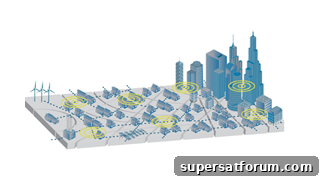
Many of us have imagined the autonomous “smart cities” that populate science fiction — urban environments that operate seamlessly through interconnected systems and devices. As networks, sensors, and Internet of Things (IoT) technologies advance, that vision of a responsive, data-driven city is becoming increasingly feasible.
MLL Telecom is one company helping to shape this transition. Recently, Paul Davison, a systems architect at MLL Telecom, demonstrated a practical implementation of a “city agent” designed to monitor and manage remote telecom equipment. The demonstration highlights a clear, pragmatic path toward more resilient and maintainable urban infrastructure.
About the role
Paul Davison explains that as a systems architect he focuses on software, systems design, and practical problem solving. His work supports customers by keeping networks running reliably and by designing tools to reduce operational costs and downtime.
The city agent concept
MLL Telecom operates as a compact network provider, offering wireless backhaul and connectivity services to larger operators and local ISPs. One of the company’s real-world challenges is maintaining widely distributed equipment — from permanent nodes to temporary setups used for festivals or events. These units are often installed in urban furniture such as lampposts, where space and access are limited.
To address these challenges, MLL has developed a city agent: a small, sensor-equipped device that installs alongside telecom gear. The prototype Paul demonstrated used a Raspberry Pi connected to multiple sensors. Typical sensor inputs include temperature, humidity, light levels, and shock or vibration detection. The device also includes an output that controls a relay, allowing remote power cycling of equipment.
Power cycling is an effective first-line remedy for many network faults. As Paul observed, rebooting devices resolves a high percentage of issues. By providing remote diagnostics and the ability to restart equipment from a central console, operators can avoid unnecessary truck rolls and the associated costs. The demonstration showed a web-based interface that displays sensor readings and device status. If a fault appears to be recoverable via a reboot, the operator can power cycle the unit remotely. If that restores service, the customer saves time and expense; if it does not, the team can dispatch a technician with better information about the likely cause.
Beyond immediate fault remediation, the next phase for the project is refinement: collecting feedback from early deployments, optimizing the hardware footprint, and making the city agent smaller and more robust for urban deployment.
Data, scale, and useful integration
One of the most significant opportunities — and one of the primary challenges — of deploying many sensor-equipped agents across a city is turning raw data into useful, shared insight. Devices collecting environmental and operational data can provide valuable inputs: councils may want to monitor pollution levels along busy corridors, traffic managers could use vibration or shock readings to identify heavy vehicle flows, and telecom providers can leverage environmental metrics to predict equipment failures.
However, the growing number of bespoke deployments risks data fragmentation. If each system stores information in its own isolated database, opportunities for cross-domain analysis and innovation are lost. The real value of smart city infrastructure is unlocked when disparate datasets are combined and made accessible in structured, standardized ways so that operators, municipalities, and third parties can build useful applications and services.
Paul suggests that moving from point solutions to more generalized, interoperable platforms will be essential. The city agent concept demonstrates how operational pragmatism (remote power control and localized sensing) can dovetail with larger goals around data sharing and urban analytics. By aggregating environmental and operational telemetry into centralized or federated platforms with consistent APIs and data models, cities and service providers can enable mash-ups, new services, and smarter decision-making that benefit residents and businesses alike.
Timeframe for widespread rollout
While Smart City technologies are already being piloted and adopted in pockets around the world, broader, integrated rollouts will require additional development of hardware, software, standards, and governance models. Paul believes the next year or so will be pivotal: continued experimentation, iterative hardware improvements, and early wins demonstrating cost savings and improved service will accelerate adoption.
In practical terms, expect to see more localized deployments and pilots expand over the coming 12–24 months, with integration efforts — centered around data platforms and shared infrastructures — becoming clearer as stakeholders align on standards and business cases.
Conclusion
The city agent demonstrated by MLL Telecom exemplifies a grounded, cost-conscious approach to building smarter urban systems. By focusing on practical capabilities like remote diagnostics, environmental sensing, and power control, and by emphasizing the importance of data aggregation and interoperability, projects like this can deliver immediate operational benefits while laying the foundation for broader smart city services. The promise of a truly connected, responsive city depends not only on sensors and networks, but on how data is unified and used to create value for citizens, councils, and service providers alike.
How long before smart cities fully materialize? Progress is already visible; the next year should see an acceleration from pilots to wider deployments, especially where clear cost savings and service improvements can be demonstrated.