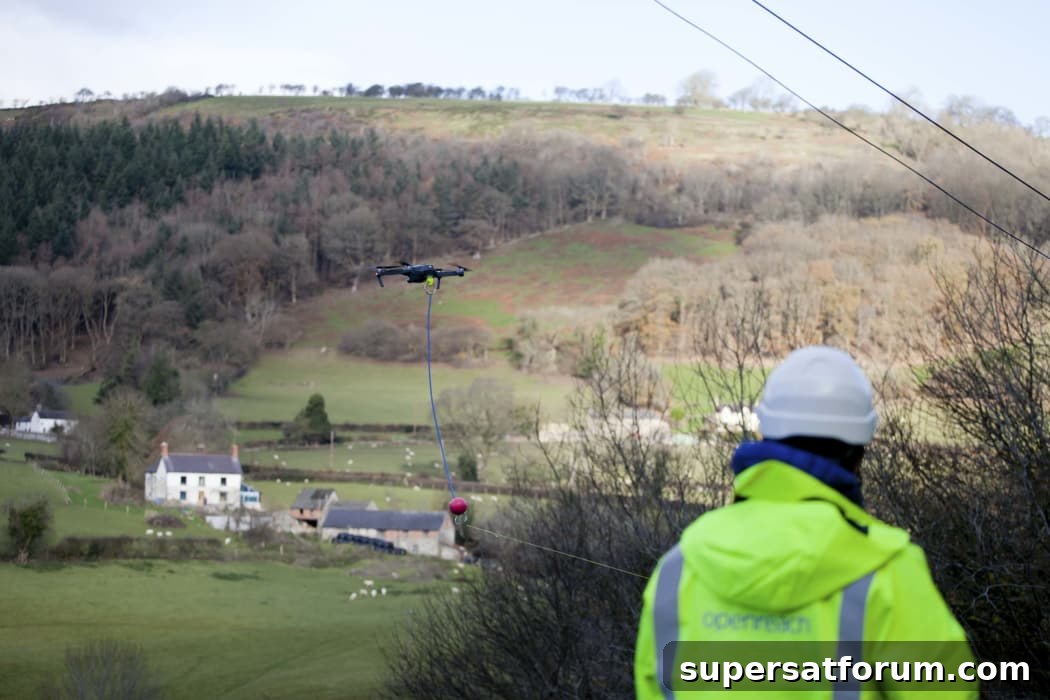
Openreach is using drones to accelerate the rollout of high-speed fibre broadband in hard-to-reach rural areas.
The drones assist by carrying a lightweight line across routes that would otherwise be difficult or hazardous to traverse. Because the small drones cannot lift the heavier fibre cable itself, engineers instead fly a high-strength fishing line—typically around 100 metres—over tree canopies and drop it across the route. That lightweight line is then attached to a stronger draw-rope, which pulls the actual fibre cable along the clear path the drone created.
One example of this approach is the village of Pontfadog in Wales, which now has access to full FTTP (Fibre-to-the-Premises). Residents there can choose broadband packages ranging from 38 Mbps up to 300 Mbps, bringing speeds that outperform many UK premises still served by FTTC (Fibre-to-the-Cabinet).
“There’s a particularly steep drop from these houses down the valley, which is covered in dense trees and scrubland. We also had the river running along the bottom to contend with, so dragging a cable and digging it in wasn’t really an option,” explains Openreach Chief Engineer Andy Whale.
He adds that running the cable through the woods risked it becoming entangled in branches and other natural obstacles. “We decided the best option was to fly it in over the top of the tree canopy and then lift it so the cable was clear of the treeline,” Whale says.
FTTP delivers a future-proof connection that will remain more reliable and faster for longer than many legacy alternatives. Villager Chris Devismes, an aspiring writer who works from home, is among the first to benefit. “I publish my work online and often send full novels to my editor or readers. Before, I’d go away and cook tea while a file uploaded; now it literally takes a matter of seconds,” he says.
Openreach’s use of drones isn’t purely altruistic: the company was working to meet contractual deadlines for connecting parts of Wales, with a target date of 31st December approaching. Using the drone method dramatically sped up the process—what might have taken days by conventional methods was completed in less than an hour, according to Whale.
Imminent drone regulations
Operating a drone is currently straightforward, but new UK regulations are set to introduce tighter controls in response to safety incidents, including near-misses with aircraft. Proposed rules will require drone users to pass safety awareness tests, ban flights near airports and above 400 feet, and give police powers to ground and seize drones suspected of unsafe or criminal use.
“We’re bringing forward this legislation to ensure that drones can be used safely, while addressing the safety and privacy concerns people have,” says Lady Sugg, Transport Minister.
Openreach’s project demonstrates a safe, practical use of drone technology to simplify and speed up complex infrastructure tasks. Well-balanced regulation should preserve public safety while allowing constructive and innovative applications like this to flourish.
Are you impressed with Openreach’s use of drones for rural broadband deployment? Let us know in the comments.
Interested in hearing industry leaders discuss topics like this and sharing real-world use cases? Attend events in the IoT Tech Expo, Blockchain Expo, AI & Big Data Expo and Cyber Security & Cloud Expo series, which bring together technology professionals to explore the future of enterprise technology.