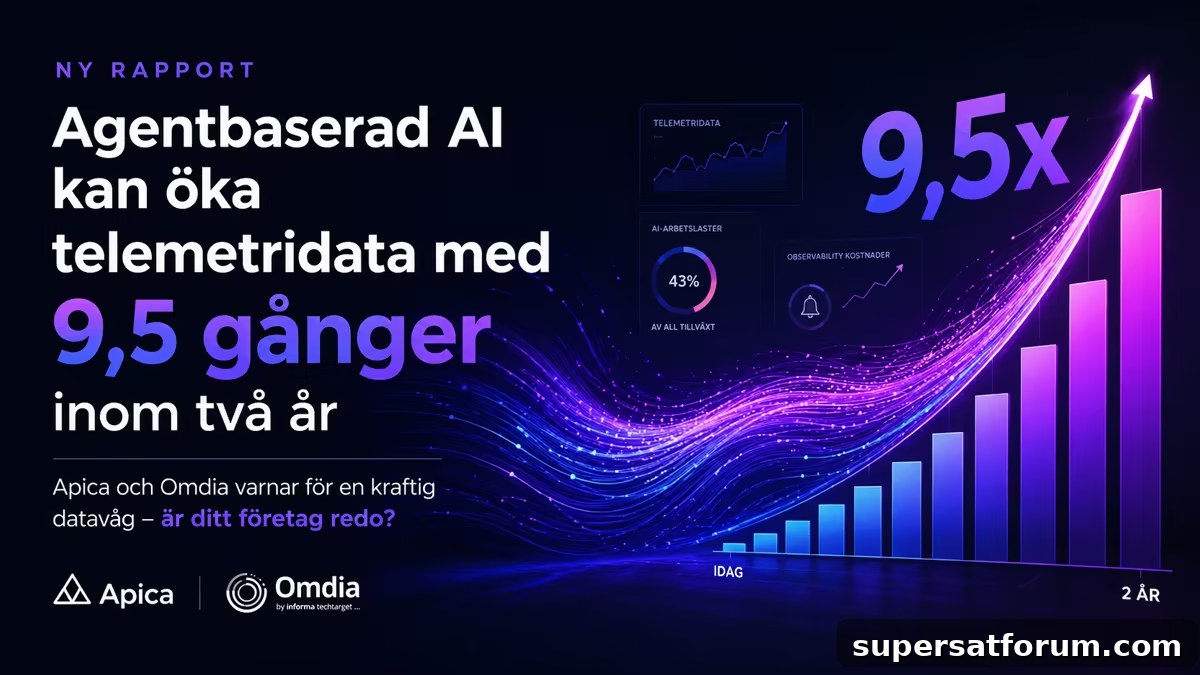
A new report from Apica and Omdia reveals that companies worldwide face a sharp rise in telemetry data as agent-based AI moves from pilots to production. At the same time, many organizations report they lack the infrastructure needed to manage this growth.
Apica today released findings from a report conducted by analyst firm Omdia showing that organizations across the globe are bracing for a dramatic increase in telemetry volumes as agent-based AI transitions from experimental projects to production environments.
The report, based on responses from more than 300 IT decision-makers in North America and Western Europe, finds that many organizations do not yet have the infrastructure required to handle the data volumes that next-generation AI agents are expected to generate.
According to Apica’s CEO Mathias Thomsen, the impact is larger than many leaders realize.
“Agent-based AI introduces new demands for how companies collect, process and analyze telemetry. Organizations that fail to build the right foundation now risk higher costs and greater operational challenges when AI agents are deployed at scale,” says Mathias Thomsen, CEO of Apica.
Telemetry volumes are already rising at record pace
The report shows that 54 percent of surveyed organizations have seen their telemetry volumes triple over the past 12 months. Average growth among respondents is 3.7 times compared with the previous year.
AI and machine learning workloads account for roughly 43 percent of this increase, making AI the main driver behind expanding data volumes in modern IT environments.
At the same time, 83 percent of respondents say AI observability is one of their top priorities for 2026.
Agent-based AI is expected to trigger a new data wave
The most notable conclusion in the report is the anticipated surge in telemetry from agent-based AI systems.
Organizations expect telemetry from these workloads to grow on average 9.5 times over the next two years. Fully 44 percent predict growth between six and 100 times current levels.
Despite these expectations, nearly two-thirds of organizations say they are only “somewhat prepared” or less for the incoming data growth.
More than one in five organizations have not yet assessed the impact agent-based AI might have on their data management practices.
Infrastructure becomes a strategic leadership issue
Andi Mann, Chief Product & Technology Officer at Apica, argues that this shift requires rethinking observability and data management.
“The data confirm what we’ve been telling business leaders since spring. Agent-based AI changes not only how observability is practiced but also the underlying architecture. A 9.5-fold increase in telemetry over two years is not a technical footnote; it’s a strategic infrastructure decision for executive teams,” says Andi Mann.

Observability costs are rising quickly
The report finds that growing telemetry volumes are already affecting corporate budgets.
Organizations report spending an average of about $3.17 million per year on observability solutions. Nearly 20 percent spend more than $5 million annually.
At the same time, 81 percent are actively searching for ways to reduce costs without sacrificing visibility into their systems and services.
Observability budgets are increasing by an average of 28 percent year over year. For 35 percent of organizations, that annual increase exceeds 52 percent.
AI projects paused due to high monitoring costs
The survey shows that costs are already influencing AI initiatives.
Fifty-nine percent of organizations report having paused or delayed at least one agent-based AI project because the costs of monitoring and observability became too high.
The use cases most often paused involve cybersecurity, compliance and fraud detection — areas where inadequate monitoring can create significant business risk.
“Scalability is the primary reason many organizations cannot proceed with their agent-based AI projects. Without suitable solutions they expose themselves to operational, legal and security risks,” says Torsten Volk, Principal Analyst at Omdia.

Telemetry pipelines identified as a key factor
Report findings highlight telemetry pipelines as a critical element for managing the coming growth.
Fifty-four percent of organizations have already implemented a telemetry pipeline, and 97 percent have either deployed or are evaluating such solutions.
According to the report, companies using telemetry pipelines are 50 percent more likely to be prepared for the data growth agent-based AI is expected to generate over the next two years.
Among organizations that have already deployed agent-based AI at scale, the likelihood of avoiding cost-related obstacles is 80 percent higher when telemetry pipelines are in place.
Apica sees growing need for modern data infrastructure
Mathias Thomsen says the results indicate AI strategies must extend beyond models and compute capacity.
“Successful AI initiatives also require control over data flows, costs and governance. Companies that invest in the right telemetry and observability architecture today will be better positioned for next-generation AI applications,” says Mathias Thomsen.

An active investment window is opening
The survey indicates the market is entering an active evaluation phase.
Sixty-eight percent of organizations plan to evaluate changes to their observability platforms within the next six months.
At the same time, 70 percent plan to assess telemetry pipelines in the same timeframe.
The report concludes many companies are already in or approaching a new investment cycle focused on future AI infrastructure.
About the report
The study was conducted by Omdia on behalf of Apica and includes more than 300 IT decision-makers in North America and Western Europe. All respondents had direct budget responsibility or decision-making authority for investments in observability and telemetry data.
Download the report here
About Apica
Apica develops telemetry management and observability solutions tailored for AI-driven organizations. The company’s platform focuses on filtering, processing and controlling telemetry before it reaches analytics systems, aiming to reduce costs while improving data quality and governance.
Apica has been named a Visionary in the Gartner Magic Quadrant for Observability Platforms.