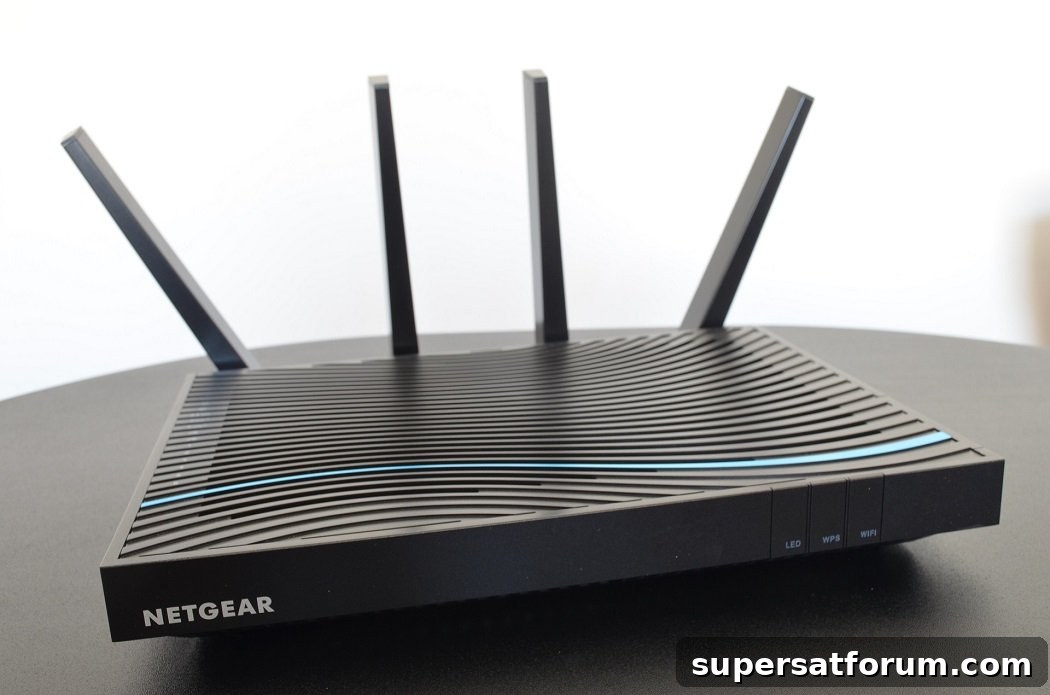
We expect strong performance from NETGEAR, especially from a premium router priced around £399 ($400) like the Nighthawk X8. Over several days of testing in a typical urban building, we evaluated its design, features, and real-world performance, leaving most settings on automatic to see how well the router manages interference from nearby signals.
Industrial Design
The Nighthawk X8 isn’t strikingly beautiful, but it’s not unattractive either. Like most routers, you’ll likely want to keep it out of sight where possible without harming signal quality. That may be difficult: the X8 is a large unit, measuring 12.4 inches across by 10.4 inches deep and weighing about 3.70 lb (1.7 kg).
NETGEAR has clearly prioritized functional, enterprise-style design over aesthetics. On the rear are six Ethernet ports, with the first two supporting link aggregation to combine gigabit speeds. You’ll also find the Internet port for your modem, a reset pinhole, a power on/off button, and the power input. Under a side flap are two USB ports — one USB 2.0 and one USB 3.0 — and the ability to hide these when not in use is a thoughtful touch.
The router’s dynamic antennas can be angled in every direction; NETGEAR recommends angling the outer antennas slightly outward and the inner antennas straight up. Each antenna tip includes a blue LED that adds a futuristic accent but can be disabled if it becomes distracting.
Features
As a flagship model, the Nighthawk X8 is packed with advanced features. It also includes capabilities that most client devices don’t yet support, which helps future-proof the router for years to come.
Setup is straightforward thanks to NETGEAR’s Genie software. With the modem and a few devices connected, we were online within minutes and running the latest firmware. Genie continues to monitor the network and provides guidance if issues appear. The Genie mobile app for Android and iOS is useful for remote monitoring of your connection.
The X8 is the first router to support the AC5300 Wi‑Fi standard, which has a theoretical top speed of 2,166 Mbps on one of its bands. While impressive, no client devices currently support this standard, so it will take time before the router’s full potential is realized.
The router also supports quad‑stream operation for very high speeds, though client devices that can use quad‑stream are not yet common. Even many devices that support three streams may choose to use fewer streams to conserve power. These features underline how the X8 is ahead of its time.
Dynamic antennas aim to reduce interference, and our results indicate they are effective. The X8’s tri‑band configuration (1 x 2.4 GHz and 2 x 5 GHz) makes it easy to separate lower‑end devices from high‑performance ones, helping ensure critical devices get the best possible connection.
Dynamic QoS (Quality of Service) is included to prioritize bandwidth for high‑demand devices and applications. The router also supports automatic backup and media sharing, features that are best demonstrated in performance testing.
Performance
At this price point, you expect outstanding performance. The X8 delivers excellent results overall but doesn’t always come out on top against rivals.
Signal range is a key concern for many buyers. In our tests, the X8 performed well but was outperformed in range by some less expensive routers such as the Linksys EA8500. We compared signal strength at the farthest point in the building using the NETGEAR Superhub 2.0 against the X8’s 2.4 GHz and 5 GHz networks. The X8 showed roughly a 10 dBm improvement across both bands in that environment.
For media sharing, the difference between the USB 2.0 and USB 3.0 ports was small. Our tests recorded a USB 2.0 write speed of 63 Mbps and read speed of 56 Mbps, while USB 3.0 achieved a write speed of 65 Mbps and read speed of 57 Mbps. Streaming full‑HD video across the network was smooth with both MKV and MP4 files.
Conclusion
The Nighthawk X8 is an impressive, forward‑looking router. Its support for new technologies will keep networks current for years, but that capability comes at a premium and may primarily appeal to early adopters.
For its price, you can reasonably expect perfection, so minor quibbles about aesthetics, Wi‑Fi range versus some competitors, and the absence of a mobile data backup option are valid. Still, the X8 represents a strong glimpse into the future of consumer routers and is recommended if cost is not a concern.
Are you impressed with the Nighthawk X8? Share your thoughts in the comments.