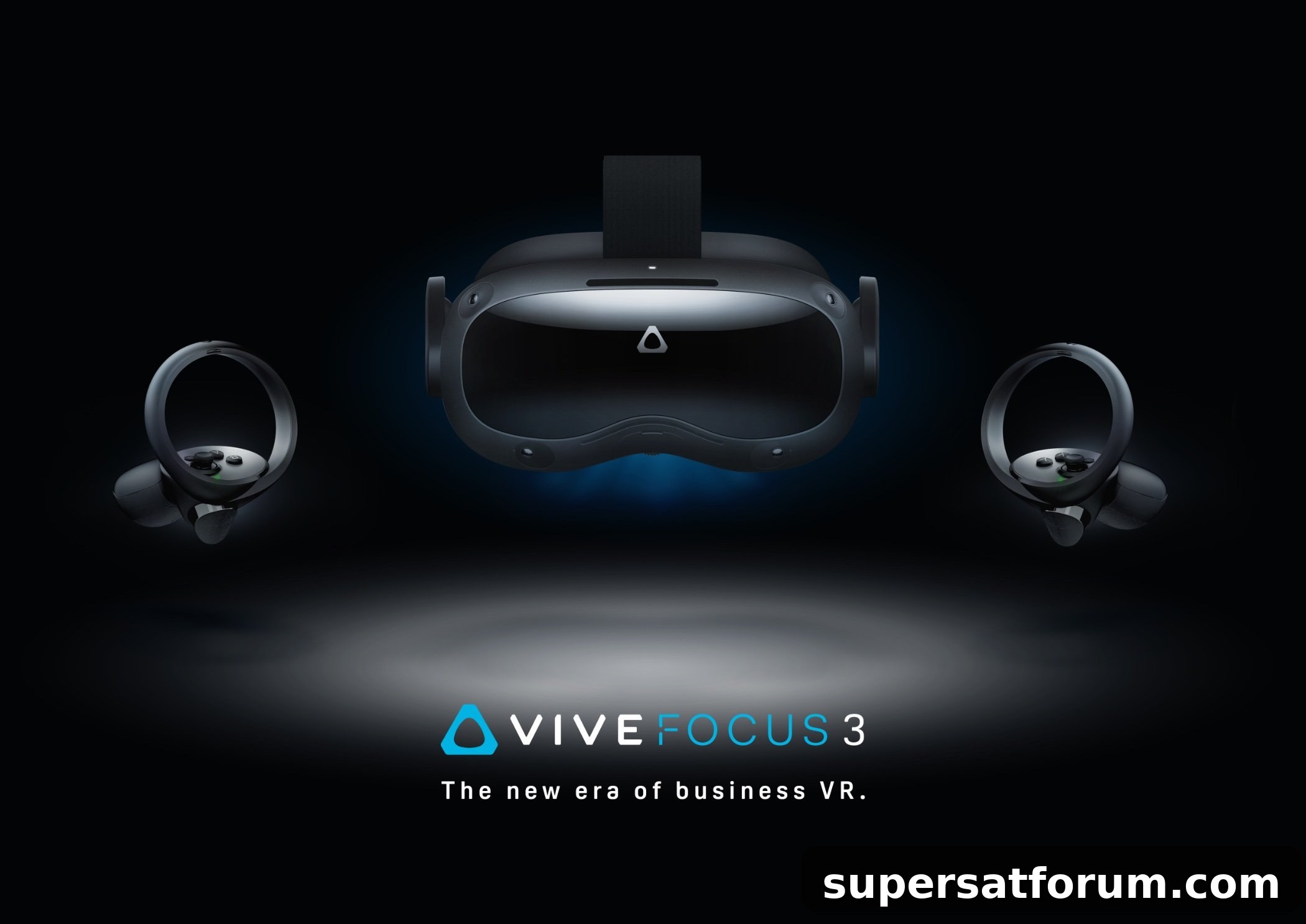
HTC is leveraging private 5G and edge computing to deliver high-fidelity wireless VR for its VIVE Focus 3 all-in-one headset.
Today’s VR users face a trade-off: connect a headset to a powerful PC for low latency and top-tier graphics, or go wireless with an all-in-one device and accept reduced performance. Achieving high-fidelity wireless VR is a critical milestone for wider adoption in both professional and consumer settings.
At CES 2021, HTC introduced its first portable private 5G solution for the VIVE Focus 3, bringing the company closer to that goal by combining high-speed, low-latency networking with local edge rendering.
“By making VR and immersive experiences more accessible, we’re creating new opportunities to explore, learn, and unwind, and advancing how people experience XR technology,” said Cher Wang, Co‑Founder and Chairwoman of HTC.
The VIVE Focus 3 connects to a private 5G network to ensure low latency and high bandwidth, while the Lumen edge platform preserves that performance by handling rendering at the network edge rather than relying on distant servers.
HTC explains that the highest-quality VR typically requires a direct connection to a powerful PC or rendering server. With this private 5G approach, the headset gains low-latency access to GPU processing power, enabling unmatched rendering quality without a physical tether.
Alternatively, some wireless headsets render content locally on the device. That approach avoids cabling but is bound by the headset’s onboard GPU capabilities. In both tethered and local-rendering setups, wired connections have constrained deployments economically and physically, limiting possible enterprise use cases.
HTC sees the VIVE Focus 3 as a key enabler for VR’s role in the Fourth Industrial Revolution, where low-latency, high-performance immersive systems support new ways of working.
The Lumen low-latency edge platform targets the demanding workloads of Industry 4.0 and enables transformational VR applications, including enterprise training, assisted operations, and virtual collaboration that require consistent, high-quality rendering and responsiveness.
To enhance training and immersion capabilities, HTC is also launching the VIVE Wrist Tracker for the Focus 3.
The wrist tracker is significantly smaller and lighter than a standard VIVE Focus 3 controller—about 85 percent smaller and 50 percent lighter—and can be attached to objects to deliver precise six-degree-of-freedom (6DoF) tracking across a wide range of VR scenarios.
Axon, a developer of technology for law enforcement and military use, partnered with HTC on the wrist tracker’s development.
“The VIVE Wrist Tracker is key for enabling the most accurate tracking of objects that an officer is holding, like a TASER device, beyond the capabilities of hand-tracking alone,” said Rick Smith, CEO of Axon.
He added that the tracker represents a meaningful advancement for de‑escalation training, which often depends on realistic handling of handheld objects.
HTC’s wireless VR solution showcases how private 5G combined with edge computing can expand VR’s role in enterprise and industrial contexts, supporting immersive applications that demand low latency, high bandwidth, and reliable local rendering.
Interested in learning more about 5G and industry opportunities? Explore events and resources from 5G Expo to hear from industry leaders and discover practical applications of private 5G and edge computing in business and enterprise settings.