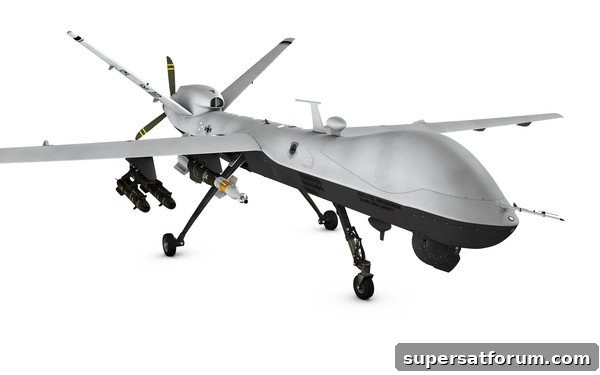
An investigation has revealed that the UK’s telecoms infrastructure plays a central role in supporting the US military’s network by providing the core communications backbone used for controversial drone operations overseas.
Human rights experts argue that the UK’s involvement is the digital equivalent of allowing the US to launch air strikes from British air bases — a practice the UK has faced criticism for in the past.
The international connection is provided under contract by telecoms giant BT. Both the UK government and BT acknowledge the existence of the network but say they lack specific knowledge about how it is used in military operations.
Last year, legal charity Reprieve alleged that the link is used to carry out unlawful drone strikes on suspected militants outside traditional theatres of war. A shortage of publicly available evidence has so far hindered efforts to hold BT or the UK government legally accountable.
However, a detailed review of public records now confirms that the UK connection is used by the US military to support targeting for these strikes. Reprieve is expected to pursue further legal action based on the newly surfaced information.
The UK–US link is part of a communications system known as DISN (Defense Information Systems Network), a detail that had remained obscure due to varied acronyms until uncovered by Reprieve. The connection is a fibre link supplied by BT that runs between a US military communications hub at RAF Croughton in Northamptonshire and Camp Lemonnier in Djibouti.
Camp Lemonnier, located on the Horn of Africa, has been identified by reports from the BBC and the Washington Post as the principal base for US drone operations targeting suspected militants in Yemen and Somalia. The base also supports humanitarian and infrastructure projects across the region, illustrating the dual-use nature of the facility.
The US Department of Defense’s 2013–2038 Unmanned Systems Roadmap indicates that drones use DISN for long-range command-and-control functions. Earlier DoD documents spanning 2005–2030 explicitly name the Reaper and Global Hawk platforms as systems that rely on the DISN network.
DISN communications are secured using KG-340 encryption devices, permitting the UK link to carry classified-level traffic. Manufacturer SafeNET states these devices meet the NSA’s specifications and algorithms, enabling the secure transmission required for military operations.
Strategic documents show that DISN is central to the US shift from traditional warfare toward network-centric operations. It is a component of the Global Information Grid (GIG), a dedicated military communications infrastructure that spans thousands of US facilities and operations across dozens of countries.
The GIG’s objective is to integrate communications among forces, commanders, platforms, sensors, satellites, radios, computer systems, intelligence agencies and allied partners into a unified network. The risks and vulnerabilities of such an interconnected system have been dramatized in popular culture, for example in the video game series Call of Duty: Modern Warfare.
A Ministry of Defence spokesperson provided a standard statement about RAF Croughton: “RAF Croughton is part of a worldwide US defence communications network, and the base supports a variety of communications activity. The Ministry of Defence does not hold information on what support to US operations is provided by RAF Croughton.”
BT told reporters it could not be held responsible for how parties use the communications infrastructure it supplies.
With new revelations confirming the network’s role, claims of plausible deniability are weakened. It remains to be seen whether this confirmation prompts any changes in how UK infrastructure supports US operations, particularly where legal and ethical concerns about targeted strikes exist.
Kat Craig, legal director of Reprieve, said: “The secret drone war in Yemen, a country with whom neither the US nor the UK is at war, is illegal. Yet missiles rain down on its population, killing hundreds of civilians and terrorising communities.”
Do you think ties should be cut as a result of these revelations? Let us know in the comments.